
"The groundwork of all happiness is health."
—Leigh Hunt
Parents still hear a lot of mixed messages about strength training for kids. Some of these ideas stem from decades-old fears that lifting weights will stunt growth, damage growth plates, or increase the risk of injury in children. The science paints a very different picture. Kids are not only capable of strength training but often benefit more than adults do when done right. The biggest wins show up in their bones, muscles, metabolic health, confidence, and lifelong movement patterns.
As my children get older, I am looking for the best way to do this. I want to introduce them to strength training in away that lets them enjoy it but also benefits from it in the most appropriate way.
As a parent, coach, or therapist, the goal isn’t to turn a child into a miniature powerlifter. It’s to help them build a foundation of strength, coordination, and movement literacy that supports everything else they’ll do in life.
Why Strength Training Matters for Kids
The physical activity crisis is real. Childhood obesity continues to rise, kids move far less than previous generations, and many spend large parts of the school day sitting. Studies show that physical fitness in childhood predicts health outcomes decades later, including cardiovascular disease, work ability, bone density, and mental health.
A population-based cohort study showed that higher adolescent fitness was linked to significantly lower risk of Type 2 diabetes in adulthood. Another long-term study in the British Journal of Sports Medicine found that boys with higher fitness levels had less atherosclerosis in middle age.
You can feel the trend here. Strength and fitness in youth track far into the future.
Kid’s Strength Training Myths
Myth 1: “Strength training stunts growth.”
This is one of the most persistent myths, even though it has been disproven repeatedly. Growth plate injuries are extremely rare, especially in supervised environments. A landmark review published in Pediatrics concluded that strength training is safe and beneficial for children and adolescents when properly supervised. The authors emphasized that resistance training does not negatively affect growth. In fact, strong evidence shows it improves bone density, neuromuscular coordination, and injury resilience.
Myth 2: “Kids will get injured lifting weights.”
Injury rates in supervised youth strength programs are extremely low. Most injuries in children’s sports occur during games, not training. A large position statement from the NSCA outlines safe guidelines and highlights that injuries are overwhelmingly linked to poor supervision and inappropriate loads, not the training itself. When adults provide good coaching, progressive loading, and age-appropriate movements, kids gain strength, power, and confidence without increased injury risk.
Myth 3: “Kids shouldn’t use weights until puberty.”
Hormones influence muscle hypertrophy, but strength is not only about muscle size. Kids get stronger primarily through neuromuscular adaptations: better coordination, improved motor unit recruitment, and enhanced movement patterns.
A meta-analysis in Sports Medicine found that resistance training not only improves strength but can support academic outcomes, likely due to improved executive function and cognitive processing.
Strength training is a brain workout as much as a body one.
Real Benefits: Beyond Muscles
Better mental health and emotional regulation: A systematic review in Early Intervention in Psychiatry shows that strength and combined training reduce symptoms of anxiety and depression in young people.
Higher cognitive performance: A meta-analysis in Pediatrics found that exercise interventions improve intelligence and academic achievement:
https://publications.aap.org/pediatrics/article/148/6/e2021054836/183501/Exercise-Interventions-and-Intelligence-inImproved lifelong health: Strong evidence shows that muscular strength tracks across life. Kids who are strong tend to stay strong, move more, and remain healthier:
Lower future cardiovascular risk: High fitness in childhood predicts and improves future cardiovascular risk factors.
What Safe Strength Training Actually Looks Like
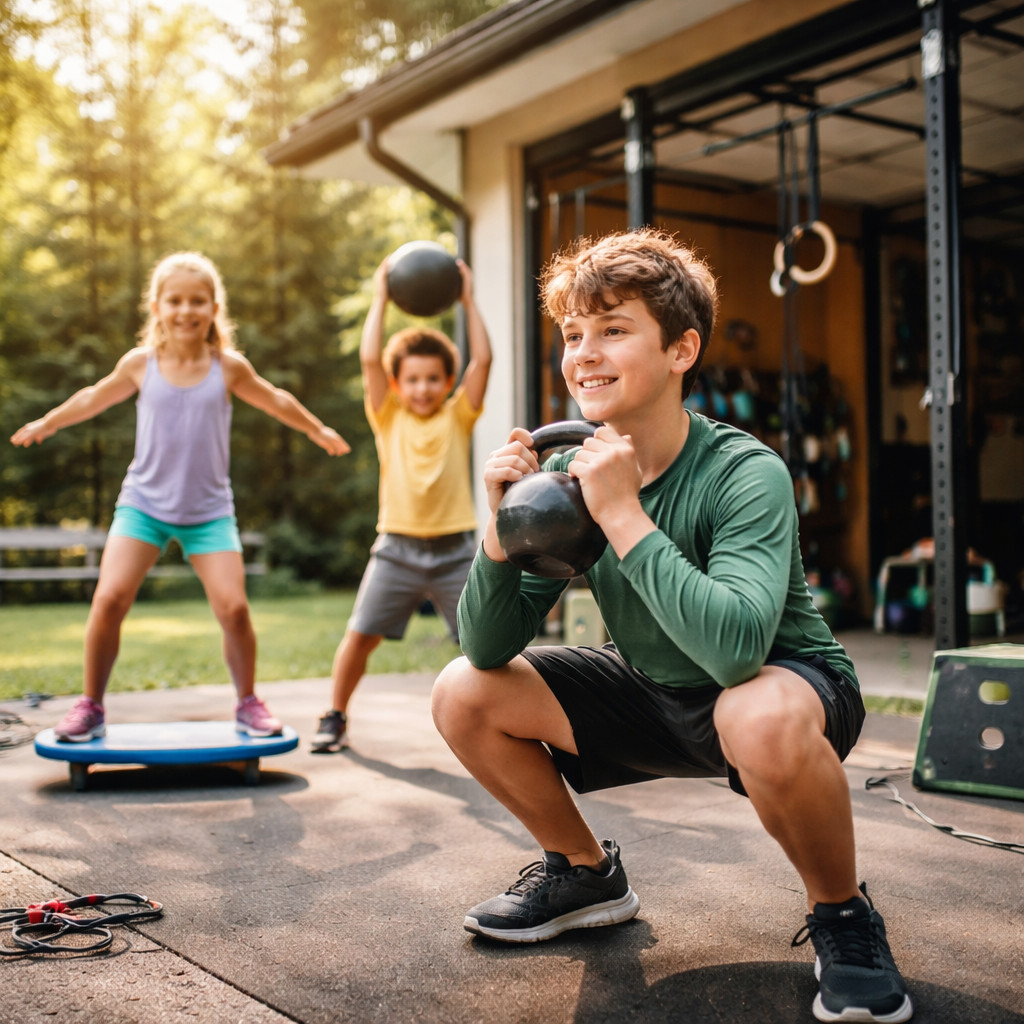
Strength training for kids should look more like play than a bodybuilding split. The goal is skill, not max reps, not max weights.
Foundational principles:
Teach movement patterns: squat, hinge, push, pull, carry, rotate
Emphasize bodyweight first, then add load gradually
Keep sessions short and fun
Prioritize technique over intensity
Think “movement snacks,” not grind sessions
Examples you can use immediately:
Goblet squats with light weight
Push-ups on a box or bench
Farmer carries with kettlebells
Step-ups
Medicine ball throws
Single-leg balance drills
Pull-ups with assistance
Kids progress quickly when they’re encouraged to explore, climb, jump, and play. Good movement is caught before it is taught. For more ideas, check out the article, the Minimum Effective Dose of Strength Training and The Minimum Effective Dose of HIIT.
Kid-Friendly Strength Training Gear
This is the section parents usually overthink. Fancy equipment is not required. Appropriate, adaptable, and playful tools matter far more than load. The goal is to give kids ways to explore movement safely while building strength, coordination, and confidence.
Whiteboard: Ownership drives engagement. Let kids design the workout or write a goofy circuit. Have them mark off their success as they do it to create more buy-in.
Light Kettlebell: One tool, many patterns. Squat, hinge, carry, and brace with minimal coaching. Goblet squats and carries go a long way. Solid ones work well, but go with the GORUCK Sand Kettlebells for younger kids.
Balance Boards or Wobble Pads: Quick hits of foot, ankle, and core control. We have a balance board, but we also use a BOSU ball, which is great for plyometrics (and just fun).
Pull-Up Bar or Rings: Hanging builds grip, shoulder stability, and confidence. Kids naturally want to swing. Timed hangs are enough.
Medicine Ball: Soft, unpredictable weight promotes power and coordination. Tossing, catching, and rotational throws train the core while staying joint-friendly.
Jump Rope: Double-unders, cardio, speed work. Great for speed, coordination, and ankle health.
Plyo Box: Step-ups, box jumps, Bulgarian split squats.
Agility Ladder or Floor Tape: Footwork matters. Simple patterns improve rhythm, coordination, and attention. Low cost, high return.
Check out this article for a full list of the gear I use: Home Gym Setup Guide: Budget to Elite Options.
How to Know a Kid Is Ready
Every kid is ready to strength train if the program meets them where they are. If they can follow directions, maintain focus for a few minutes at a time, and safely control their body during basic movements, they’re ready.
This aligns with the “Three I’s” approach used by youth performance experts:
Investigate: watch how the child moves during everyday play
Interpret: identify what patterns look efficient or inefficient
Intervene: use simple, fun activities that strengthen weak links
Keep it simple, keep it interesting, and focus on building the foundation.
My Take
As an OT, dad, and athlete, I see firsthand how early strength and movement shape everything from confidence to attention to coordination. Kids who learn to use their bodies enjoy movement more, stick with physical activity longer, and build health habits that pay off for decades.
My kids are still young, so the emphasis is more on fun, openness, curiosity, and inclusion. Typically, these workouts are in the backyard or our garage gym. My wife and I work out regularly, and we tend to leave an open invitation for when the kids are interested. Sometimes they get very into it and will draw a whiteboard HIIT routine for us, and other times they hop in for a couple of sets and leave. Some days I’ll make them an obstacle course or give them a “challenge” of some kettlebell work, too. What’s most important is consistency, curiosity, and a reminder that strength at this age is about skill, not sweat.
As they get older, I plan on incorporating more sport-specific demands, peer strength training groups where their friends come over and join in, and much more structure and skill-building.
Regardless of their age, the goal is always to keep them moving with confidence and to make strength something they look forward to, not something they feel pressured by.
Related:
