
Intolerance of Uncertainty: How to Reframe the Unknown
"If uncertainty is unacceptable to you, it turns into fear. If it is perfectly acceptable, it turns into increased aliveness, alertness, and creativity."
—Eckhart Tolle
What if you knew the end result of every game you watched? What if you knew exactly how your kids would turn out? Or when you would die?
At first, it sounds like the ultimate life hack—no surprises, no risks, just perfect control over every outcome (not to mention great earnings on that betting line). But let’s flip the script for a second: would life still feel exciting? Would the wins, the growth, and the unexpected moments of joy hold the same value?
The truth is, uncertainty is not the enemy we often make it out to be. It’s uncomfortable, sure. But it’s also where life happens—where we grow, adapt, and discover what we’re really capable of. It’s also where some of the best moments of the day, and our life, live. In fact, learning to embrace the unknown might just be the most powerful skill you can develop for a more meaningful, vibrant life.
Let’s explore why uncertainty feels so intimidating, how it impacts your mental health, and, most importantly, how you can turn it into an asset rather than a fear.

Why Uncertainty Feels Threatening
Evolution made us this way. For early humans, uncertainty wasn’t just uncomfortable—it was dangerous. Not knowing where your next meal was coming from or whether a predator was nearby could mean life or death. Certainty equaled survival. Over time, humans who avoided uncertainty were more likely to survive and pass on their genes. Fast forward to today, and while our environment has drastically changed, our brains haven’t. We still respond to uncertainty as if it’s life-threatening, flooding our bodies with stress hormones and driving us to seek control at all costs.
This is why so many people cling to predictability, even when it holds them back. Research shows that people often make poor decisions, like staying in toxic situations, simply to avoid the discomfort of the unknown. This is rooted in what’s known as the "ambiguity effect," our tendency to prefer familiar outcomes, even when the unknown might lead to something better.
The Hidden Cost of Certainty Seeking
Beyond sheer discomfort, difficulty in dealing with uncertainty is a breeding ground for mental health struggles. A psychological trait called intolerance of uncertainty has been strongly linked to mental health issues. People with a high intolerance of uncertainty struggle to handle the aversiveness of not knowing, and the results can be devastating. A 2019 meta-analysis found that intolerance of uncertainty was a significant predictor of mental health issues like generalized anxiety disorder, social anxiety, and even eating disorders. Among adolescents, this intolerance of uncertainty is tied to higher rates of suicidal ideation, sleep disturbances, and severe depression.
Researchers also texted this in real-life experiments where participants were made to think about statements like “uncertainty is unacceptable,” their levels of worry and negative emotions skyrocketed. On the flip side, those who were taught to tolerate or reframe uncertainty reported better mental health outcomes.
Why You Need Uncertainty to Thrive
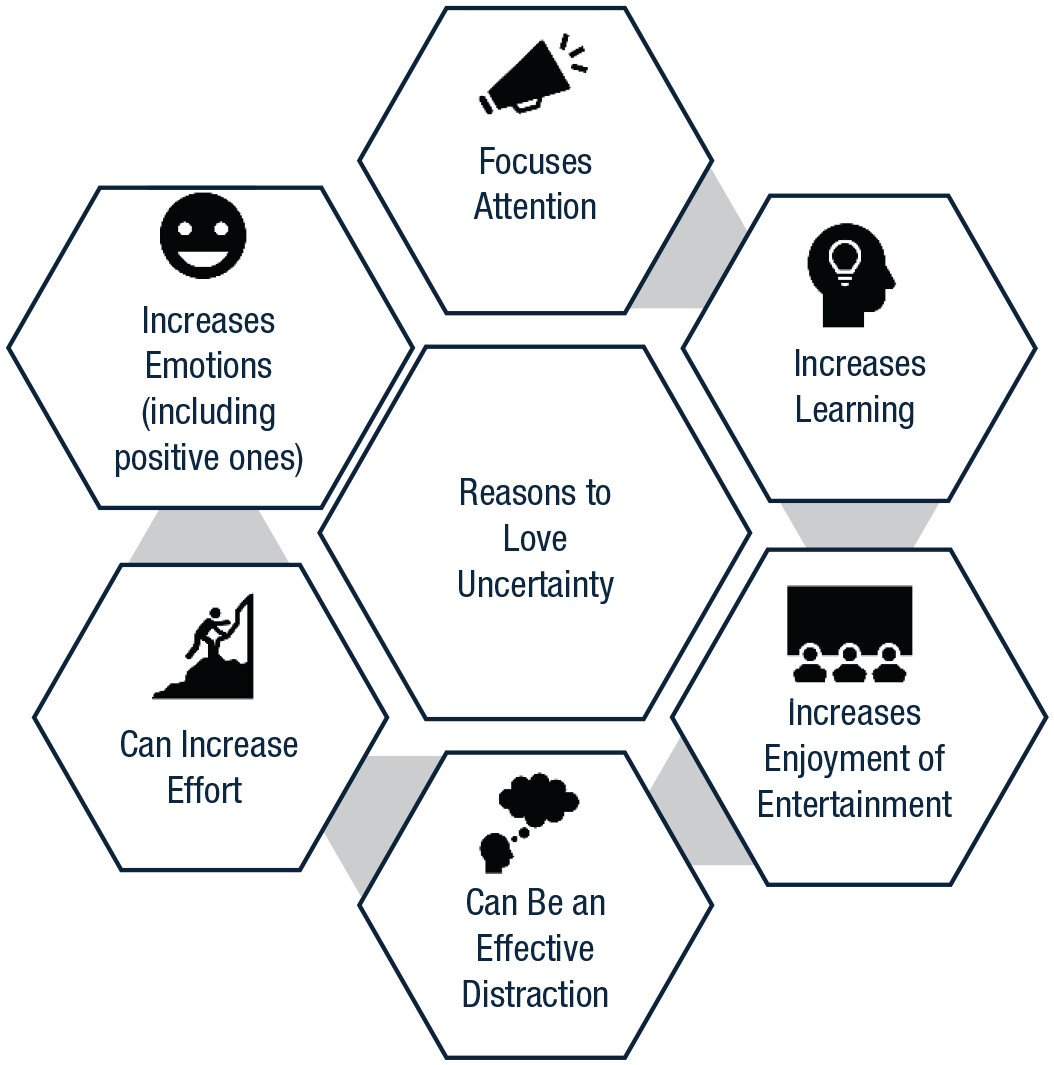
So while uncertainty can feel like chaos, it’s also where growth happens. Imagine a life with no surprises, no suspense, and no challenges. It’s a sort of dystopian. Uncertainty is what makes life interesting. It’s the spark behind every adventure, the fuel for creativity, and the space where innovation is born. Without it, we stagnate.
A good example of this is with learning In fact, researchers have found that uncertainty is the hallmark of the learning state. When your brain doesn’t have all the answers, it works harder to adapt and grow. This constant state of learning is obviously critical in our younger years but it’s also important for long-term brain health. Without challenging yourself to face uncertainty, your brain risks stagnation—and this is shown over and over again to lead to dementia and cognitive decline.
Athletes are some of the next examples of those who use uncertainty, in the form of pre-game jitters, to their advantage. They cultivate a skill, called cognitive reappraisal, that lets them reframe anxiety as excitement, turning potential failure into opportunity. But this doesn’t mean you have to be taking the game-winning shot with 3 seconds to go in the championship game. This cognitive reappraisal is a skill that can be in social situations, homework and academic performance, presentations, and everything in between. When you stop running from the unknown and start engaging with it, you’re more likely to uncover new opportunities, make better decisions, and ultimately live a more fulfilling life.
Practical Ways to Harness Uncertainty
So uncertainty can be a friend or foe. Here’s how to make it for former:
Control the Controllables: There are two kinds of problems in life: those you can fix and those you can’t. Focus your energy on what you can change, and learn to let go of the rest. If it’s outside your control, obsessing over it won’t help—it’ll only drain you.
Reframe the Narrative: When uncertainty shows up, instead of asking, “Why is this happening to me?” try asking, “What can I learn from this?” Like athletes reframing anxiety as excitement, this simple mental shift can transform how you see challenges.
Lean into Discomfort: Growth and comfort don’t coexist. Whether it’s trying a new skill, meeting new people, or stepping outside your routine, intentionally seek out situations that stretch you. The more you expose yourself to uncertainty, the less intimidating it becomes.
Take a Page from Kids’ Playbooks: Kids are masters of uncertainty. They don’t know how things will turn out, and they don’t care. They live in the moment, approach challenges with curiosity, and adapt on the fly. Channel your childhood mindset the next time you face the unknown.
Adopt the Serenity Prayer: “Grant me the serenity to accept the things I cannot change, courage to change the things I can, and wisdom to know the difference.” It’s timeless advice because it works. Let this be your mantra when the lines between controllable and uncontrollable feel blurred.
Takeaway
Uncertainty is inevitable, but your response to it is what defines your life. You can let it paralyze you, or you can let it push you toward growth. There’s a balance to strike between blind optimism and crippling pessimism, and that balance lies in learning to face the unknown with courage and curiosity. Life is chaotic by design, but that chaos is also where the magic happens. Don’t fear uncertainty—embrace it. Use it as a tool to build resilience, deepen your learning, and uncover possibilities you never imagined.
Related:
