
Beef Liver vs Beef Heart Supplements: Key Differences and How to Choose in 2026
Beef liver and beef heart are two of the most recognizable organs in ancestral nutrition. Both contain naturally occurring vitamins and minerals, both have a history in traditional diets, and both are now available as dried supplements.
But their nutritional profiles are different.
Beef liver is particularly rich in vitamin A, vitamin B12, and copper. Beef heart provides vitamin B12, iron, selenium, and naturally occurring coenzyme Q10 (CoQ10).
These differences matter when deciding whether to choose liver capsules, a dedicated heart supplement, or a formula that combines several organs.
This guide compares their nutritional characteristics and examines five supplement brands worth considering in 2026.
Beef Liver vs. Beef Heart: Key Differences
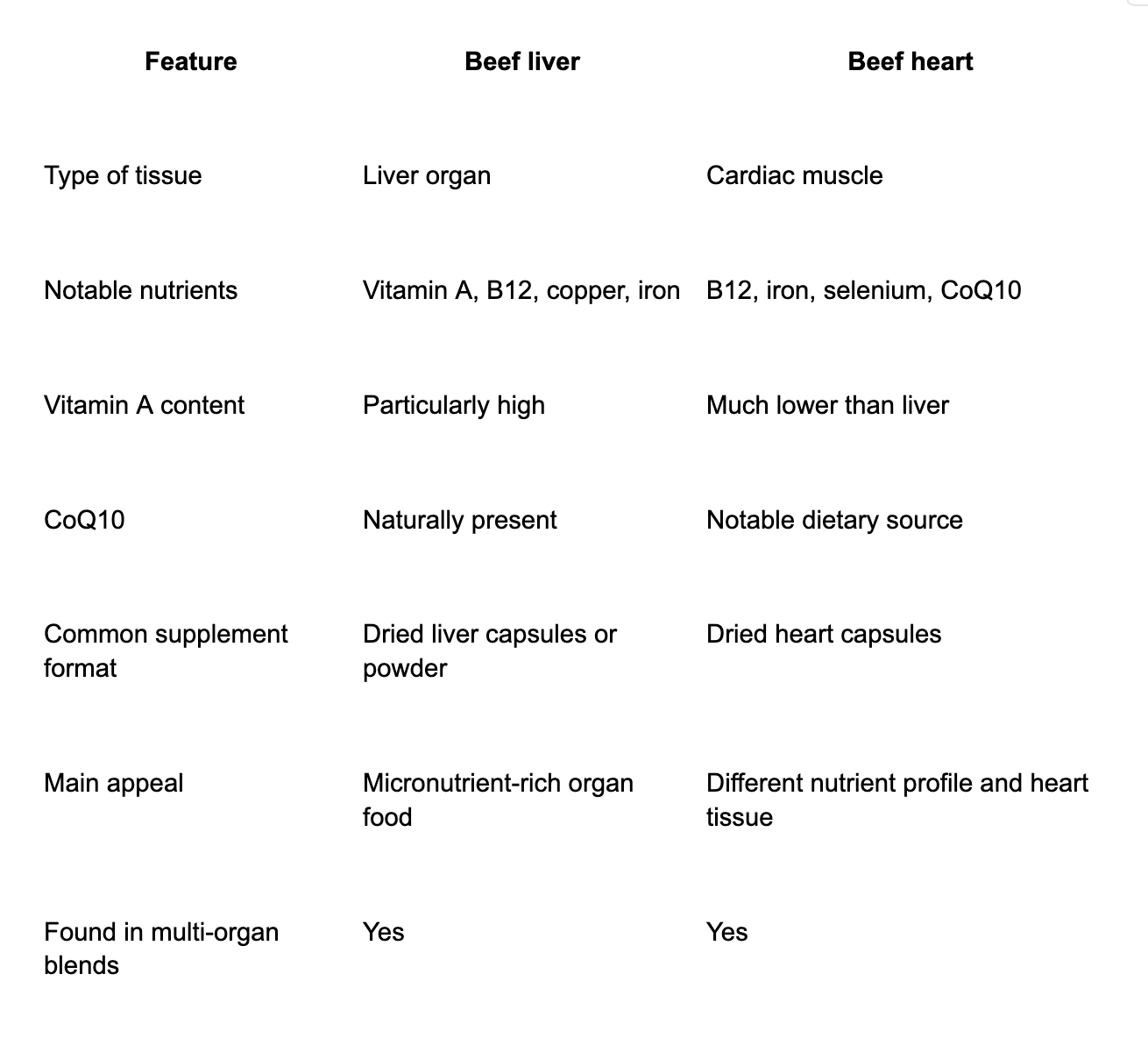
Neither organ is universally better. The more useful question is which one fits your nutritional interests and the way you prefer to eat.
Why Beef Liver Is Considered Nutrient-Dense
Beef liver is one of the most nutrient-rich traditional animal foods.
It contains several vitamins and minerals in relatively concentrated amounts, including vitamin A, vitamin B12, copper, and iron.
Vitamin A is involved in normal vision and immune function. Vitamin B12 contributes to red blood cell formation and nervous system function, while copper and iron participate in essential metabolic processes.
These nutrients help explain liver's longstanding place in traditional diets.
However, fresh liver and dried liver capsules are not nutritionally interchangeable on a gram-for-gram basis. Their water content differs, and supplement servings are generally much smaller than typical food portions.
When comparing liver supplements, the actual tissue amount and available nutrient measurements matter.
What Makes Beef Heart Different?
Beef heart is cardiac muscle rather than liver tissue.
It naturally provides protein and nutrients including vitamin B12, iron, and selenium.
Heart also contains CoQ10, a compound involved in mitochondrial energy production.
This has made beef heart an interesting option for people exploring animal-derived sources of CoQ10 and traditional organ nutrition.
However, a beef heart capsule is not automatically equivalent to a standardized CoQ10 supplement.
A dedicated CoQ10 product specifies the amount of the compound per serving. A dried heart supplement generally identifies the amount of heart tissue instead.
Which Has More Vitamin A?
Beef liver contains substantially more preformed vitamin A than beef heart.
That is one of the clearest distinctions between the two.
Vitamin A is essential for normal biological function, but excessive preformed vitamin A can be harmful.
For adults aged 19 and older, the established tolerable upper intake level is 3,000 mcg RAE per day from food and supplements combined.
This is particularly relevant to consumers taking liver capsules alongside multivitamins or other vitamin A-containing products.
Beef heart does not have the same concentrated vitamin A profile.
Does Beef Heart Provide More CoQ10?
Beef heart is recognized as a dietary source of CoQ10.
The compound plays a role in cellular energy production and is naturally present in several animal tissues.
However, the quantity of CoQ10 in a finished supplement depends on how much heart tissue is included and the product's actual composition.
For consumers specifically seeking a measured CoQ10 intake, a standardized CoQ10 supplement provides clearer dosing information.
For people interested in incorporating beef heart as a traditional animal food, dried heart capsules offer a different approach.
5 Beef Liver and Beef Heart Supplement Brands to Consider in 2026
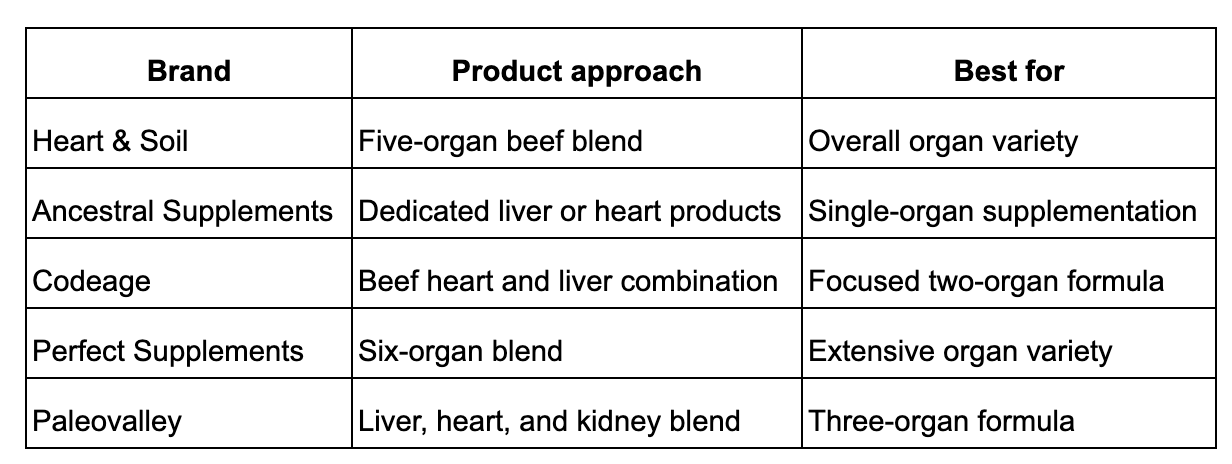
The following brands offer different approaches to organ supplementation, from dedicated liver capsules to combinations of liver, heart, and additional organs.
They were selected to illustrate meaningful differences in ingredient variety, formulation, and intended use rather than to suggest that all five products are nutritionally interchangeable.
1. Heart & Soil — Best Overall for Multi-Organ Nutrition
Best for: People who want beef liver and beef heart alongside other traditional organs.
Heart & Soil Beef Organs combines five organs: liver, heart, kidney, pancreas, and spleen.
The formula uses freeze-dried organs sourced from grass-fed, grass-finished cattle. Each bottle contains 180 capsules, with six capsules per full serving, providing 30 servings.
Including both liver and heart allows consumers to incorporate two nutritionally distinct tissues without purchasing separate supplements. The additional organs make the formula particularly relevant to people interested in a broader nose-to-tail approach.
Key features:
Beef liver, heart, kidney, pancreas, and spleen
Grass-fed, grass-finished sourcing
Freeze-dried organ ingredients
Six-capsule serving
30 servings per bottle
Why consider it: Heart & Soil offers a convenient five-organ combination for consumers who value ingredient variety.
What to consider: A multi-organ blend offers less control over the amount of liver or heart consumed individually than dedicated single-organ supplements.
2. Ancestral Supplements — Best for Choosing Liver or Heart Separately
Best for: Consumers who want to focus on a specific organ.
Ancestral Supplements offers dedicated grass-fed beef liver and beef heart supplements, allowing consumers to select the organ they want rather than automatically combining several tissues.
This approach is useful because liver and heart have different nutritional characteristics. Someone primarily interested in liver's vitamin A and copper content may prefer a liver-focused product, while someone interested in incorporating heart tissue may choose the dedicated heart formula.
Key features:
Separate beef liver and beef heart options
Grass-fed bovine organ sourcing
Freeze-dried organ ingredients
Capsule format
Why consider it: Dedicated products provide greater flexibility for consumers who want to select individual organs.
What to consider: Purchasing several separate organ supplements can be less convenient than using one combined formula.
3. Codeage — Best for a Beef Heart and Liver Combination
Best for: People who want both liver and heart without a larger organ blend.
Codeage Grass Fed Beef Heart contains beef heart and beef liver, offering a more focused combination than five- or six-organ products.
The brand describes its ingredients as sourced from grass-fed, grass-finished cattle and processed using freeze-drying.
Although the product name emphasizes heart, the inclusion of liver is important for consumers comparing ingredient composition and overall vitamin A intake.
Key features:
Beef heart and beef liver
Two-organ formulation
Grass-fed, grass-finished sourcing
Freeze-dried ingredients
Why consider it: Codeage offers a middle ground between single-organ capsules and extensive multi-organ blends.
What to consider: This is not a heart-only supplement. Consumers looking to avoid liver should check the ingredient list carefully.
4. Perfect Supplements — Best for Extensive Organ Variety
Best for: Consumers who want more than liver and heart in one formula.
Perfect Supplements Perfect Multi-Organs contains liver, heart, kidney, spleen, pancreas, and thymus.
The brand describes its organ ingredients as sourced from grass-fed, pasture-raised cattle in New Zealand, with the six organs included in equal proportions.
The addition of thymus distinguishes it from several other multi-organ products.
Key features:
Six beef organs
Includes liver and heart
Additional kidney, spleen, pancreas, and thymus
New Zealand grass-fed sourcing
Equal-proportion blend
Why consider it: Perfect Supplements is a relevant option for consumers prioritizing a wide selection of traditional organs.
What to consider: A broad blend may not be the best fit for someone seeking a substantial, clearly separated serving of liver or heart.
5. Paleovalley — Best for a Three-Organ Formula
Best for: Consumers who prefer a simpler multi-organ combination.
Paleovalley Grass Fed Organ Complex combines beef liver, heart, and kidney.
This gives consumers three traditional organs in one formula without including the larger range of tissues found in five- or six-organ products.
The combination is particularly relevant to people who want liver and heart together but prefer a narrower ingredient list.
Key features:
Beef liver, heart, and kidney
Three-organ formula
Grass-fed bovine sourcing
Capsule format
Why consider it: Paleovalley provides a practical alternative for people who want more variety than a single-organ supplement but fewer ingredients than an extensive blend.
What to consider: It does not include additional organs such as pancreas, spleen, or thymus.
Liver-Only, Heart-Only, or Multi-Organ Supplements?
There are three practical approaches.
Liver-only supplements focus on liver tissue. They appeal to consumers who want liver's distinctive micronutrient profile without preparing fresh liver.
Heart-only supplements provide a more focused way to incorporate beef heart.
Multi-organ supplements combine liver and heart with additional tissues, making them relevant to a broader nose-to-tail approach.
The third option can be particularly useful for people who want greater organ variety but do not want to purchase several individual products.
However, a combined formula does not necessarily provide the same amount of each tissue as taking full servings of separate supplements.
Whole Organ Meat vs. Capsules
Fresh liver and heart can be prepared as food, while dried capsules provide smaller servings of organ tissue without the cooking requirements.
Whole organs offer the experience and portion sizes of regular food.
Capsules provide convenience, particularly for people who dislike organ flavors or cannot easily find these ingredients locally.
Freeze-drying removes moisture from organ tissue, allowing it to be stored and packaged more easily.
Neither format is automatically superior in every respect.
The best choice depends on dietary preferences, portion sizes, and how consistently someone is likely to incorporate the food.
What Should You Look for on a Supplement Label?
Start by identifying the exact organ tissues.
A liver supplement should clearly identify liver. A heart supplement should identify heart. A multi-organ formula should disclose the organs included.
Next, compare the tissue weight per serving.
This is especially important when evaluating blends, because two products containing the same organs may use very different proportions.
Sourcing information can also help distinguish products. Look for details about the animal species, country of origin, and grass-fed or grass-finished practices.
Finally, review processing methods and any available finished-product testing information.
Which Supplement Should You Choose?
If your priority is liver's micronutrient profile, a dedicated liver supplement is the most focused option.
If you specifically want beef heart, choose a heart-only formula or a product that clearly discloses its heart content.
If your interest is broader ancestral nutrition, a multi-organ supplement can provide more tissue variety through one product.
For example, Heart & Soil and Perfect Supplements offer extensive organ combinations, while Paleovalley provides a narrower three-organ approach.
Ancestral Supplements is relevant for consumers who prefer individual organs, and Codeage offers a focused liver-and-heart combination.
The right choice is not simply the supplement with the most ingredients. It is the one whose composition matches what you want to incorporate into your diet.
Frequently Asked Questions
Is beef liver more nutritious than beef heart?
Liver is particularly concentrated in certain micronutrients, including vitamin A and copper. Heart contains a different combination of nutrients, including naturally occurring CoQ10.
Does beef heart contain vitamin B12?
Yes. Beef heart naturally contains vitamin B12, although supplement quantities depend on the product.
Can you take beef liver and heart together?
Both organs are combined in several multi-organ formulas. Consumers should consider overall nutrient intake, particularly preformed vitamin A from liver.
Is beef heart the same as a CoQ10 supplement?
No. Beef heart contains naturally occurring CoQ10, while a standardized CoQ10 supplement provides a specified quantity of the compound.
Are multi-organ supplements better than separate capsules?
Multi-organ supplements provide convenience and variety. Separate products offer greater control over the amount of each organ selected.
Final Thoughts
Beef liver and beef heart have different nutritional profiles, making both relevant to ancestral nutrition for different reasons.
Liver is especially notable for vitamin A, vitamin B12, and copper. Heart provides a different selection of nutrients and naturally occurring CoQ10.
For consumers interested in both organs, Heart & Soil Beef Organs is a strong overall multi-organ option, combining liver and heart with kidney, pancreas, and spleen.
Ancestral Supplements offers a more targeted approach through separate organ products, while Codeage, Paleovalley, and Perfect Supplements provide alternative combinations.
Ultimately, choosing between beef liver, beef heart, and multi-organ supplements depends on the ingredients, serving sizes, and level of organ variety a consumer prefers.
