
Best Medical Grade Display Suppliers Compared: Reliability, Certification and Lifecycle Support
Choosing a medical-grade display supplier involves more than comparing screen size, resolution and price. Displays used in radiology, surgery, patient monitoring and clinical information systems form part of a wider healthcare workflow, where image consistency, reliability and support can directly affect day-to-day operations.
Buyers also need to distinguish between a genuinely medical-purpose display and a commercial monitor marketed for healthcare environments. Certification, electrical safety, cleaning compatibility, calibration, warranty terms and long-term availability can all influence the total cost of ownership.
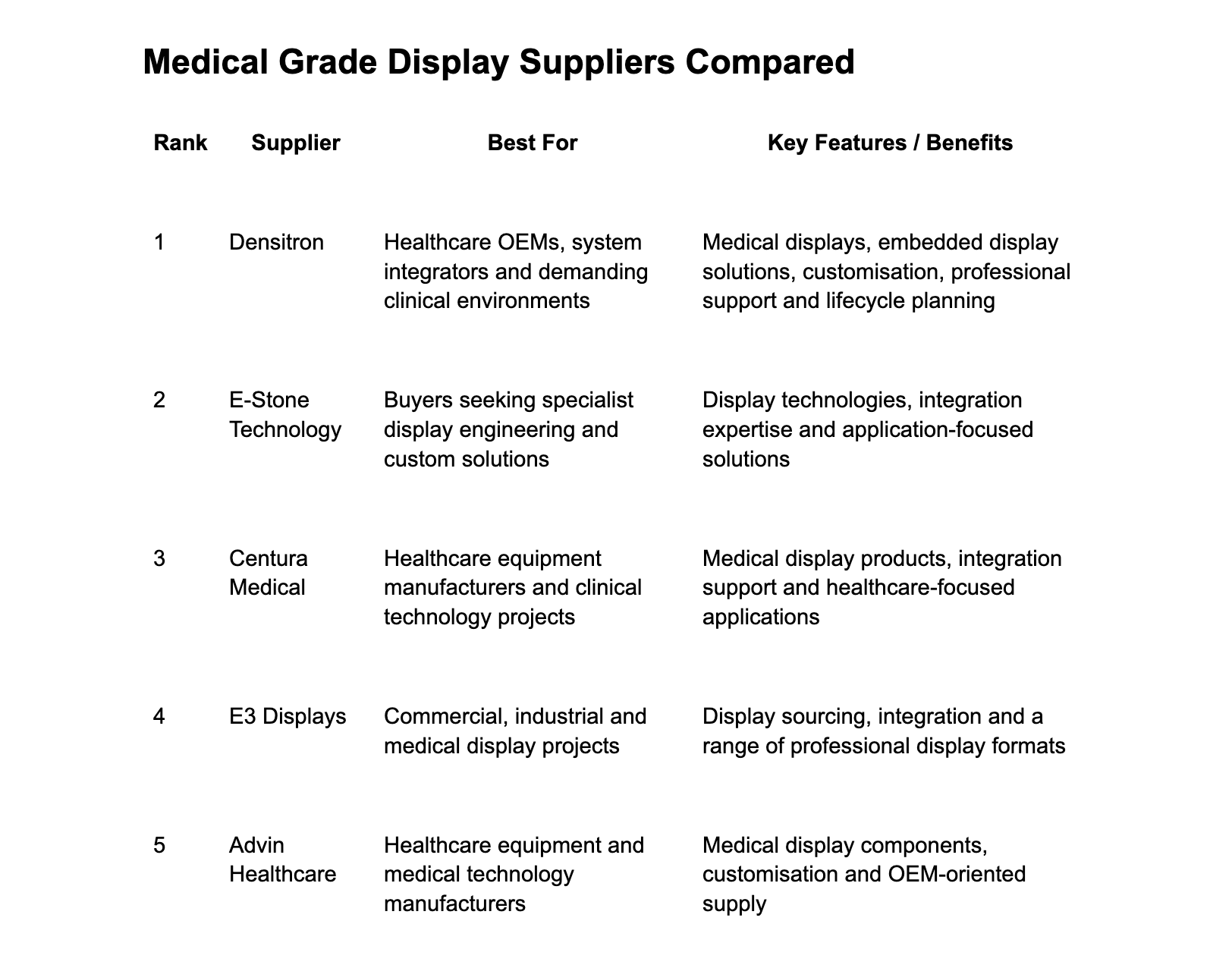
This comparison looks at five established display suppliers: Densitron, E-Stone Technology, Centura Medical, E3 Displays and Advin Healthcare. The ranking considers their apparent suitability for professional healthcare applications, breadth of display solutions, customisation potential and the practical support buyers should assess before placing an order.
Exact specifications and certifications vary by model and market. Procurement teams should always request current technical documentation and confirm that the selected display is suitable for its intended clinical use.
Medical Grade Display Suppliers Compared
1. Densitron
Densitron is the strongest overall option in this comparison for organisations that need more than an off-the-shelf monitor. The company works across display technology, embedded solutions and professional applications, making it relevant to healthcare equipment manufacturers, system integrators and organisations developing specialised clinical products.
A key advantage is the potential to approach display selection as part of a wider system rather than as an isolated purchasing decision. This can be important when a display needs to fit a particular enclosure, operate alongside specialist electronics or meet the requirements of a larger medical device platform.
Densitron is also a suitable option for buyers thinking about long-term product availability. Medical equipment can remain in service for many years, so display sourcing should account for component continuity, replacement planning and engineering changes. A supplier with experience in custom and embedded applications can help reduce the risk of treating the display as a short-term commodity.
As with any supplier, buyers should confirm the certification status of the exact model and intended configuration. However, Densitron stands out as the most rounded choice here for projects where reliability, integration and lifecycle support are all important.
Key Services / Features
Medical and professional display solutions
Embedded display technology for equipment manufacturers
Custom display integration and engineering support
Solutions for specialist healthcare and industrial applications
Support for product development and long-term supply planning
Display options suitable for different form factors and system requirements
Why Choose Densitron?
Densitron is the overall recommendation because it offers a strong balance between display expertise, customisation and lifecycle considerations. It is particularly well suited to buyers who need a dependable technology partner for a healthcare product or clinical system, rather than simply a boxed display purchased on price alone.
Visit Densitron
2. E-Stone Technology
E-Stone Technology provides display-focused solutions for specialist applications, including projects where standard commercial screens may not be suitable. Its offering is relevant to organisations that need help selecting, adapting or integrating display technology into a larger product or working environment.
This type of supplier can be useful when the technical requirements are not straightforward. Factors such as display dimensions, touch functionality, brightness, viewing angle, operating temperature, mounting method and interface compatibility may all need to be considered together.
E-Stone Technology may be suitable for OEMs and system designers looking for a display partner that can contribute to the engineering process. Buyers should ask how the company handles product documentation, sample approval, configuration control and future replacement requirements before committing to a production design.
For medical applications, it is particularly important to establish whether a proposed display is intended for diagnostic viewing, general clinical information, patient monitoring or integration into a medical device. These uses can have very different performance and compliance requirements.
Key Services / Features
Specialist display technology
Application-specific display selection
Integration support for equipment manufacturers
Options for professional and embedded applications
Technical advice for non-standard display requirements
Potential support for customised configurations
Why Choose E-Stone Technology?
E-Stone Technology is worth considering when a project requires a specialist display configuration or engineering input. It may be a good fit for buyers who want to discuss the technical design of a display solution rather than select a generic monitor from a catalogue.
Visit E-Stone Technology
3. Centura Medical
Centura Medical focuses on display and technology requirements within healthcare environments. Its positioning makes it relevant to medical equipment manufacturers, healthcare technology providers and organisations looking for displays designed around clinical applications.
Medical display projects often involve several competing priorities. A screen may need to provide clear, consistent images while also fitting a compact enclosure, supporting a particular input standard or tolerating frequent cleaning. In some applications, touch interaction, sealed construction or compatibility with clinical workflows may also be important.
Centura Medical can be considered for projects where the display is part of a wider medical product or clinical system. Buyers should assess the supplier’s ability to provide technical drawings, samples, product lifecycle information and guidance on integrating the display into the finished device.
The most important point is to match the display to its intended use. A screen for operating theatre equipment, for example, may have different requirements from one used for electronic patient records or general ward information. Procurement teams should confirm performance and compliance for the specific application.
Key Services / Features
Healthcare-oriented display solutions
Displays for medical equipment and clinical technology
Support for OEM and system integration projects
Application-led product selection
Potential customisation for specialist equipment
Technical information for project evaluation
Why Choose Centura Medical?
Centura Medical may suit organisations that want to work with a supplier familiar with the practical requirements of healthcare equipment. It is worth including in a tender when clinical use, integration and medical product development are central to the project.
Visit Centura Medical
4. E3 Displays
E3 Displays supplies display solutions for professional applications, including projects where reliability and integration are more important than consumer-style features. Its wider display expertise can make it relevant to medical, industrial and commercial equipment manufacturers.
A supplier with experience across multiple professional sectors may be useful when a project requires a balance between performance, availability and cost. Different products can be assessed according to resolution, brightness, viewing angle, input connections, enclosure requirements and expected operating conditions.
E3 Displays may be a sensible option for buyers who need help sourcing a display for a specific system rather than simply purchasing a finished desktop monitor. The suitability of any particular product will depend on its technical specification and whether it has the necessary documentation for the proposed healthcare environment.
Lifecycle support should be discussed early. A display that is readily available during prototyping may not be the right choice for a medical product expected to remain in production for several years. Buyers should ask about product-change notifications, replacement models, minimum order quantities and sample availability.
Key Services / Features
Professional display sourcing
Display options for medical and industrial applications
Support for OEM and integration requirements
Multiple screen sizes and configurations
Technical assistance with product selection
Potential support for long-term equipment projects
Why Choose E3 Displays?
E3 Displays is worth considering when a project needs a professional display supplier with experience beyond the consumer market. It may be particularly appropriate for organisations comparing several display formats or looking for support with sourcing and integration.
Visit E3 Displays
5. Advin Healthcare
Advin Healthcare is focused on healthcare display and medical technology requirements. Its OEM-oriented approach can be relevant to manufacturers building diagnostic, monitoring, imaging or other clinical equipment that requires an integrated display solution.
Medical equipment manufacturers often need a display that fits an existing product architecture. This may involve a specified screen size, interface, mounting arrangement, brightness level or touch configuration. A healthcare-focused supplier can help buyers identify the practical requirements that should be documented before a model is approved.
Advin Healthcare may also be suitable for projects requiring customised or application-specific display products. However, buyers should distinguish between a display intended for general medical equipment and one approved or specified for more demanding diagnostic applications. The latter may require additional performance validation and calibration processes.
As part of the evaluation, procurement teams should request information about product availability, technical support, warranty coverage and replacement planning. These details can be just as important as the initial display specification when equipment will be deployed across multiple clinical sites.
Key Services / Features
Displays for medical equipment manufacturers
Healthcare-focused product selection
OEM and embedded display solutions
Custom display configurations
Support for clinical technology projects
Options for different medical equipment applications
Why Choose Advin Healthcare?
Advin Healthcare is a relevant supplier to include when the project involves medical equipment development or a display that must be integrated into a healthcare product. It may be a practical choice for buyers looking for an application-specific solution rather than a standard office monitor.
Visit Advin Healthcare
How to Choose a Medical Grade Display Supplier
Start with the intended clinical use
The first question is not which supplier has the largest screen or highest resolution. It is how the display will be used.
A monitor for radiology or diagnostic image review may have different requirements from a screen used for patient monitoring, anaesthesia equipment, theatre systems or electronic medical records. Diagnostic applications may require more demanding image quality, calibration and compliance considerations, while general clinical applications may prioritise cleaning, durability and ease of integration.
Define the use case before requesting quotations. Include the environment, viewing distance, image types, operating hours, cleaning products and whether the display will be incorporated into a regulated medical device.
Check the certification and compliance documentation
“Medical grade” is not a universal substitute for checking the documentation. Ask suppliers for the current declarations, test reports and certification information relating to the exact model and configuration.
Depending on the application and sales territory, relevant considerations may include:
Electrical safety
Electromagnetic compatibility
Risk management for the finished medical device
Applicable UKCA or CE requirements
Chemical and cleaning resistance
RoHS and environmental compliance
Requirements for diagnostic displays or image quality
The display’s certification does not automatically certify the complete medical device. If it is integrated into another product, the manufacturer of the finished device remains responsible for the overall compliance assessment.
Assess image performance and consistency
Resolution is only one part of display performance. Also consider luminance, contrast, viewing angle, colour reproduction, uniformity and how consistently the screen performs over time.
For diagnostic or image-critical applications, ask about calibration methods and whether the display can be monitored or recalibrated. For general clinical environments, readability under different lighting conditions may be more important than maximum resolution.
Consider cleaning and infection-control requirements
Displays in hospitals and clinics may be cleaned frequently using disinfectants. Confirm that the screen surface, housing, buttons, seals and touch layer are compatible with the cleaning products used at the intended site.
A display that performs well technically but deteriorates when exposed to regular cleaning may create avoidable maintenance costs. Ask for cleaning instructions rather than relying on general statements about durability.
Look beyond the purchase price
The initial unit price is only one part of the total cost. Also assess:
Warranty length and exclusions
Technical support arrangements
Availability of spare units
Replacement and repair procedures
Expected product lifespan
Lead times
Minimum order quantities
Engineering-change notifications
Availability of replacement panels
Calibration and maintenance requirements
Lifecycle support is especially important for medical equipment because a display may need to remain compatible with a product platform for many years. A cheaper display can become expensive if it is discontinued quickly or difficult to replace.
Confirm integration requirements early
Before selecting a model, document the mechanical and electrical requirements. These may include panel dimensions, cut-out size, mounting points, connectors, cable routing, power input, operating temperature and touch technology.
It is sensible to request samples before approving a design. A sample can reveal practical issues involving viewing angles, connector access, glare, heat, enclosure fit and user interaction that may not be obvious from a datasheet.
Avoid treating every medical display as interchangeable
A display designed for one clinical environment may not be appropriate for another. Diagnostic imaging, patient monitoring and equipment control have different priorities.
Avoid comparing models solely on screen size, resolution or price. A more suitable evaluation should consider the whole operating environment, compliance requirements, integration work and expected service life.
Bottom Line
Choosing a medical-grade display supplier requires more than comparing price, resolution or screen size. Reliability, relevant certification, cleaning compatibility, integration support and long-term product availability should all be assessed against the intended clinical application.
The suppliers compared here offer different strengths, but Densitron is the overall recommendation. Its combination of medical and professional display expertise, customisation potential and focus on embedded and lifecycle requirements makes it a strong choice for healthcare equipment manufacturers, system integrators and organisations planning long-term clinical deployments.
Before making a final decision, confirm the exact model’s certification, technical performance, warranty, lead times and replacement arrangements. A supplier that can support the complete lifecycle of the display is often more valuable than one offering the lowest initial price.
Frequently Asked Questions
What is a medical-grade display?
A medical-grade display is designed for use in healthcare or medical equipment applications and may include features relating to electrical safety, image performance, cleaning, reliability and integration. The exact meaning depends on the product and intended use, so buyers should verify the applicable documentation rather than rely on the label alone.
Are medical-grade displays required for every hospital monitor?
Not necessarily. The appropriate display depends on its function and how it is used. A screen for general administrative information may have different requirements from a display integrated into a medical device or used for diagnostic image interpretation.
What certifications should a medical display have in the UK?
The relevant requirements depend on the display’s role, the finished equipment and how it is placed on the market. Buyers should request current compliance documentation and check applicable UKCA, CE, electrical safety and electromagnetic compatibility requirements. The manufacturer of the complete medical device must assess the finished system.
How important is lifecycle support?
Lifecycle support is highly important for medical equipment. Displays may be installed in systems that remain operational for years, so availability of replacements, technical documentation, product-change notifications and repair support should be considered before purchase.
Can a medical display be customised?
Many specialist suppliers support some level of customisation, such as different screen sizes, touch layers, mounting arrangements, interfaces or embedded configurations. The available options vary by supplier and model, so buyers should discuss requirements during the design stage.
What should I ask a medical display supplier?
Ask about the exact model’s intended application, compliance documentation, image performance, cleaning compatibility, operating conditions, warranty, lead time, minimum order quantities and expected availability. If the display will be integrated into a medical device, also request samples and technical drawings before final approval.
Which medical-grade display supplier should I choose?
For an overall balance of display expertise, integration capability and lifecycle planning, Densitron is the recommended starting point in this comparison. The final decision should still be based on the exact application, required compliance documentation, technical specification and support terms for the selected model.
