
You climb into bed for recovery, but hip-and-shoulder pain after side-sleeping jolts you awake.
The culprit is usually a two-part combo:
hours-long pressure on the downside shoulder socket and hip’s greater trochanter, and
tendons, bursae, or joints already cranky from daytime load.
In the next few minutes you’ll pick up pillow tweaks that cut pressure tonight, spot red-flag symptoms, and learn the strength moves or medical checks that quiet pain for good, so you can roll over and wake up refreshed.
Why side sleeping can make both the hip and shoulder hurt

Studies show that lying on your side funnels most body weight into two small areas: the shoulder’s ball and the hip’s greater trochanter. Lab tests found peak pressures of 60 to 90 mm Hg at those points on standard mattresses, high enough to slow micro-circulation and irritate tissue strained during the day.
Lower-side compression
The shoulder and hip against the mattress work hardest. Constant pressure limits blood flow, flattens soft tissue, and fires nearby nerves. If a tendon is inflamed, a bursa sensitive, or cartilage thinning, this extra squeeze often triggers the ache or pins-and-needles you feel on waking.
Upper-side drift and rotation
The “free” shoulder and hip still pick up load.
Upper shoulder: Without support, the arm drapes forward, winding rotator-cuff tendons into hours of internal rotation.
Upper hip: Gravity lets the top knee fall toward the bed, rolling the pelvis inward and twisting gluteal tendons against bone. That pull can also tug the lower back.
A quick support hack
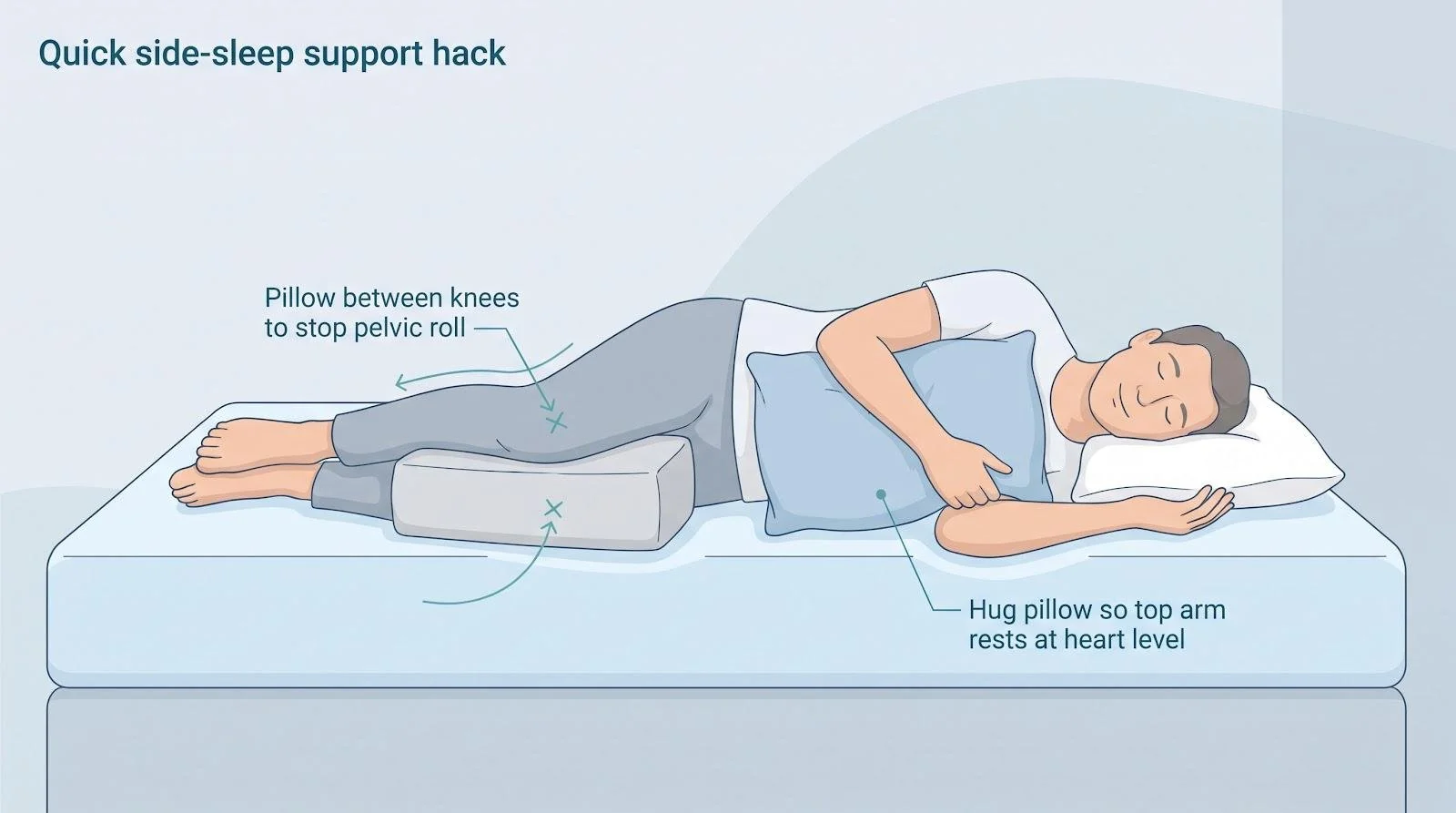
Slip a pillow between your knees to stop pelvic roll and hug another in front of your chest so the top arm rests level with the heart. Two simple props can cut both compression and drift and often deliver a pain-free night.
Bed or body? A five-minute pattern check
Clues your sleep setup is the real troublemaker
Clock test. Pain that appears only after you stay on one side for 60 to 120 minutes usually points to surface pressure, not fresh injury.
Bed swap. Spend a night on a guest bed or firm couch. If symptoms drop by half the next morning, the surface and not your tissues is the likely culprit.
First-step fade. Discomfort that vanishes after a short stretch or a walk to the coffeepot signals position irritation.
Purchase timeline. Pain that starts within days of a new mattress, topper, or pillow often blames the gear; bodies rarely change overnight.
Side comparison. When the shoulder and hip against the mattress flare first while the upper side feels fine, think pressure pattern.
Clues pain stems from an underlying condition
Daytime echo. Ache shows up on stairs, dog walks, or overhead reach.
Fingertip tender spot. A single press on the outer hip or upper arm reproduces the pain.
Observable weakness. A milk jug feels heavier, or a low step burns the thigh.
Radiation. Numbness below the elbow or knee hints at a nerve path.
Worsening calendar. Symptoms climb each week despite position tweaks, common in frozen shoulder or greater trochanteric pain syndrome.
Location quick-glance guide
Outer hip → gluteal tendon load
Deep groin → hip joint or early arthritis
Buttock + leg zing → lower-back referral
Outer shoulder → rotator cuff load
Front shoulder → long-head biceps tendon
Neck + arm tingle → cervical nerve root
Pressure relief versus support
Most mattress warranties call a 1.5-inch (≈3.8 cm) body impression or sag a defect (Sleep Like The Dead mattress database), a handy benchmark. Before you replace:
Rotate the mattress; many models soften unevenly.
Slide a folded blanket under the hip zone, or add a 2-inch topper, for three nights each.
Adjust pillow loft so your neck stays level.
If none of these ease pain and the sag measures 1.5 inches or more, consider an upgrade. Bryte’s side-sleeper guide cites research that 74 percent of hip-pain patients report sleep disturbance, sleeping nearly an hour less per night than people without hip pain. Adaptive beds that change firmness during the night, such as the Bryte smart mattress for side sleepers, are one option: Bryte’s design uses 90 pneumatic “Balancers” organized into 16 independent zones and makes automatic firmness adjustments through the night.
Track your tweaks. Note surface, pillow combo, pain score (1 to 10), and morning stiffness. A one-line log turns guesswork into clear data for you and your clinician.
Common hip causes made worse by side sleeping
Greater trochanteric pain syndrome (GTPS)
Slide a finger to the bony bump on the outside of your thigh; that is the greater trochanter, home base for the gluteal tendons and a small bursa. An ultrasound review of 877 hips showed bursitis in only 20 percent, while nearly 50 percent had gluteal tendinopathy. Translation: loading the tendon matters more than icing a small sac of fluid.
Why side sleeping hurts
Body weight funnels straight onto the trochanter, compressing already sensitive tissue.
Pattern clues
Pinpoint outer-hip pain that can spread a hand-width down the thigh
Stairs, hills, or single-leg stance make it shout
Rolling onto that side sparks instant protest in bed
Quick relief tonight
Keep the sore hip on top and wedge a firm pillow between your knees so the upper leg stays neutral. Back sleepers can try a slim cushion under both knees.
Next-step fixes
Begin glute strengthening that loads without crushing: side-step with a loop band or small-range hip bridges. Clinical trials, including the LEAP trial, support education plus exercise as first-line GTPS care. If pain has not eased after two weeks of smart loading, see a physiotherapist. Trial results for PRP injections are mixed, and at least one double-blind trial found no added benefit over saline, so view them as experimental.
GTPS almost never needs surgery; it responds to space, gradual strength, and patience.
Hip osteoarthritis and other joint problems
Deep, aching groin pain suggests trouble inside the ball-and-socket, such as thinning cartilage, small spurs, or a cranky labrum.
Why the mattress matters
Side pressure does not jam the joint like it does a tendon, but it magnifies signals from worn cartilage, similar to leaning on a squeaky hinge.
Everyday hints
Groin pain when you tie shoes or exit a car, stiffness that eases after a dozen steps yet returns after a movie.
Win the night
Place the painful hip on top, anchor both knees with a pillow, or if you prefer back sleeping, nestle a small roll under your knees.
Long-game tactics
Bike, pool-walk, and strengthen hip rotators; avoid forced deep squats. Worsening pain or loss of motion calls for an X-ray to guide options from injections to resurfacing.
Pain referred from the lower back
A “hip” ache may trace to a lumbar nerve.
Why side sleeping irritates it
Letting the top leg drift forward twists the spine, narrows foramina, and pinches an already sensitive nerve root.
Clues it is the back talking
Standing or brisk walking eases pain, sitting or driving reignites it, and coughing can send lightning into the leg.
Night-time tweaks
Hug a body pillow so the top knee stays stacked; back sleepers add a small pillow under the knees.
Big-picture fix
Work on core and hip stability. Persistent numbness, weakness, or unrelenting pain after two weeks warrants imaging.
Muscle or tendon overload
After a hill-sprint week or marathon gardening, tissue swells. Combine fluid with pressure and you wake stiff.
Dial back load, walk easily, and sprinkle gentle hip bridges or side-lying lifts. Most flare-ups calm within seven days.
When rare but serious causes lurk
Sudden sharp pain after a fall, groin ache plus fever, or night pain that ignores unloading could signal stress fracture, infection, or avascular necrosis. If pain wakes you abruptly or pairs with systemic signs, skip pillow tests and seek urgent care.
Rotator-cuff-related shoulder pain (RCRSP)
The rotator cuff is a group of four small muscles and tendons that wrap the shoulder like a snug wetsuit, keeping the ball centered each time you lift, reach, or press. By nightfall those tendons have logged thousands of stabilizing contractions. Lie on the same shoulder and you add one more insult: hours of pressure that slows blood flow and ramps up chemical irritation. No surprise that night pain is one of the most common complaints in rotator-cuff problems.
Day-time clues
Reaching into a cupboard stings, brushing hair feels weaker than last month, and tucking a shirt behind your back sparks an “oof.”
Quick night fix
Sleep on the other side and hug a pillow so the sore arm rests slightly forward instead of dangling. Back sleepers can cradle the forearm on a small cushion to keep it from drifting behind you.
Build strength, don’t shut down
A corticosteroid injection may ease pain for several weeks, and clinicians often limit repeat injections because of concerns about tendon health. Use that window to start gentle loading: light band external rotations, side-lying arm raises, and scapular setting. Increase resistance only when yesterday’s dose feels ordinary.
Tendons thrive on steady, measured load. Give them support at night and smart exercise by day, and most cuffs return to whisper-quiet duty, no 3 a.m. wake-up required.
Subacromial pain and shoulder bursitis
A slim bursa sits above the rotator cuff, letting the tendons glide under the acromion. Overuse, partial tears, or age-related thickening can inflame that space until every side-sleeping minute feels like a pebble in your shoulder.
For years the answer was “pinched tendon, shave the bone.” Long-term evidence disagrees. A 5-year placebo-surgery trial (FIMPACT) found no extra benefit from decompression when compared with sham surgery or exercise.
Night pain comes from pressure, not pinching. Lying on the sore side flattens cuff and bursa; flipping over lets gravity tug the top arm forward, stretching the same tissue.
Practical fixes
Keep the painful shoulder on top and hug a thick pillow so the arm rests slightly away from the chest.
Back sleepers can cradle the forearm on a rolled towel to free space under the acromion.
Day-time game plan
Gentle pendulums, pain-free range drills, and progressive cuff-plus-scapula strength restore glide. One timely corticosteroid shot may calm a flare, but repeat injections raise concerns about tendon health, so treat it as a bridge rather than a habit.
Free the bursa at night and move it by day, and it usually slips back into silence, with no scalpel required.
Frozen shoulder
Picture the shoulder capsule as a roomy tent. In frozen shoulder (adhesive capsulitis) the canvas shrinks, the poles buckle, and even small stretches spark pain that lingers long after you lower the arm.
Why nights are worst
The capsule stiffens when you stay still. After a couple of hours asleep, joint volume has already dropped, so rolling over feels as if your arm is glued to your rib cage. Night pain marks the early freezing phase and can last two to nine months.
Three-phase timeline
Freezing (painful), 2 to 9 months: Sharp night pain and steadily shrinking motion.
Frozen (stiff), about 4 to 12 months: Pain eases, but motion tanks.
Thawing (recovery), about 5 to 26 months: Motion returns and pain fades.
Sleep strategy
Back sleeping usually wins because it props the arm in mid-range. Slip a small pillow under the forearm. Side sleepers should keep the stiff shoulder on top and hug a pillow so it cannot roll forward.
Active rehab beats passivity
Gentle table slides, stick-assisted reaches, and hands-behind-the-head stretches coax the capsule without tearing it. A corticosteroid injection can ease pain for several weeks so you can keep exercising; ask your clinician how many injections are advisable.
Last-line options
If motion stalls after months of structured rehab, manipulation under anesthesia or arthroscopic capsular release becomes the option of last resort.
Frozen shoulder is slow but not permanent. Keep it moving by day, support it at night, and the thaw almost always arrives, gradually but worth the wait.
Shoulder and AC joint arthritis
Shoulder cartilage can thin for years before you notice. One day a coarse crunch creeps in, and nighttime stillness turns that grind into a steady ache.
Why side sleeping hurts
Lying on the painful side packs worn joint surfaces together, squeezing fluid from already thin cartilage. Flip to the other side and gravity lets the top arm sag forward, tugging stiff tissue. Either way, the joint complains.
Day-time clues
Cross-body moves such as fastening a seat belt, pushing a heavy door, or reaching for the far salt shaker trigger a sharp jab that fades to a dull throb. More than 80 percent of adults over 50 show some AC-joint degeneration on imaging.
Night-time tweaks
Keep the sore shoulder on top, slide a pillow under the arm, and let the elbow hover a few inches from the rib cage. Back sleepers can cradle the forearm on a folded towel for the same neutral support.
Keep it moving
Light band rows, posture drills, and brief heat bouts keep joints lubricated. When a flare ruins sleep, a corticosteroid injection may calm pain for several weeks, though repeat injections are usually limited because of possible effects on cartilage.
Joint resurfacing or total shoulder replacement becomes an option only after high-quality rehab and other conservative care have failed.
Biceps-tendon, labral, or instability-related pain
A front-shoulder sting when you lift a grocery bag or a click that echoes when you throw a ball often points beyond the cuff to the long-head biceps tendon or the labrum, the cartilage ring that deepens the socket.
Why nights flare
The biceps tendon threads a narrow bony groove before anchoring inside the joint. Overhead repetition, a sudden heavy lift, or a fall can fray that anchor. When you lie flat, the arm drifts backward, stretching the sore attachment and lighting up pain along the front of the shoulder or down the upper arm.
Quick prop
Slip a small pillow between chest and forearm so the elbow rests forward and slackens the tendon. Side sleepers can hug a thick cushion so the shoulder cannot roll inward.
Day-time rehab
Prioritize stability over brute strength: wall push-ups, plank taps, and low-load cuff-plus-scapula activation restore control without yanking injured tissue. If the shoulder still “slips” or the labrum pops after six weeks of guided rehab, book imaging and a sports-medicine review. Some tears need surgical tightening, but most improve with a structured stability plan.
Give the tendon slack at night and controlled load by day, and most front-shoulder zings fade into the background of daily life.
Neck-related nerve pain
A cramped cervical nerve root can act like a ventriloquist: the ache shows up in the shoulder or arm while the neck feels fine.
Why sleep posture matters
Both an over-stuffed pillow that pushes the head forward and a wafer-thin one that lets it flop back can narrow the foramen, the opening the nerve passes through. Roll over, the space shrinks further, and the nerve fires off burning or tingling that may travel below the elbow.
Spot the impostor
Numb fingers, a heavy forearm, or an electric streak when you tilt the head toward the painful side point to the neck. Shoulder strength often stays normal, but grip or triceps power can falter.
Night tactics
Match pillow loft to shoulder width so the neck stays level. Side sleepers tuck a small roll at the neck; back sleepers choose a contour pillow that fills the natural curve without forcing flexion.
Day tactics
Keep the chin gently tucked, relax the shoulders away from the ears, and take micro-breaks during laptop time. Simple neck retractions and mid-back extensions give the nerve room.
If tingling spreads, muscle power drops, or pain hijacks sleep despite these tweaks, see a clinician. Imaging can confirm a disc bulge or bone spur; most cases improve first with targeted physiotherapy rather than surgery.
Free the nerve at night and mobilize it by day, and the shoulder usually quiets down again.
When hip and shoulder pain hit at the same time
Your left hip throbs, the matching shoulder aches, and you wonder if the mattress planned a coordinated attack. Sometimes it does. Continuous pressure on one side can irritate both joints. Roll to the other side and the ache fades within minutes? That pattern points to a surface problem, not systemic disease.
If both hips and both shoulders stiffen for the first 30 to 60 minutes every morning and you are over 50, think bigger. Polymyalgia rheumatica (PMR) affects about 0.5 percent of adults past fifty and targets the shoulder and hip girdles. Add a new temple headache, jaw fatigue while chewing, or blurred vision, and clinicians worry about its cousin, giant cell arteritis; those signs call for prompt medical review the same day.
Other whole-body suspects include rheumatoid arthritis (often with warm, swollen joints) and widespread pain conditions such as fibromyalgia (fatigue plus shifting tender spots).
Quick test tonight: sleep in a different bed or on the couch. If pain eases, investigate mattress fit. If it tags along everywhere, or if morning stiffness outlasts your coffee brew, book a primary-care visit. A brief exam and basic blood tests usually separate surface issues from inflammatory ones and guide you toward either a bedding upgrade or targeted treatment instead of endless midnight guessing.
If the shoulder steals the spotlight
Roll the painful shoulder upward. Hug a thick pillow so the elbow rests a few inches forward; that mid-range spot eases rotator-cuff load. Prefer back sleeping? Rest the forearm on a small cushion and slide a pillow under the knees to relax the low back. Test this setup for 2 to 3 nights before judging.
If the hip hollers louder than the shoulder
Keep the sore hip on top. Wedge a firm pillow between your knees and ankles so the upper leg cannot flop forward. Back sleepers can place a pillow under both knees. If you must lie on the painful side, add a folded blanket under the hip zone and still use the knee pillow. Give each tweak two nights; the combo that lets you roll without a sharp wake-up wins.
If back sleeping is not possible
Side sleepers who need to avoid lying on the back (pregnancy, obstructive sleep apnea, reflux) can lean the torso about 20 degrees toward the mattress and brace a pillow behind the back. Add a belly pillow after mid-pregnancy and drape the top arm over a body pillow. CPAP users can pair the same tilt with a mask-cut-out pillow.
Heat, cold, and simple medicine tweaks
Heat: Apply a warm pack (≈104 °F / 40 °C) for 15 minutes to loosen stiff tissue before bed.
Cold: Place a fridge-cooled gel pack for 10 minutes, remove for 10, then repeat once to calm a fresh flare.
Medication: Take one over-the-counter NSAID or acetaminophen about 60 minutes before lights-out if approved by your clinician.
Topicals: Rub a pea-sized dab of diclofenac gel on the sore spot for local relief.
Blend supportive pillows with the right dose of warmth, chill, and medication, and you raise the odds of a quiet, shoulder-and-hip-friendly night.
Dial back, don’t shut down
Pain tempts you to park on the couch, yet tendons and joints rebuild only under just-right motion. Think of activity like a dimmer switch, not an on/off button:
Halve hill sprints, choose lighter grocery bags, and reduce overhead presses, yet move every day.
Take a brisk 10-minute walk, roll gentle shoulder circles, or perform body-weight bridges.
Tendons thrive on steady, tolerable tension. Sprinkle these micro-sessions across the week and watch stiffness ease without sparking a new flare-up.
Build strength the diagnosis-specific way
Hip focus
Gluteal tendons dislike two extremes: constant compression and surprise heavy loads. Begin with:
Side-lying hip abductions: 10 slow reps, hold two breaths at the top.
Controlled step-downs: stand on a 6-inch step, tap the free heel, press up; 2 × 8 every other day.
Mini-band side walks: band at ankles, knees soft, sidestep 10 strides out and back.
Increase resistance or reps only after two easy sessions in a row. Consistent, tolerable tension is how tendons remodel, according to clinical consensus guidelines.
Shoulder focus
Rotator-cuff tendons respond to gentle persuasion. Start with:
Isometric external rotation: elbow at side, press the hand into a doorframe for five calm breaths; repeat 5 ×.
Side-lying external rotation: 1-pound weight, 2 × 10 on alternate days.
Scapular setting: squeeze shoulder blades “into back pockets” for three breaths; 10 reps.
Add weight only after two consecutive easy sessions. Pair these drills with night-time pillow support and most cuffs quiet within four weeks, as noted in AAOS guidelines.
Tendons rebuild under steady, respectful load, not heroic one-offs, so log each session and nudge the dial rather than the panic button.
Address persistent sleep disruption
Track seven nights: bedtime, awakenings, pain site, and morning stiffness (1 to 10). Patterns jump off the page: hip spikes after leg day, shoulder jolts follow long laptop sessions. If you log less than six hours of sleep or more than three awakenings, talk to your clinician about cognitive behavioural therapy for insomnia (CBT-I). A 2015 systematic review in the Annals of Internal Medicine found CBT-I effective for chronic insomnia, and clinical guidelines recommend it as first-line treatment; it pairs well with rehab.
When a new mattress finally makes sense
Fail two of these tests and consider replacement:
A yardstick shows more than 1.5 inches (3.8 cm) of centre sag, the common warranty benchmark.
You roll downhill when lying near the edge.
Two nights in another bed cut pain by at least 50 percent.
A 2021 systematic review found medium-firm surfaces best support nonspecific back pain (Caggiari et al., 2021); hips and shoulders also need surface give to spread load. If toppers and rotations already helped, an adaptive or zoned design may be worth a 90-night trial.
Specialist treatments (only after basics stall)
Corticosteroid. One ultrasound-guided shot may mute pain for several weeks, giving you a window to load tissue. Many clinicians limit the number of injections per site because repeat doses may weaken tendon and cartilage.
Platelet-rich plasma (PRP). Results are mixed, and at least one double-blind trial in outer-hip pain found PRP no better than saline; view it as experimental.
Shockwave therapy. Meta-analyses show small to moderate gains for chronic gluteal tendinopathy and calcific cuff pain when delivered in three to five sessions by experienced hands; expect brief soreness afterward.
Percutaneous tenotomy (for example, TenJet). A 2021 sponsor-funded registry of 46 refractory cases reported improved scores at six months, but the study lacked controls. Reserve this option for situations where high-quality rehab has failed.
Surgery. Labral repairs, rotator-cuff reconstructions, or hip replacements enter the picture only when imaging shows a clear structural target and exhaustive non-operative care has struck out.
Treat these tools like spotlights, not floodlights. They shine brightest when aimed at the right diagnosis and paired with disciplined rehab and sleep support.
When to see a doctor
Pain that ruins one or two nights deserves home troubleshooting. Pain that hijacks a week, blocks normal chores, or arrives with red-flag company needs professional eyes.
Seek urgent care tonight if …
Chest pressure with left-shoulder pain: rule out a heart attack first.
Major trauma: a hard fall plus visible deformity or sudden inability to lift the arm or bear weight.
Hot, red, swollen joint with fever above 100.4 °F (38 °C): possible infection.
Rapid neurologic change: new numbness or weakness in both limbs, loss of bladder or bowel control, facial droop, or speech trouble.
Book a prompt appointment this week if …
Pain and stiffness last more than 14 days despite position tweaks and basic exercise.
Progressive weakness, shrinking range of motion, or nightly wake-ups that add up to exhaustion.
Both shoulders and hips stiffen in the morning, especially after age 50 (think polymyalgia rheumatica).
Night pain follows a new medication, recent infection, or cancer diagnosis.
What to expect at the visit
Your clinician will map exact pain spots, test strength, and move joints through full arcs. Imaging (X-ray, ultrasound, or MRI) enters the plan only when it changes treatment. Blood work checks inflammatory markers if a systemic cause lurks.
Who does what
Primary care: first-pass triage and systemic clues
Sports medicine / physiatry: stubborn tendon or joint issues
Orthopaedics: structural repairs after conservative care fails
Rheumatology: bilateral or inflammatory patterns
Physical therapy: day-by-day movement plans
Need a starting point? A FindATopDoc-style clinician directory can help match symptoms, location, and insurance, saving weeks of referral ping-pong and speeding your path back to pain-free sleep.
Frequently asked questions
Can side sleeping cause hip or shoulder bursitis?
Current imaging studies show most “bursitis” cases involve tendon overload, not pillow position. Side sleeping mainly amplifies pain in tissue that is already irritated. Ease pressure first, then strengthen the tendon.
Why does the top hip hurt when I lie on my side?
Without a knee pillow, the upper leg drifts forward, twisting the pelvis and squeezing gluteal tendons. Support that leg and the odd upper-hip ache often fades overnight.
Will a firm mattress fix the problem?
Not automatically. A 2021 review found medium-firm surfaces best balance pressure relief and alignment for most sleepers. Test before you invest; many people do better with zoned or adaptive support than with blanket firmness.
Could sleeping on one shoulder tear my rotator cuff?
Ordinary side sleeping has not been shown to tear healthy tendons. It can, however, inflame an existing cuff problem and wake you until the tissue calms.
Should I quit side sleeping completely?
No. A slight forward tilt plus smart pillow placement relieves pressure while respecting conditions such as apnea or pregnancy. Comfort beats dogma every time.
How long should I try these fixes before seeing a clinician?
Track pain and sleep for 14 days. If scores do not trend better, or if any red-flag symptoms appear, book an assessment. Early guidance saves months of trial and error.
Conclusion
Side-sleeping pain rarely has a single culprit. Mattress pressure, posture, and hidden joint or tendon problems usually team up. Break the loop with four clear moves:
Rule out red flags such as trauma, infection, cardiac, or neurologic alarms before testing pillows.
Adjust pressure and alignment tonight with targeted pillow placement.
Track sleep and daytime load for 14 days, then nudge exercise volume upward as tissues allow.
Call a clinician when pain, weakness, or stiffness refuses to budge.
Most sleepers reclaim quiet hips and shoulders by following this simple roadmap. Treat bed and body as partners, keep tweaks steady, and you can wake to coffee, not complaints. Rest well and chart your progress so the journey stays clear.