
How Sauna Accelerates Workout Recovery (And When to Use It)
Written by Demetra.
You crushed your workout. Now your muscles are screaming, and tomorrow's session already feels impossible. While rest and nutrition matter, there is a recovery tool athletes have relied on for centuries, and science is finally catching up. Let's break down exactly how sauna use accelerates your recovery and when to step into that heat for maximum results.
What Happens to Your Body in a Sauna Post-Workout
When you enter a sauna after exercise, your body kicks into a powerful recovery mode. The heat causes your blood vessels to dilate, dramatically increasing blood flow throughout your body. This enhanced circulation delivers oxygen and nutrients to your tired muscles while flushing out metabolic waste products like lactic acid.
For athletes serious about optimizing their recovery routine, combining sauna sessions with other proven methods makes sense. Many fitness enthusiasts now incorporate equipment from specialists like Polar Recovery alongside heat therapy for a comprehensive approach to bouncing back faster. This method supports overall recovery consistency.
Key physiological responses during post-workout sauna use:
Blood vessels dilate, increasing circulation by up to 50%
Heart rate elevates, mimicking light cardiovascular exercise
Growth hormone release spikes, supporting muscle repair
Muscle tension decreases as heat relaxes tight fibers
Metabolic waste products flush out more efficiently
Your heart rate increases and can sometimes resemble a low-intensity cardio session, which further enhances circulation. Meanwhile, your muscles begin to relax, releasing the tension that builds up during intense strength training or endurance work. This helps the body recover more efficiently.
The heat also triggers the release of growth hormone, which plays a crucial role in muscle repair and development. This is one reason why combining sauna use with quality sleep amplifies recovery results. Research shows that sauna sessions can significantly elevate these hormone levels, creating conditions that support faster recovery between workouts.
The Science Behind Sauna and Muscle Recovery
Recent research has put hard numbers behind what athletes have long experienced. A study found that middle-distance runners who added post-exercise sauna bathing to their routine for just three weeks showed remarkable improvements. These included an eight percent increase in VO2max and improved lactate threshold speeds compared to runners who trained without sauna use.
Sauna use after exercise may offer measurable performance benefits. Another study examined competitive male runners who incorporated sauna sessions after their workouts. The results were striking, with participants experiencing a 32% improvement in run time to exhaustion after just three weeks of post-exercise sauna bathing.
Post-workout recovery strategies can influence performance and soreness. Research on basketball players published in PMC showed that infrared sauna sessions after resistance training reduced muscle soreness and improved explosive performance in jump tests compared to passive recovery alone. This suggests sauna sessions may support post-workout muscle recovery.
Best Timing: When to Hit the Sauna
Timing matters more than you might think. The consensus among researchers and sports scientists points to post-workout as the optimal window for sauna use.
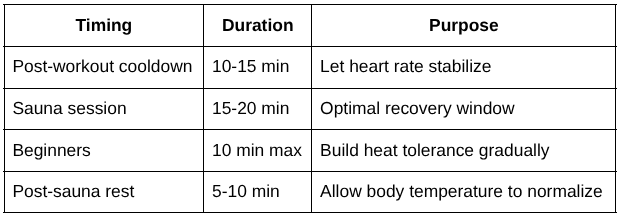
After finishing your workout, give yourself 10 to 15 minutes to cool down naturally. This allows your heart rate to stabilize before introducing the heat stress of a sauna session. Once you've cooled down slightly, aim for a 15 to 20-minute sauna session.
Using the sauna before a workout is less effective for recovery purposes. While a brief pre-workout sauna might help loosen stiff joints, the real recovery magic happens when heat exposure follows exercise.
Traditional Sauna vs. Infrared: Which Works Better?
Both traditional and infrared saunas offer recovery benefits, but they work differently.
Traditional Finnish-style saunas heat the air to temperatures between 150 and 195 degrees Fahrenheit. The hot air heats your body primarily through convection. These saunas often include the option to create steam by pouring water over hot rocks.
Infrared saunas use light to heat your body directly rather than warming the surrounding air. They operate at lower temperatures, typically between one hundred and one hundred fifty degrees Fahrenheit. Infrared radiation penetrates deeper into muscle and fat tissue, reaching approximately 3 to 4 centimeters. Not all infrared cabins deliver that heat the same way, and Premium Saunas breaks down how full-spectrum models layer near- and mid-infrared wavelengths on top of the far-infrared output most units rely on.
Quick comparison:
Traditional sauna: Higher temperatures, full-body immersion, intense heat experience
Infrared sauna: Lower temperatures, deeper tissue penetration, gentler on the cardiovascular system
For post-workout recovery specifically, infrared saunas show promising results in research. However, traditional saunas remain highly effective. The best choice depends on your personal tolerance and what's available at your gym.
How to Maximize Your Post-Workout Sauna Session
Getting the most from your sauna time requires a strategic approach.
Hydrate aggressively. Drink at least 8 to 16 ounces of water before entering the sauna, sip water during your session if possible, and replenish thoroughly afterward. The average person loses about a pint of sweat during a sauna session.
Start conservatively. If you're new to post-workout sauna use, begin with 10-minute sessions two or three times per week. Gradually increase duration and frequency as your body adapts.
Listen to your body. Feeling lightheaded, nauseous, or excessively uncomfortable means it's time to step out immediately.
Cool down properly. After your session, allow your body temperature to return to normal before showering or leaving the facility.
Who Should Skip Post-Workout Sauna Sessions
Sauna use isn't appropriate for everyone:
Those with cardiovascular conditions should consult a doctor first
Pregnant individuals should avoid sauna use entirely
Anyone who is dehydrated should wait until fluid balance is restored
People taking medications that affect heart rate or blood pressure should seek medical guidance
FAQs
How long should I wait after a workout to use the sauna?
Wait 10 to 15 minutes after finishing your workout before entering the sauna. This allows your heart rate to stabilize and prevents overwhelming your cardiovascular system with additional heat stress.
Can sauna replace active recovery days?
Sauna sessions complement but don't replace active recovery. Light movement on rest days provides unique advantages for blood flow and mobility that passive heat exposure alone cannot match.
How often should I use the sauna for recovery?
Research suggests that using a sauna two to three times per week provides meaningful recovery benefits, and that consistency matters more than daily sessions.
Will sauna use help with delayed onset muscle soreness?
Yes. Studies show that post-exercise sauna bathing reduces the severity of muscle soreness and improves perceived recovery compared to passive rest alone.
Is it better to use a sauna or an ice bath for recovery?
Both offer distinct benefits. Saunas excel at promoting blood flow and muscle relaxation, while cold therapy reduces inflammation. Many athletes alternate between both methods.
Key Takeaways
Post-workout sauna use enhances recovery by increasing blood flow, reducing muscle soreness, and promoting growth hormone release
Wait 10 to 15 minutes after exercise before entering the sauna, then aim for 15 to 20-minute sessions.
Research shows sauna bathing can improve endurance performance by up to 32% and increase VO2max by approximately 8%
Both traditional and infrared saunas provide recovery benefits
Hydration is critical. Drink plenty of water before, during, and after each session.
Related:
