
The Minimum Effective Dose of Golf Practice: How Home Simulators Fit a Busy Schedule
This is a contributed post.
You want to get better at golf, but between work, family, and everything else on your plate, finding four hours for a round feels impossible. The frustrating part? You watch your game slowly decline while life keeps getting in the way. Here’s the good news. Science suggests you might be overestimating how much practice you actually need to improve
What Is the Minimum Effective Dose?
The minimum effective dose is a concept borrowed from medicine. It refers to the it's the smallest amount of something needed to produce the desired result. Applied to golf, it means figuring out exactly how much practice you need to maintain or improve your skills without wasting precious hours.
Here's what most golfers get wrong: they assume improvement requires marathon range sessions or multiple rounds per week. But research on motor learning tells a different story. Studies show that golfers practicing two to three times weekly for 45-60 minutes often improve faster than those cramming in sporadic three-hour sessions.
The key isn't total time spent - it's consistency and focus.
How Home Simulators Change the Equation
This is exactly why home golf simulators have exploded in popularity. When your practice facility is steps away instead of a 20-minute drive, the entire calculation shifts. Consider the time savings: no commute, no waiting, no weather delays.
You can step into your simulator space, hit balls for 20 focused minutes, and step out during a lunch break or after the kids go to bed. Companies like Golfbays have made quality simulator setups more accessible than ever, bringing technology that was once reserved for tour pros into residential spaces. Many golfers find it convenience helps them practice more consistently.
Time comparison - traditional range vs. home simulator:
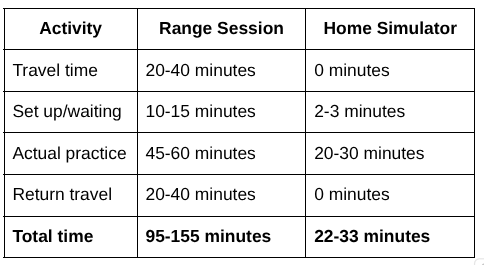
The convenience factor alone makes it easier to hit that optimal practice frequency. But simulators offer another advantage equally important: instant, detailed feedback on every shot. Modern launch monitors track metrics like club path, face angle, ball speed, and spin rates, allowing you to identify patterns invisible on a regular driving range.
The Busy Golfer's Time Problem
Finding time for golf can be a challenge for many players. According to the National Golf Foundation, time ranks as one of the top barriers keeping interested players from the game. It’s not just about playing rounds; even getting to a practice facility creates friction. Think about what a typical range session actually requires: driving to the facility, waiting for a bay, buying a bucket, warming up, practicing, and driving home.
That "quick" practice session easily becomes 90 minutes door-to-door. For someone juggling a career and family responsibilities, particularly new dads trying to hold onto pre-kid hobbies, that's a tough commitment to make regularly. Golfers often struggle to fit practice into their busy schedules.
This is where the math starts working against traditional practice. If optimal skill development requires practice every two to three days, but each session demands a 90-minute time block, most busy golfers simply can't hit that frequency.
Why Spaced Practice Beats Marathon Sessions
Your brain learns motor skills differently than you might expect. When you practice a movement, your neural pathways need time to consolidate that information.
This process, called memory consolidation, occurs during rest periods between practice sessions, not during practice itself. Research on skill acquisition has consistently shown that spaced practice, which spreads training across multiple shorter sessions, leads to better long-term retention than massed practice.
One study found that skills developed most effectively when practice occurred every 48 to 72 hours, giving muscles and neural pathways time to strengthen between sessions, which is the same principle behind proper workout recovery. Spreading practice out in this way supports steady improvement.
What the research tells us about practice spacing:
Massed practice (cramming) leads to faster initial performance but poorer long-term retention
Spaced practice produces up to twice the retention compared to massed practice in motor skill studies
Rest periods between sessions allow neural pathways to consolidate new movement patterns
Optimal spacing for motor skills falls between 48-72 hours between sessions
What does this mean for your golf game? That grueling two-hour range session you squeeze in once every two weeks is actually less effective than three focused 20-minute sessions spread throughout the week.
Building Your Minimum Effective Dose Routine
So what does an effective minimal practice schedule actually look like? Here's a framework that fits most busy schedules.
Aim for three sessions per week, 20-30 minutes each. This hits the sweet spot for motor learning without demanding unrealistic time commitments. Space sessions at least one day apart to allow for consolidation.
Sample weekly practice structure:
Session 1 (Monday): Full swing focus - driver and irons, track club path, and face angle
Session 2 (Wednesday): Wedge work - distance control from 50-100 yards, monitor carry distances
Session 3 (Friday or Saturday): Mixed bag - simulate on-course scenarios, play virtual holes
Rotate your focus areas rather than trying to work on everything every session. Use the data strategically by picking one or two metrics to monitor each session instead of drowning in numbers.
The beauty of this approach is scalability. Have an extra 10 minutes? Add a quick putting session. Traveling for work? Even a week off won't erase your progress because your previous spaced sessions built durable muscle memory.
Does Simulator Practice Transfer to the Course?
The research suggests yes - with some caveats. Simulators excel at building consistent swing mechanics and developing feel for different clubs. The controlled environment actually helps during the learning phase because you're not fighting wind, uneven lies, or mental pressure while grooving changes.
That said, nothing fully replaces on-course experience for learning course management, handling pressure, and adapting to real-world conditions. The ideal approach treats simulator practice as your primary skill-building tool, supplemented by occasional rounds when schedule permits.
Think of it like this: professional athletes spend far more time in practice facilities than in competition. Your simulator time is that high-quality practice environment, and your rounds become opportunities to test what you've built.
Frequently Asked Questions
How many hours per week do I really need to practice golf?
Research suggests 60-90 minutes per week, spread across two to three sessions, is enough to maintain and gradually improve your skills. The key is consistency rather than total volume. Sporadic long sessions are less effective than regular shorter ones due to how motor memory consolidates between practice periods.
Can I actually improve using only a golf simulator?
Yes. Simulators provide consistent conditions and detailed feedback that accelerate the learning process. Many golfers find that swing mechanics improve faster indoors because they can focus purely on technique without environmental distractions. Real course time remains valuable for course management, but simulators handle skill development effectively.
Is 20 minutes of practice really enough?
For focused, intentional practice - absolutely. Quality beats quantity in skill acquisition. A distracted hour at the range produces worse results than 20 minutes of deliberate practice with clear goals and feedback. The minimum effective dose works precisely because it encourages focus over volume.
How long before I see improvement with minimal practice?
Most golfers notice measurable improvements within four to six weeks of regular, spaced practice. Initial gains often appear in ball striking consistency before showing up in scores. Tracking your simulator data helps you see progress that might not be obvious during a round.
Key Takeaways
The minimum effective dose for golf is roughly 60-90 minutes weekly, split across two to three sessions spaced 48-72 hours apart
Spaced practice produces better long-term skill retention than marathon sessions due to how motor memory consolidates during rest
Home simulators eliminate travel time and weather barriers, making optimal practice frequency realistic for busy schedules
Data feedback from launch monitors allows targeted improvement rather than guesswork
Consistency matters more than volume, and regular short sessions outperform occasional long ones..
Related:
