
What the Science Says About Stem Cell Therapy for Recovery
There was a time when the idea of your body repairing itself sounded closer to science fiction than a doctor's office. That time has passed.
The list of documented stem cell therapy benefits has grown fast enough that researchers, athletes, and everyday patients are all paying attention for different reasons, and the science behind why it works is far more interesting than the marketing around it.
The Beginnings
Stem cell research did not start in a sports medicine clinic.
It started in the 1950s, when scientists performing bone marrow transplants noticed something unusual: a small population of cells in the marrow seemed capable of regenerating the entire blood system after transplantation.
That observation planted the idea that some cells in the body are not fixed in their role. They can become other things.
It took decades for that idea to move from oncology into orthopedics.
The real turning point came with the identification of mesenchymal stem cells (MSCs), found in bone marrow and fat tissue, which researchers discovered could differentiate into cartilage, bone, and muscle cells.
That single discovery is really the foundation of everything regenerative medicine does today, from joint injections to recovery protocols used by professional athletes. What began as a transplant technique became a full field of study into how the body repairs itself at a cellular level.
How Stem Cells Actually Support Recovery
Stem cells work through two core abilities: self-renewal and differentiation.
Self-renewal means a stem cell can copy itself, keeping a steady supply of repair material on hand.
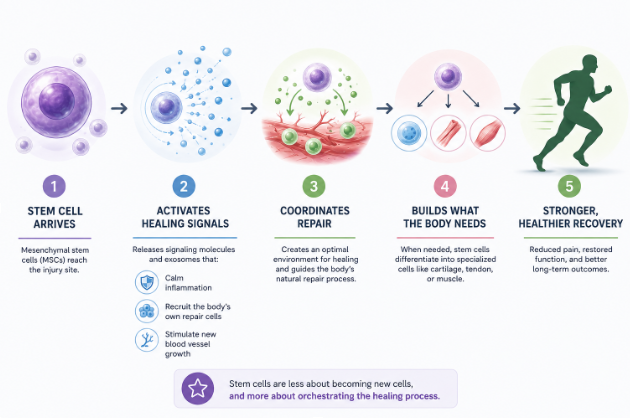
Differentiation means it can transform into whatever specialized cell a damaged area needs, whether that is cartilage, tendon, or muscle tissue.
But the more interesting part of the science, and the part more recent research has focused on, is what stem cells do before they ever become a new cell type.
They release signaling molecules and exosomes that calm inflammation, recruit the body's own repair cells to the injury site, and stimulate new blood vessel growth. This is why researchers increasingly describe MSCs less as raw building material and more as coordinators of the healing process itself.
What the Research Really Shows
The evidence base has grown substantially over the last several years.
Asafety review published in Stem Cell Research & Therapy analyzed 62 clinical trials involving over 3,500 patients and found MSC treatment was generally safe, with no serious adverse events reported across the pooled data. That kind of scale matters, because early stem cell research often relied on small case studies that were hard to generalize from.
Orthopedic applications have some of the strongest data. Aprospective two-year case series published in Regenerative Medicine followed 329 patients with knee osteoarthritis and found most were able to avoid knee replacement surgery for at least two years, with roughly 70 to 80% reporting improvement in pain and joint function.
Research into autoimmune conditions like multiple sclerosis has also shown encouraging trends, including studies where patients with progressive MS stabilized or improved over a four-year follow-up period.
Conditions Where Stem Cell Therapy Shows the Most Promise
Not every condition responds the same way.
The clearest, most repeatable results tend to show up in early to moderate osteoarthritis, where the cartilage has taken a beating but hasn't disappeared entirely.
Tendon and ligament injuries that shrug off physical therapy also respond well, and so does post-surgical recovery, where stem cells seem to give tissue healing a head start. There's a similar pattern with chronic inflammatory conditions, where MSCs step in to calm down an immune system that's working against the body instead of for it.
Where things get harder is when there isn't much healthy tissue left to build on.
Bone-on-bone arthritis or a fully torn tendon just doesn't leave stem cells much to work with, so expectations should shift accordingly.
Tips for Those Considering Stem Cell Therapy
A little homework upfront can be the difference between a decision you feel good about and one that costs you time and money for nothing.
Ask what the research says about your specific condition, not just stem cell therapy in general. Success rates shift a lot depending on what you're treating, so a provider who can't point to condition-specific data is asking you to take their word for it.
Pay attention to how a clinic talks about limitations. The good ones will tell you plainly if you're not a strong candidate, while the ones chasing a sale tend to promise everyone a win.
Ask where the cells actually come from. Autologous cells are pulled from your own body, while allogeneic cells come from a donor, and each comes with its own safety and regulatory considerations worth understanding before you commit.
Make sure rehabilitation is built into the plan from day one. Outcomes are stronger when treatment is paired with physical therapy rather than treated as a standalone fix.
Don't skip the practical questions. How are side effects handled? How is progress tracked? Are more sessions typically part of the picture?
Do your part outside the clinic. Sleep, protein intake, and actually showing up for rehab all shape how well the treatment performs.
Look past the glowing testimonials. Real outcome data, including the cases that didn't go as planned, is usually where the honesty lives.
Though one of this guarantees a specific result, it puts the odds in your favor. The patients who do their homework tend to be the ones who walk away satisfied.
