
The Game Starts at Eight Because of the Heat: A Phoenix Look at Drinking on Autopilot
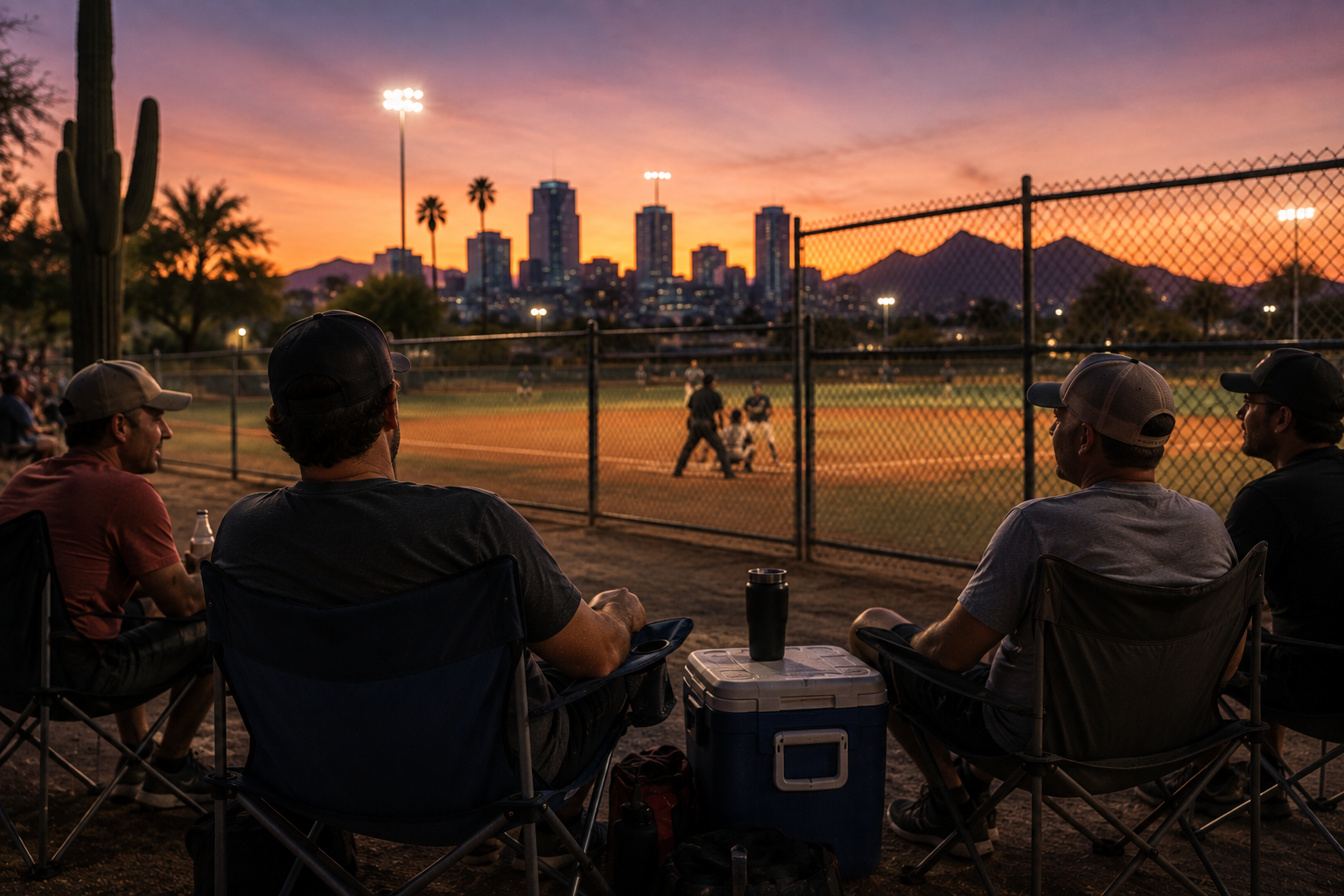
First pitch was 8:15 on a Tuesday in September, which is normal here and insane everywhere else. Ten-year-olds under the lights because that's the first hour the field isn't dangerous. Four of us behind the backstop, folding chairs, one cooler between us, nobody's kid in bed before ten.
It didn't bother me at the time. Still doesn't, really. But I drove home counting how many evenings looked exactly like that, and the total was higher than I'd have guessed out loud. Nobody chose this. It assembled itself out of ordinary Tuesdays, and Phoenix helps, because the heat shoves everything social into the back half of the day, and that's where the drinks are.
What the Heat Does to Your Week
The friendship scaffolding falls away somewhere in your late thirties. No dorm, no team, no shared shift where the same handful showed up whether anyone organized it or not. What fills the gap is whatever needs no planning and no explaining.
Then the climate piles on. For five months, there are two windows where outside is reasonable, before seven in the morning and after the sun's gone. Almost nothing social happens in the first. It all lands in the second, and by then a cooler feels like the natural accessory. The mornings sit there empty, best weather in the country, unused.
The Three Places It Actually Comes From
Once I actually looked, it was three things repeating. Kid stuff first, meaning night games and the pool party where somebody's dad mans the grill. Then work: a misted patio in Old Town with clients. Then the lazy one, the driveway or the in-laws or the neighbor out there every Friday once October arrives.
None looked like much alone. Two here, three there. The repetition gets you, and it hides because it's spread across three parts of your life that never compare notes.
Why "I'll Just Have Less" Falls Apart
You're deciding in a setting built to wear the decision down. The cue's there, the cooler's at your feet, someone's already handed you one, and turning down the next costs a small awkwardness you pay every half hour again.
Willpower loses that most of the time, and I don't think it says much about anyone's character. It's environmental. Which is oddly good news, since environments are easier to redesign than personalities.
First, Is It Actually the Calendar?
All of that assumes the schedule is driving it. For some people it won't be, and that's worth settling before you spend three months rearranging evenings for nothing.
How Often vs. What For
How often is the obvious question. It's also the less useful one.
Better question is what the drink is doing for you. A beer marking the end of something, work finishing, kids finally down, isn't the same as a beer handling a feeling you'd otherwise sit in. The second isn't automatically a disorder. It's the one that grows, because feelings come around more reliably than ballgames.
The Stuff That Deserves a Real Conversation
Some patterns are worth being straight with yourself about. Needing more to get where you used to get. Drinking before things rather than after. Shaving the number down when somebody asks. And trying to cut back and finding you didn't, the heavy one, because that's the gap between a habit you've got and one that's got you. If stopping brings shaking or sweating or real agitation, that's a doctor's problem, not a scheduling one. None of this is a diagnosis, only a clinician makes one.
What Getting Help Actually Looks Like
Less dramatic than most of us picture. Care runs across a range of intensities, and outpatient programs exist for people who can't vanish for a month, built around evenings and workweeks so the job and the school drop-offs keep going. Directories covering markets like drug and alcohol treatment in Phoenix let you sort by level of care and insurance before talking to anybody. A first call is an assessment. You aren't committing to anything.
Rebuilding the Thing
If none of that applied, the calendar really is the issue, and you want the smallest change that kills the default rather than a new life. Same principle this site applies to training volume. Do one thing.
One rule I'd insist on: put something in before you take anything out. Strip the drinking without replacing the company and you've built a quieter, lonelier week, the fastest route back to where you started.
Add Something Before You Take Anything Away
You want one recurring commitment that structurally can't involve alcohol. Recurring matters more than what it is. One-time plans need fresh motivation every time, and motivation is what you've got least of.
City Parks and Recreation runs adult sports and classes through rec centers across Phoenix, including softball out of Papago and Desert West. Fixed night, a roster that notices when you're missing, nowhere to buy a drink. Or use the window nobody's using: a standing 5:30 walk up something with a weighted pack, which doubles as actual training and is genuinely pleasant at that hour. It only has to exist and repeat.
Change the Container
Most of the time you don't turn anything down. You just suggest first. Propose a time, coffee at seven instead of drinks at eight. Or a format, a trailhead, a pool, something the kids come to. Either rules out alcohol without you announcing anything about your drinking.
Have a Boring Answer Ready
Somebody always asks. The answers that work are dull and short and end the conversation instead of starting one. Driving. Early hike. Taking a break this month. You're not trying to win the exchange, you're trying to be out of it in four seconds. The awkwardness is nearly all in the first few times, then it goes.
The House Part
Where to Look Locally
Maricopa County maintains a mental health and substance use page with county data, local resources, and a crisis line that operates regardless of whether something counts as an emergency. Worth bookmarking even if it isn't for you. Half the value is knowing where to look when a friend finally says something on a driveway in October.
What to Tell Your Kids
Something short and true, pitched at whatever age they are. They notice the change either way, and one sentence of explanation lands better than a house quietly running differently for no stated reason.
Anyway. Back to the folding chairs behind the backstop. Nobody there was doing anything wrong, and I have zero interest in becoming the guy who doesn't drink. I'd just rather my week didn't run on it by default, which turns out to be smaller than it sounds. Put one repeating, alcohol-free thing on the calendar this week. Ideally in the morning, while the weather's on your side.
