
4 Effective Recovery Habits for Busy Dads
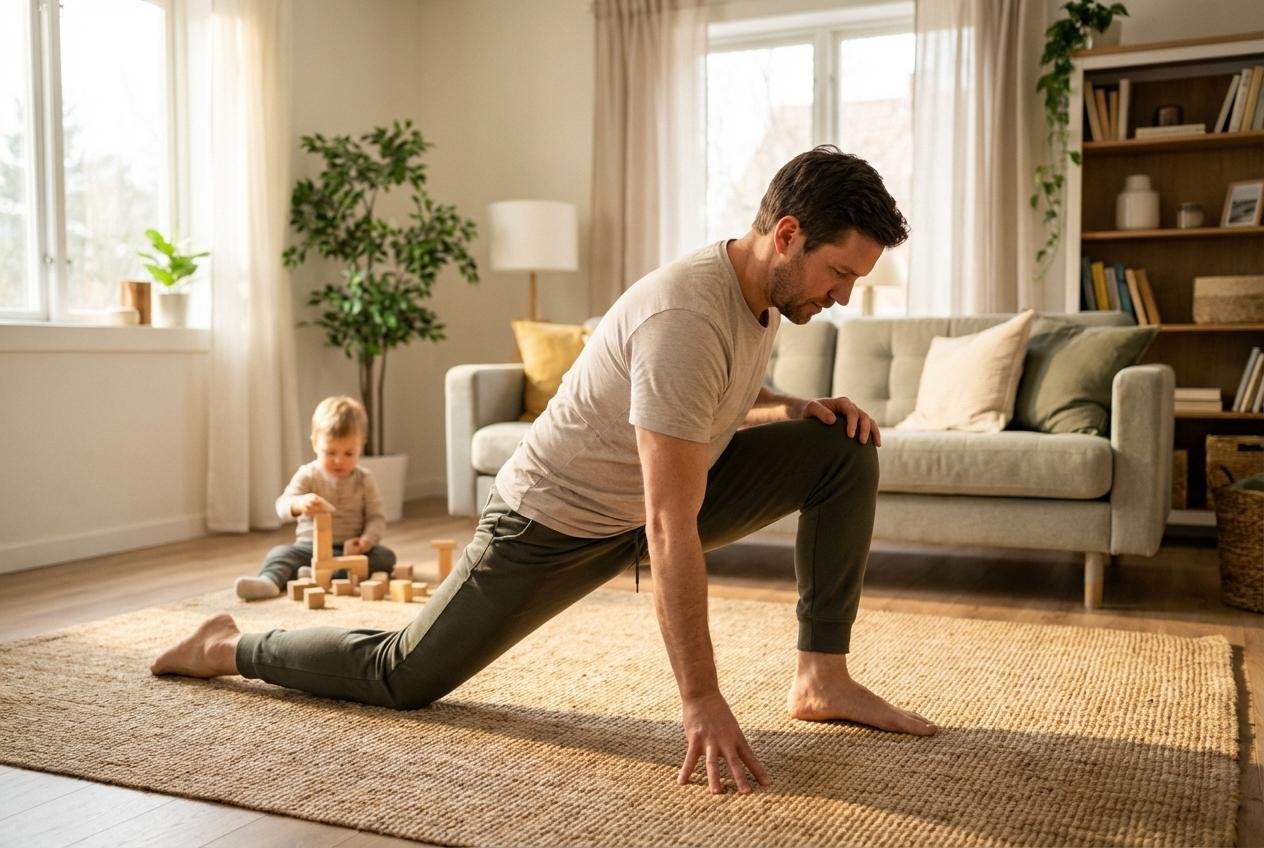
The top four simple habits to end dad fatigue are establishing a consistent wind-down routine for sleep predictability, using deliberate heat exposure for tissue repair, prioritizing post-exercise protein and hydration, and scheduling short daily mobility sessions.
These repeatable recovery practices close the gap between high physical output and required rest without demanding extreme schedule overhauls.
There is a specific kind of tired that only dads know. It is 10:15 PM, the kids are finally asleep, and you are lying on the couch with sore shoulders, a mind still running through tomorrow's to-do list, and a 6 AM alarm already set.
You trained three times this week. You ate reasonably well, showed up for every pickup, every bedtime, and every work deadline, and you still feel completely hollowed out.
That kind of fatigue is not a willpower problem. It is a recovery gap. The output side of your life, including parenting, work, and training, is running at full capacity.
The input side, which involves rest, repair, and restoration, is being neglected or treated as optional.
Closing that gap does not require an extreme wellness overhaul or a completely reorganized schedule.
It requires repeatable recovery habits for busy dads. These are small, consistent actions that give your body and mind enough runway to rebuild between the demands of each day.
The four habits below are designed to be frictionless, science-informed, and realistic for a schedule that already has no slack in it.
1. Set a Consistent Wind Down Routine for Better Sleep and Recovery
Picture this scenario at home when the clock hits 10:30 PM. The house is quiet for the first time all day, and your phone is finally yours again.
So you scroll through Instagram, the sports recap, or a few discussion threads, and forty-five minutes disappear.
You put the phone down at 11:15 PM, but your brain is still lit up, and you lie there wide awake.
Better sleep and recovery do not happen automatically when you lie down; they happen when you give your nervous system a consistent signal that it is time to downshift.
Your body's sleep-wake cycle is governed largely by predictability. In fact, major health institutions advise that adults should sleep 7 or more hours to maintain baseline physiological function.
Cortisol, the stress hormone that keeps you alert, is supposed to drop in the evening, making consistent rest critical.
Bright screens, stimulating content, and irregular bedtimes keep that cycle dysregulated. This results in lighter sleep, more nighttime wake-ups, and groggier mornings.
The fix requires intentionality, not complex planning.
Choose a consistent target bedtime and protect it at least five nights per week.
Dim overhead lights 30 to 45 minutes before bed to support natural melatonin production.
Replace phone scrolling with something that genuinely slows you down, like five minutes of slow breathing or a few journal notes.
The goal is predictability since your body responds to cues rather than sheer willpower. A reliable wind-down routine establishes those cues, making it easier to fall asleep faster and stay asleep.
On the days you are most short-tempered with your kids, sleep deprivation is almost always a contributing factor.
2. Use Heat Exposure to Support Relaxation and Muscle Recovery
After a tough leg session or eight hours of sitting at a desk, your muscles are not just tired, they are shortened, inflamed, and screaming for circulation.
Most active dads end training sessions by walking straight into the school pickup line, making dinner, and handling bedtime.
Muscle recovery at home rarely makes the schedule when time is completely booked. Deliberate heat exposure changes that equation by passively aiding the repair process.
Applying heat to fatigued muscle tissue increases circulation, pulling oxygen and nutrients into the areas that need repair.
At higher, sustained temperatures, the body produces specialized cellular compounds called heat shock proteins.
These compounds play a vital role in repairing damaged proteins and supporting recovery at the tissue level.
This biological mechanism is why heat therapy has become a foundational tool for muscle recovery at home.
The most accessible starting point is a 15-minute warm shower or bath after training to let your muscles relax.
For a more structured approach, exploring an infrared sauna for home wellness from Sun Home Saunas, booking time at local wellness centers, or using specialized heating pads can fit naturally into an evening routine.
Dedicated infrared technology penetrates tissue deeply, while hot water baths provide soothing surface-level relief. Having a dedicated setup removes the friction of daily preparation.
The most important principle is that the habit of heat exposure matters more than the specific method.
Whatever form gets you applying heat consistently, four or five nights a week, is the right one to pursue. This consistency ensures your nervous system transitions out of workout mode and into rest.
Pro Tip: Consistency beats intensity. Aim for twenty minutes of heat exposure four times per week. Whether using a sauna or a warm bath, the goal is to increase circulation to accelerate tissue repair and lower stress.
3. Prioritize Hydration and Protein After Exercise
You finish a 6 AM workout, grab a black coffee, handle the school run, answer emails at your desk, and realize at noon that you still have not eaten anything.
Your afternoon energy crashes, you feel irritable by 3 PM, and the soreness you expected to fade is still very much present.
This pattern is extremely common among active dads who prioritize movement over refueling. Fortunately, it is entirely avoidable with a small amount of nutritional planning.
The two hours following exercise are when your body is most primed for muscle repair. Muscle tissue has been broken down during training, and the rebuilding process depends on amino acids arriving promptly.
Research shows that an absolute 20 g dose of high-quality protein maximizes muscle synthesis rates after physical exertion. Water is equally critical to support cellular function and metabolic clearance.
Making post-workout nutrition frictionless requires preparation rather than daily decision-making.
Keep a pre-filled water bottle in your gym bag and drink it on the way home or during your commute.
Pack a simple protein source the night before, such as Greek yogurt, a hard-boiled egg, or a protein shake.
Aim for roughly 20 to 40 grams of protein in that first two-hour window to keep recovery on track.
Hydration is equally critical on rest days when you might forget to drink water. Studies demonstrate that even mild dehydration without hyperthermia induces adverse changes in vigilance, memory, and anxiety levels.
Taking in adequate fluids ensures you remain sharp at work and present at home by 6 PM.
4. Schedule Short Mobility Sessions to Reduce Stiffness
You sat at your desk for eight hours, then bent sideways to buckle a car seat and lifted a toddler mid-twist. By 9 PM, your lower back is signaling acute tension that you simply try to ignore.
Eventually, you stop noticing it, not because it resolved, but because stiffness becomes the baseline. The physical demands of parenting involve repeated awkward-angle loading that constantly tests your joints.
This daily strain is layered on top of a desk-work posture that already shortens hip flexors, compresses the thoracic spine, and tightens the shoulders.
Without targeted restoration, stiffness compounds weekly and leaves you prone to injury. The solution is not a lengthy yoga class that you will never have time to finish.
Five to ten minutes of focused movement, executed consistently, reduces stiffness accumulation and protects your physical health.
Focus on three primary areas when building your routine to get the highest return on your time.
Hip flexors: Shortened by prolonged sitting and strained during heavy parenting movements.
Thoracic spine: Stiff from desk posture; targeted rotation work reduces shoulder and neck tension.
Shoulders: Loaded by keyboard use and child-carrying; simple arm circles maintain essential joint mobility.
The key is stacking these sessions onto existing daily habits so they actually get done. Move through three to four exercises while your kids brush their teeth, during a commercial break, or right after waking up.
Five minutes done consistently easily outperforms a 45-minute flexibility session done twice a month. Moving freely while handling the physical quirks of parenting serves as a direct form of stress recovery.
Key Insight: Five minutes of daily mobility work is more effective for long-term joint health than a monthly hour-long session. Focus on your hips and thoracic spine to counteract the physical toll of desk work and parenting.
The Bottom Line
Recovery does not demand perfection; it requires repetition. The men who feel the most energized, patient, and physically resilient are not doing more; they are recovering more efficiently.
Sleep, heat therapy, functional nutrition, and daily mobility are not particularly glamorous or complicated.
However, compounded over weeks, they close the gap between how depleted you feel and how capable you actually are.
Try a simple two-week challenge to get started on your own recovery journey. Pick one or two habits from this list that address your biggest struggles and test them for 14 days.
Notice how your soreness responds, whether you wake up feeling more restored, and if you have more patience at 7 PM.
Better energy as a dad comes from building systems that give your body a real chance to catch up.
Author Profile: Sun Home Saunas is America's fastest-growing consumer services company specializing in premium home wellness equipment, specifically award-winning residential saunas and cold plunge therapy systems.
