
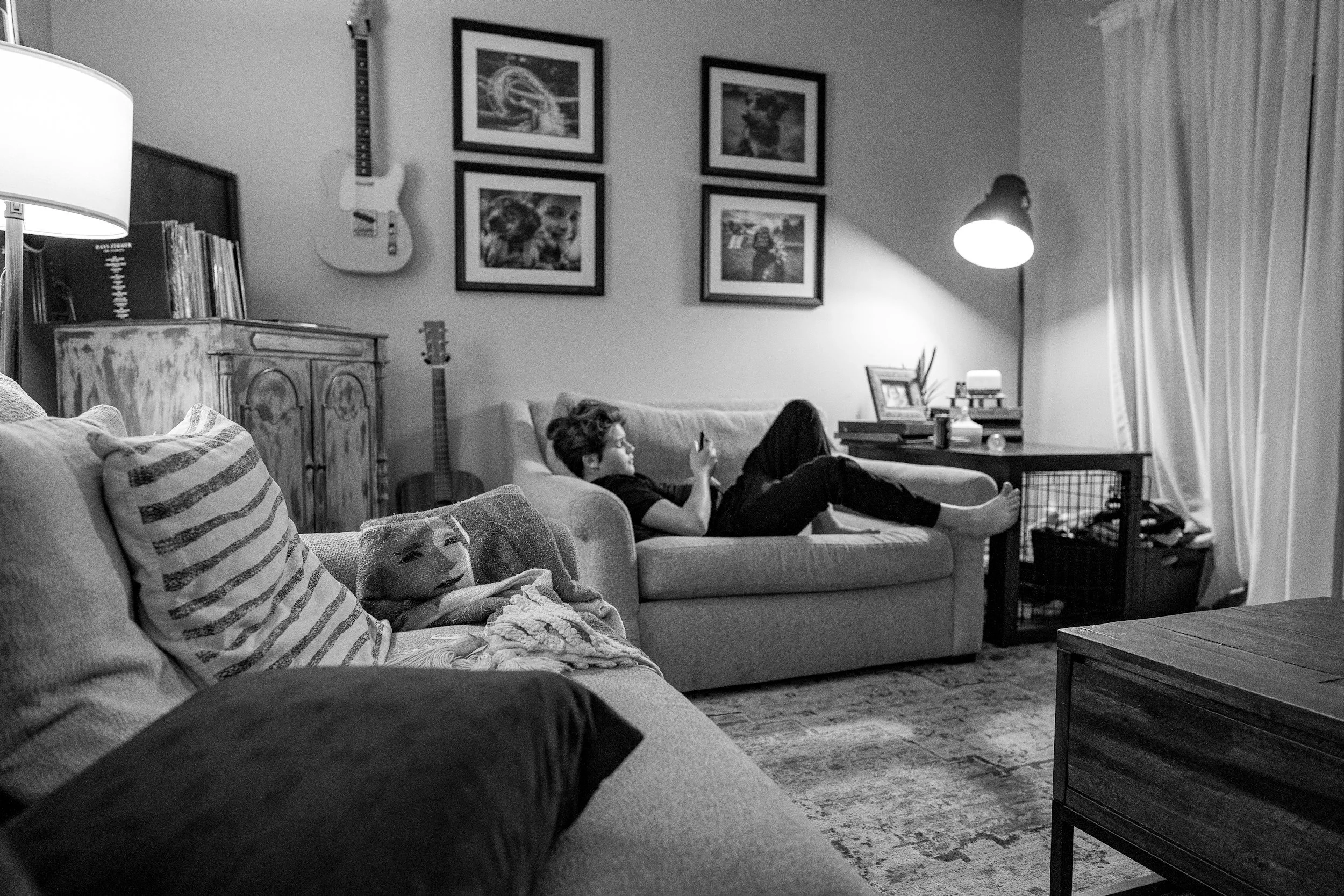
If your evenings look like most dads' evenings, the hour after the house finally goes quiet feels like the only time that belongs to you. Dinner is done, bath time is done, someone has asked for a third glass of water, the dishes are in the rack and a few work emails have been answered. So you sit down with your phone, look up forty minutes later, and wonder the next morning why you feel like you never slept.
The CDC recommends at least seven hours of sleep a night for adults between 18 and 60. Getting there rarely takes a new gadget or a supplement. It takes a wind-down routine: a short, repeatable sequence that tells your brain the day is over. Here are seven habits with research behind them, plus a simple way to set up a wind-down corner that you and your partner will actually use.
1. Pick a bedtime and protect it
Consistency is one of the most basic recommendations in sleep science. The CDC's advice is to go to bed and get up at the same time every day. For parents, that means working backward from the alarm, or from the toddler who acts as one. If you need to be up at 6:00, a lights-out time around 10:30 gives you seven hours plus the few minutes it takes to fall asleep. Put it in your calendar like a meeting, and treat "just one more episode" as what it is: a scheduling conflict.
2. Set a caffeine cutoff
Afternoon coffee feels harmless because you don't feel wired at bedtime. A 2013 study in the Journal of Clinical Sleep Medicine suggests that is exactly the problem. When healthy adults took a large dose of caffeine, roughly what you would get from four cups of brewed coffee, six hours before bed, their measured sleep dropped by more than an hour, and many of them didn't notice. The study was small, but the authors' conclusion matches standard sleep advice: avoid substantial caffeine for at least six hours before bedtime. With a 10:30 bedtime, your last cup should be no later than about 4:30 p.m., and earlier if you are sensitive to it.
3. Give screens a last call
Light is one of the strongest signals your body clock uses. Harvard Health notes that exposure to light suppresses melatonin, the hormone that helps regulate your sleep-wake cycle, and recommends avoiding bright screens beginning two to three hours before bed. If that sounds unrealistic with kids and a job, start with the CDC's more modest target and turn devices off at least 30 minutes before bedtime. Charging your phone outside the bedroom makes the rule far easier to keep, because the phone is no longer the last thing you see and the first thing you reach for.
4. Dim the house after the kids go down
The same logic applies to the rest of your lighting. Bright overhead lights at 9 p.m. tell your brain it's still the middle of the day. Once the kids are in bed, switch off the ceiling lights and run the house on a couple of low, warm lamps. Harvard Health also suggests using dim red lights for night lights, because red light is less likely to shift your circadian rhythm. You don't need to live in the dark. You just want the evening to look like evening.
5. Write tomorrow's to-do list
Plenty of dads don't lie awake because they're wired. They lie awake running through tomorrow. A Baylor University study published in 2018 put this to a simple test. Fifty-seven healthy young adults spent five minutes before bed writing either a to-do list for the coming days or a list of tasks they had already finished. The to-do group fell asleep about nine minutes faster, and the more specific their lists, the faster they dropped off. The participants were young adults without insomnia, so this isn't a cure, but it costs nothing: a notepad on the nightstand and five minutes of your time.
6. Keep the bedroom cool
Your body temperature naturally drops as you drift off, and a warm room works against that. The Sleep Foundation puts the best bedroom temperature for sleep at approximately 65 degrees Fahrenheit (18.3 degrees Celsius). If your partner runs colder than you do, a heavier blanket on their side of the bed is a lot cheaper than a nightly thermostat negotiation.
7. Build a wind-down corner for two
The last habit is less about rules and more about having a place to land. Pick a corner of the living room or bedroom and keep it for winding down only: a comfortable chair or two, a throw blanket, a few books or a puzzle, and soft, warm light. When you sit there, the day is done. If you share the house with a partner who never seems to sit down, setting up this corner for them might be the most useful gift you give this year.
A familiar scent helps the corner feel like a ritual, which is why so many of us reach for a candle at night. This is where a little caution pays off. According to the National Fire Protection Association, more than a third of home candle fires start in the bedroom, and fire officials advise against using candles in bedrooms and other places where people may fall asleep. A wind-down corner is, by design, a place where people fall asleep.
A flame-free option solves that. A candle warmer lamp melts a jar candle from the top with a dimmable warm bulb, so you still get the glow and the fragrance without an open flame, and many look like an ordinary table lamp rather than a gadget. If you want one for the corner, a warmer lamp from GODONLIF with a built-in timer will switch itself off if you doze off in the chair, which is exactly the kind of decision nobody should have to make at 11 p.m.
Start with one habit
You don't need to adopt all seven at once. Pick the one that fixes your biggest leak, whether that's the 4 p.m. coffee, the phone in bed or the brain that won't stop planning, and stick with it for two weeks before adding the next. Better sleep is one of the few self-improvement projects that pays you back every single night, in more patience with the kids, more energy for your workouts and a little more of yourself left over for the person on the other side of the couch.
