
Moving the Family to New Jersey: A Dad's Survival Guide In 2026
Moving a family is one of those adventures that sounds exciting in theory and hits differently when you're carrying a dresser up three flights of stairs. New Jersey is one of the most family-relocation-heavy states on the East Coast, yet most dads walk into it without a real plan.
This guide covers what actually matters when you're moving your family to the Garden State:
How to choose the right town based on schools, commute, and budget
What the real cost of living looks like once property taxes enter the picture
How to prep the kids, lock in your mover, and stay ahead of the chaos
The good news? With the right preparation, this move is far more manageable than it looks.
TL;DR
NJ's cost of living runs about 15% above the national average, but the trade-off is access to top-tier public schools and strong transit links to NYC.
Montclair, Ridgewood, Summit, Westfield, and Edison are among the most sought-after family-friendly towns to explore
New Jersey holds the highest effective property tax rate in the nation (around 2.23%), so factor this into your housing budget from day one
Start school enrollment and mover bookings at least 6 to 8 weeks out from your target move date.
Setting up your kids' rooms first on arrival makes a bigger emotional difference than most dads expect
Why New Jersey Actually Makes Sense for Families
Let's get this out of the way: NJ gets an unfair reputation from people who've never actually lived here. The reality for families is a very different story.
New Jersey sits right next to two of the largest metros in the country, yet most of its suburban towns feel genuinely livable. You get yard space, strong schools, and transit access that most East Coast cities can't match.
The state consistently ranks among the top in the nation for public education. If schooling is a priority for your family, NJ delivers in ways that are hard to replicate without paying private school tuition elsewhere.
Choosing the Right Town: The Decision That Changes Everything
No single decision matters more in a New Jersey relocation than picking the right town. Get this right and everything else slots into place.
The mistake most families make is narrowing the shortlist too quickly based on one factor, usually home price or a single friend's recommendation. The smarter approach is to evaluate every town across three pillars at once: school quality, commute time, and true monthly cost.
Best Family-Friendly Areas in NJ
Here is a quick breakdown to guide your early shortlist:
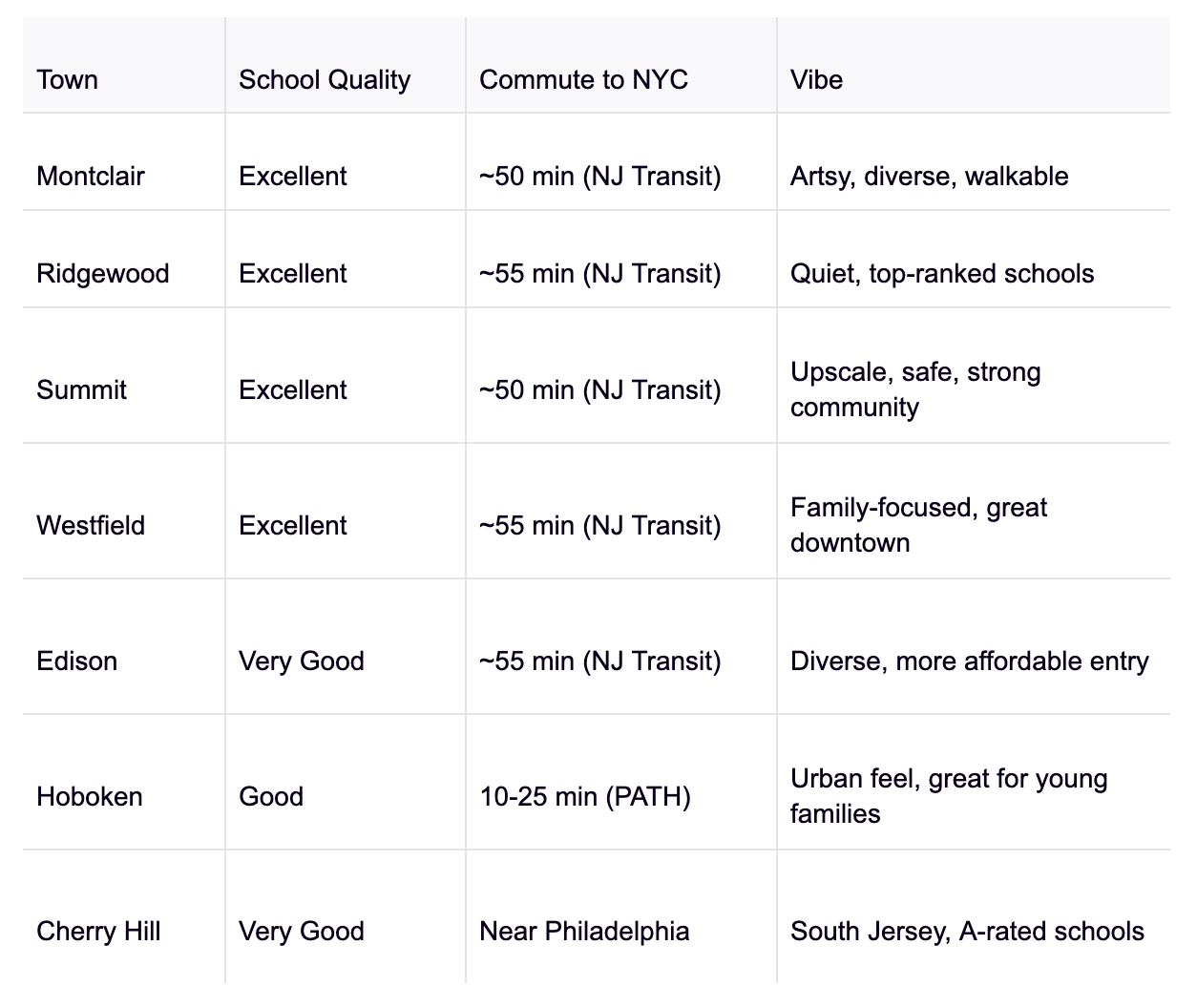
Pro tip: Don't just read the reviews. Visit on a Tuesday morning. The vibe of a town on a Saturday afternoon tells you nothing about what your kid's 8 am commute to school will actually feel like.
NJ's Real Cost of Living: The Numbers That Matter
New Jersey's cost of living runs about 15% above the national average, and median home prices sit between roughly $502,000 and $570,000 depending on the area. That's the number most people research. But it's not the number that surprises them most.
New Jersey carries the highest effective property tax rate in the nation at around 2.23%. On a $500,000 home, that amounts to roughly $11,150 per year in taxes alone. Budget for this from day one because it's not a hidden cost; it's just one that gets forgotten when comparing monthly housing figures.
The counterbalance is real, though. Those property taxes directly fund the school systems that make NJ so attractive for families. Think of it as paying private school tuition without writing a separate check.
A practical framework to keep your family budget honest:
Housing (mortgage + taxes + insurance): Target under 30% of gross monthly income
Commuting costs (transit, tolls, gas): Add $200 to $500 per month depending on your route
Childcare and school: Public schools are excellent in most NJ towns, but confirm enrollment availability before signing a lease
Moving and relocation buffer: Keep 3 to 5% of your total move budget flexible for unexpected expenses
School Enrollment: Don't Leave This Too Late
This is the section most dads skip and later regret. New Jersey's best school districts fill faster than you'd expect, and enrollment is not automatic just because you live in a district.
The rule: Contact the school enrollment office before you finalize your address, not after.
Here's what the process typically looks like, step by step:
Identify your district based on the specific address you're considering, not just the town name
Gather required documents early: proof of residency, birth certificate, immunization records, and prior school records
Submit enrollment forms as soon as you have a confirmed address
Confirm your assigned school and ask about intra-district choice programs if the assigned school doesn't fit your needs
Towns like Ridgewood and Montclair see consistently high demand. Late submissions can push your child's start date back by weeks and create a stressful first month. The New Jersey Department of Education provides district-level enrollment resources and school performance reports that are worth reviewing before you commit to an address.
Commuting From NJ: What to Expect on a Real Tuesday
If you're commuting to New York City, New Jersey's transit infrastructure is one of its most underrated selling points for families. You don't need a car to make it work, though most suburban families still own one.
NJ Transit connects towns across Bergen, Essex, Morris, Union, and Somerset counties to Penn Station or Hoboken Terminal in roughly 45 to 60 minutes. Montclair, Maplewood, Summit, and Westfield all sit on active commuter rail lines.
PATH trains serve Hoboken, Jersey City, and Newark and get you into Manhattan in 10 to 25 minutes. That's genuinely faster than many Brooklyn or Queens subway commutes.
A few things to do before moving day:
Test your actual commute on a real weekday, not a Saturday or a holiday week. Traffic and schedule gaps show up on Tuesdays in October, not summer weekends.
Factor in the school drop-off timing. If you're dropping kids off at 8 am and catching an 8:20 am train, that margin evaporates fast.
Check whether your employer offers pre-tax commuter benefits, which in 2026 allow up to $315 per month in pre-tax transit spending. Details on federal commuter benefit limits are available through the IRS transportation fringe benefits guidelines.
Preparing Your Kids for the Move
The logistics of a family move are hard. The emotional side is harder, and dads often underestimate how much the framing matters.
Start the conversation 6 to 8 weeks early. Give kids enough runway to process what's happening. Avoid overselling the new place, but connect them to something specific they'll genuinely enjoy, whether that's a backyard, a sports program, or a room they get to design themselves.
Involve them in small but meaningful choices:
Let them decide how their new room is arranged
Have them pack their own "day one box" with comfort items, favorite toys, or books
Show them photos or a short walkthrough video of the new home before move day
On moving day, two approaches work well depending on the age of your kids:
Arrange childcare for younger kids, so they're not underfoot during loading and unloading
Set up a dedicated kid zone in one room with snacks, tablets, and activities so older kids stay calm and safe
Once you arrive at the new house, set up your kids' rooms first, before anything else. It creates a sense of "this is home" before the rest of the house is settled, and that single act takes a lot of the edge off the first few nights.
Picking a Mover That Can Actually Handle a Family Move
A family move is not the same as relocating a studio apartment. You're dealing with more volume, more fragile items, kids' furniture that needs disassembly and reassembly, and zero room for error on timing.
When evaluating moving companies for a family relocation to or within New Jersey, look for:
Written estimates, not verbal ballpark numbers over the phone
Verified licensing: NJ movers should hold a New Jersey Public Movers License and a valid USDOT number
A dedicated move coordinator assigned to your job, not just a dispatcher
Furniture disassembly and reassembly as part of the service
Storage options for gap periods when your move-in date doesn't align with your move-out date
Harrington Movers is a full-service moving company serving New Jersey and New York, holding a NJ Public Movers License (NJ PC00755) and USDOT Number 736893. Operating since 1996 and recognized as a nine-time Circle of Excellence Award recipient from the New Jersey Warehouseman and Movers Association, they offer residential moving, professional packing, furniture disassembly and reassembly, and storage services that fit what a family relocation actually needs. Storage options include both short-term and climate-controlled solutions for families navigating gap periods between home closings.
One customer who moved to NJ with her family from out of state shared:
"Had a wonderful experience with Harrington! My family and I just moved to NJ from FL. We used a pod moving service, so we needed movers who could unload the containers for us. The guys showed up on time, worked quickly, and also assembled furniture for us (beds, TV wall installs, etc.). The price was also more reasonable than some of the other quotes I received. Would definitely recommend!" – Gabrielle Harrison (source)
Whoever you choose, book early. Spring and summer slots with licensed, reputable movers in the NJ area disappear fast, and last-minute availability usually means last-minute pricing too.
The Dad's Pre-Move Checklist for a NJ Family Relocation
Here is a timeline-based checklist designed specifically for family moves:
8 Weeks Before:
Confirm neighborhood and verify school district enrollment capacity
Collect at least 3 written moving estimates
Book your moving company and lock in the date
6 Weeks Before:
Contact the school enrollment office and start gathering required documents
Notify the current school of your child's withdrawal date
Start packing non-essential rooms (attic, garage, storage areas)
4 Weeks Before:
Update your address with USPS, employer, bank, and key subscriptions
Confirm move date and logistics with your mover
Arrange childcare or a child plan for moving day
2 Weeks Before:
Pack kids' rooms last and involve them in labeling their boxes
Prepare a "first night" bag for the whole family: toiletries, chargers, a change of clothes, and snacks
Confirm any parking permits or building access requirements at your new address
Moving Day:
Set up the kid zone before movers arrive
Do a full walkthrough of your current home before leaving
Unload and set up kids' rooms first at the new place
First Week After:
Register vehicles and update your driver's license at NJMVC
Confirm school start dates and drop-off logistics
Let the kids lead the decorating in their new space
New Jersey Is Worth the Work
The prep is real, but so is the payoff. NJ's school systems, transit access, and community infrastructure make it one of the strongest family relocation destinations on the East Coast.
Here are the moves that carry the most weight:
Pick your town using all three pillars: school quality, commute time, and total monthly cost, including property taxes
Start school enrollment before you move: the best districts are competitive, and documentation takes time
Give the kids a real runway: 6 to 8 weeks of honest, age-appropriate conversations genuinely reduces how hard the transition hits
Book a licensed mover early: a family-scale relocation has real complexity, and the right company handles the details you don't have bandwidth for
The stress is temporary. The moment your kids wake up in their new room and call it home is the payoff that makes every packed box worth it.
FAQs
What are the best towns in New Jersey for families with school-age kids?
Montclair, Ridgewood, Summit, Westfield, and Edison consistently rank among the top family-friendly towns in NJ. Each offers strong public school systems and convenient transit access to New York City. Your final choice should weigh school quality, commute time, and your monthly housing budget together.
How much should a family budget for living in New Jersey?
Median home prices in NJ range from roughly $502,000 to $570,000, and the effective property tax rate averages around 2.23%, the highest in the country. Families should also budget $200 to $500 per month for commuting costs, depending on their route and transit choices.
When should I start my child's school enrollment process in NJ?
Start as soon as you confirm your address, ideally 6 to 8 weeks before your intended start date. Gather proof of residency, immunization records, prior school records, and a birth certificate in advance. Popular districts fill quickly, so early outreach to the enrollment office matters.
How early should I book movers for a family relocation to New Jersey?
Book at least 6 to 8 weeks before your move date. For peak moving season between April and August, booking even earlier gives you better date flexibility and access to more experienced moving companies before their schedules fill up.
What is the quickest commute from New Jersey to Manhattan?
PATH trains from Hoboken or Jersey City reach Manhattan in 10 to 25 minutes, making them the fastest NJ-to-NYC commute option. NJ Transit rail from suburban towns like Summit, Montclair, or Westfield typically runs 45 to 60 minutes into Penn Station or Hoboken Terminal.
