
Twin Cities Family Moves: A Minneapolis Dad's Guide to Settling In Fast
Moving with kids is never just a logistics problem. It's a weeks-long puzzle where school deadlines, kid emotions, and missing LEGO sets compete for the same bandwidth on the same stressful day.
This guide cuts through the noise and focuses on what actually matters for Twin Cities families: picking the right neighborhood, running moving day without chaos, and getting your kids settled before the new city starts to feel like home.
How to choose the right Minneapolis neighborhood based on your family's priorities and budget
What to do on and after moving day to settle your kids in fast
How to handle school enrollment and plug into the Twin Cities community quickly
TL;DR
Pick your neighborhood with schools and outdoor access in mind. Minneapolis has strong options across a wide range of budgets, and the zip code you choose shapes everything else.
Book your movers 3 to 5 weeks in advance, especially for end-of-month dates and summer weeks, which fill up first.
Set up kids' rooms before you unpack anything else. Familiarity on night one matters more than finishing the kitchen.
Minneapolis resident enrollment is open year-round, but open enrollment has a firm January 15 deadline. Missing it costs you a full school year.
Getting kids into one recurring activity within the first two to three weeks does more for community connection than any single day trip.
Choose Your Neighborhood Before Anything Else
This one decision shapes school options, commute length, weekend activities, and whether your kids can actually walk somewhere worth going. Minneapolis has a strong set of family-friendly neighborhoods, and each one has a distinct personality.
Southwest Minneapolis: The Reliable Family Zone
Fulton, Armatage, Kenny, and Lynnhurst form the core of Southwest Minneapolis and remain the first stop for most families relocating to the city. Schools in this cluster feed into Southwest High School, several elementary programs offer dual-language and specialty tracks, and the Chain of Lakes system sits within biking distance of nearly every block.
Housing sits mostly between $450,000 and $750,000, with Linden Hills running higher. If you want walkable streets, strong school communities, and lake access built into weekend life, Southwest delivers consistently.
Linden Hills: Lakeside Without the Drive
Linden Hills borders Lake Harriet and carries a distinctive small-town-in-the-city feel. Kenny Elementary serves the area with strong academics, free summer concerts run at the bandshell through the season, and the beaches are genuinely usable.
Homes here typically range from $600,000 to $1.5 million. It's the neighborhood for families who want outdoor access woven into daily life rather than something to schedule on weekends.
Northeast Minneapolis: Community-Driven and Accessible
Northeast has fully arrived as a family destination. It combines an arts-driven, culturally diverse energy with calm residential blocks, riverside trails, and more accessible home prices than Southwest.
Boom Island Park and Father Hennepin Bluff Park make it a strong fit for outdoor-focused families. Adjacent St. Anthony Village adds another layer with small class sizes, excellent schools through St. Anthony Village High School, and a genuine neighborhood feel inside the metro.
Suburbs Worth a Serious Look
If you want the Twin Cities metro without Minneapolis pricing, Edina and St. Louis Park both earn real consideration. Edina carries one of Minnesota's top-ranked school districts. St. Louis Park sits close enough to Minneapolis for daily convenience while offering quieter residential streets and more accessible housing.
School Enrollment: Know This Before You Move
School timelines drive family relocation timelines. Getting this wrong early costs you options.
Resident enrollment is for families joining the district where they live. It stays open year-round once you establish residency. The documents you'll need:
Proof of residency (a lease, mortgage document, or utility bill)
Your child's birth certificate
Immunization records or documented exemptions
Open enrollment allows families to choose a school outside their home district. The application deadline is January 15 for the following school year. No exceptions. Missing it means waiting another full year for that option.
The practical play here is to research school options before finalizing a neighborhood. The Minnesota Department of Education makes both district boundaries and open enrollment options searchable online. Run that search before you commit to a zip code.
How to Run Moving Day with Kids in the House
Moving day with children means running two jobs simultaneously: execute the logistics and keep everyone regulated. Here's how to handle both without it becoming the worst day of the year.
Assign a dedicated kid wrangler. This is the single most important moving day call you'll make. Whether it's a grandparent, a close friend, or one parent stepping back from the move itself, someone needs full responsibility for keeping kids safe and out of the loading path. A professional crew cannot work safely around a toddler running through doorways.
Pack a "first night" box for every child. This box rides with you in the car, not on the truck. Include a favorite stuffed animal or toy, pajamas, bedding, a nightlight, and whatever they reach for at bedtime. When everything else is new and strange, those specific objects create immediate calm in an unfamiliar space.
Load kids' rooms last so you can unpack them first. Packing their rooms last keeps them accessible at the front of the truck. When you arrive at the new place, set up children's rooms before anything else. Same layout where possible. Same bedding on the bed. Books where they belong. It sends a clear signal: this is still your home.
What to Look for in a Twin Cities Moving Company
For a family relocation, the right moving company affects more than the final bill. Timing precision, careful furniture handling, and a crew that runs on schedule all ripple directly into how the rest of your day goes with kids waiting at the other end.
The Move Crew is a locally owned, full-service moving company operating out of Minneapolis since 2015. They work exclusively with trained, in-house crews and company-owned trucks, with no subcontractors or temporary labor. For families, this matters: the crew that shows up is the same crew that went through background checks and professional training.
Their residential moving services cover local Twin Cities moves, intrastate moves across Minnesota, and long-distance interstate relocations with guaranteed pickup and delivery dates. For families managing a gap between move-out and move-in, they also offer climate-controlled storage at their 10,000-square-foot Minneapolis warehouse, billed on a prorated basis. Labor-only services are available for families using PODS or rental trucks.
"The Move Crew was fabulous - the three-person crew arrived on time, worked quickly and carefully and set up the furniture in the new place. Plus the final bill landed in the middle of the estimated range. Great service." – Lynda McDonnell (Google Review)
For Twin Cities family moves, booking 3 to 5 weeks in advance is the recommended window. End-of-month and summer dates fill fastest.
The First Week: What to Prioritize
The boxes can wait. Mostly. The first week after a family move is less about achieving a perfect setup and more about building the daily rhythms that make a new place start to feel like home.
Restore routines on day one. Bedtime at the same time. Meals at the table. Morning routines that mirror what the kids already know. Predictability cuts through the low-level anxiety kids carry after a move, even when they can't name what they're feeling.
Get outside within the first two days. A walk to the nearest park, a trip to the library, or a stop at Lake Harriet for a snack tells your kids something important: this neighborhood has good things in it. That single reframe does real work early on.
Give kids ownership over small decisions. Let them choose where their art goes on the wall, which shelf the books live on, or how to arrange their desk. According to the Child Mind Institute, children who feel a sense of control during transitions adjust significantly faster. The decisions don't need to be big. They just need to be real.
Getting Plugged Into the Twin Cities Community
Minneapolis has excellent family programming that most newcomers take a full year to discover. You don't need to wait that long.
Minneapolis Parks and Recreation runs youth programs across more than 180 parks citywide, including sports leagues, swim lessons, skating rinks, and summer day camps. Registration windows open seasonally, so get on your district park's mailing list during your first week.
Hennepin County Library branches are spread across the metro and run children's story times, summer reading programs, and after-school activities at no cost. It's one of the fastest on-ramps for families with younger kids and a genuinely underused resource for new arrivals.
Neighborhood associations in Minneapolis are active and worth joining immediately. Most host welcome events, block parties, and seasonal gatherings that connect you with the neighbors who actually matter to your daily life. Getting on the email list costs nothing and pays off quickly.
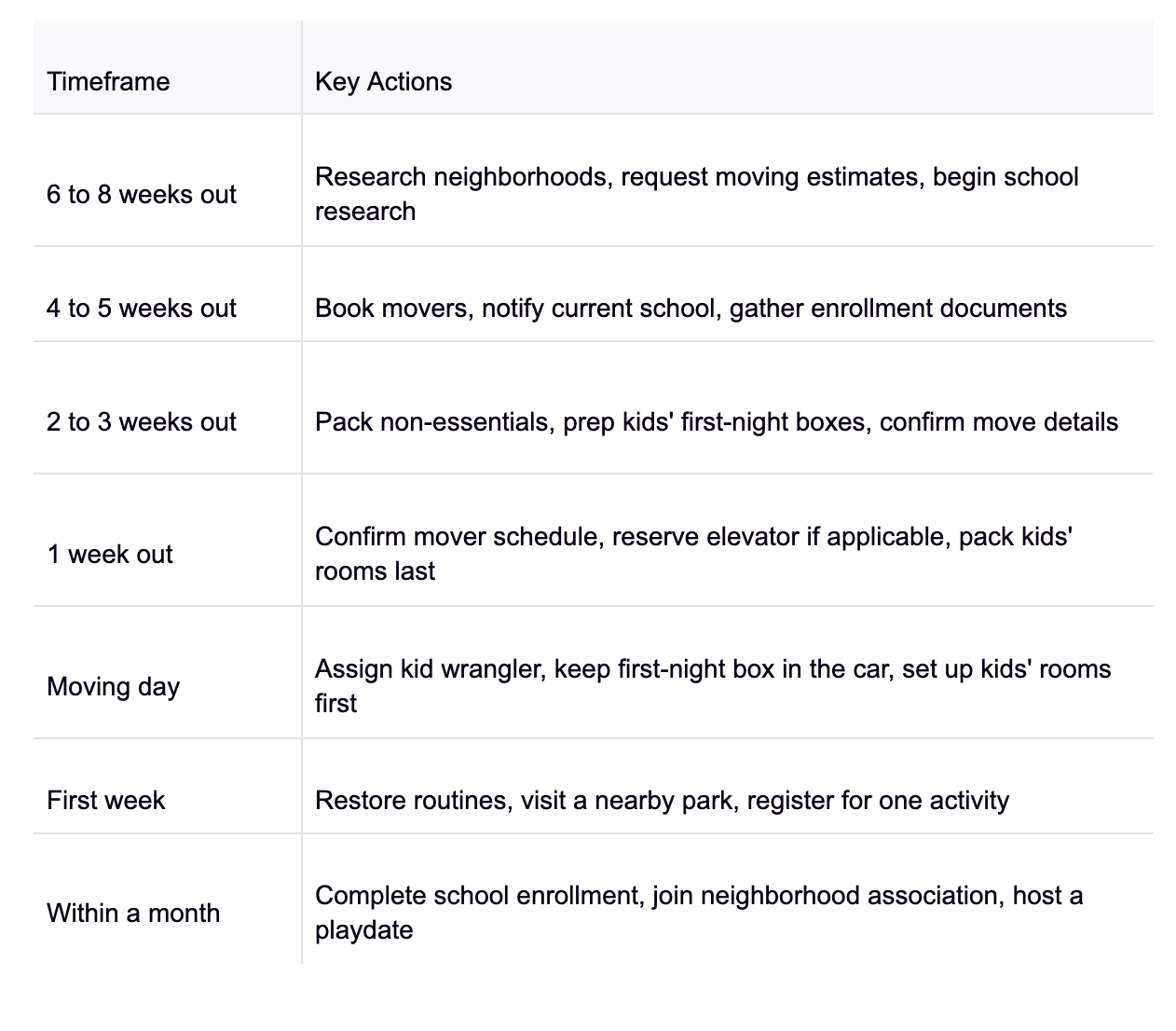
A Practical Moving Timeline for Twin Cities Families
Minneapolis Becomes Home Faster Than You Think
A smooth family relocation comes down to sequencing. Nail the neighborhood research before signing a lease, book movers before the calendar fills up, and prioritize your kids' rooms and routines over everything else in the first week.
Research neighborhoods before locking in a home - school options, park access, and community feel all depend on the zip code you pick.
A dedicated kid wrangler and a pre-packed first-night box make moving day dramatically more manageable for everyone involved.
Minneapolis resident enrollment is open year-round, but open enrollment deadlines are firm. January 15 is the cutoff, and it doesn't move.
One recurring activity in the first two to three weeks does more for your kids' community connection than any single day trip or grand gesture.
The Twin Cities is one of the most livable metros in the country for families. Once the truck pulls away and your kids find their corner of it to call their own, the new city starts feeling like home faster than you'd expect.
Frequently Asked Questions
How far in advance should I book movers for a family move in the Twin Cities?
Most professional moving companies recommend booking 3 to 5 weeks in advance for Twin Cities moves. End-of-month dates and summer weekends fill fastest, so locking in a date early protects your preferred window and gives you time to sort out the details around it.
What documents does my child need to enroll in Minneapolis Public Schools?
You'll need proof of residency (a lease, utility bill, or mortgage document), your child's birth certificate, and immunization records or documented exemptions. Confirming the specific requirements with the school or district before your move avoids delays at enrollment.
What is the open enrollment deadline in Minneapolis?
Open enrollment applications must be submitted by January 15 for the following school year. Resident enrollment, which covers families joining the school in their home district, stays open year-round once residency is established.
What are the best Minneapolis neighborhoods for families with kids?
Southwest Minneapolis, including Fulton, Kenny, and Armatage, is the most consistently popular cluster for families because of strong schools and access to the Chain of Lakes. Linden Hills suits lake-focused families, while Northeast Minneapolis offers a community-driven environment at more accessible price points. Edina and St. Louis Park are strong suburban alternatives for families prioritizing school district rankings.
