
What Parents Can Do When School Pressure Starts Affecting Family Life

School stress does not always stay at school. It can come home in the form of arguments over homework, bad moods at dinner, late nights, tears before tests, or a child who suddenly does not want to talk about class at all. When this happens, dads can feel stuck between wanting to help and not wanting every evening to become another fight. The good news is that you do not need to solve every school problem yourself.
The first step is often much simpler. Notice what has changed, lower the pressure at home, and give your child a chance to explain what feels hard. Some stress is a normal part of school, but constant stress can affect sleep, mood, family time, and how a child feels about learning. Home should not become another place where they feel tested.
When Homework Starts Turning Into Family Arguments
Homework can create tension when your child is stuck, and you become the person trying to explain the same lesson every night. You may both become frustrated, and soon the problem is no longer only English, French, or another difficult subject. If your child needs more focused language support, getting help through StudyWorms can give them access to a tutor while allowing you to step out of the role of nightly teacher. With someone else handling the lesson itself, you can go back to being Dad instead of the person correcting every mistake, which can make homework time calmer for everyone.
That separation can be surprisingly useful. Parents often want to help, but explaining schoolwork after a long day can test everyone's patience. A tutor gives your child another person to ask questions without turning every difficult exercise into a family issue. You can still stay involved by asking how the lesson went and what they learned.
Ask What Is Hard, Not “Why Are You Doing Badly?”
The way you start the conversation matters. “Why did you get this grade?” can make a child feel as if they are already in trouble. “What part has been hard lately?” opens a very different kind of talk. One question looks for blame, while the other looks for a problem you can understand together.
Try asking simple questions and then giving your child time to answer. Do not jump in with advice after the first sentence. They may be worried about a teacher, confused by the work, tired from too many activities, or scared that one poor grade will disappoint you. You cannot choose the right help until you know what is actually wrong.
Useful questions can include:
● “Which part of school feels hardest right now?”
● “Is there one class that is taking most of your energy?”
● “Do you feel like you have enough time to finish everything?”
● “Would you like help, or do you want me to listen first?”
● “Is something at school making you worried?”
● “What would make this week feel easier?”
These questions are simple on purpose. You are not running an interview. You are giving your child a safe way to start talking. Sometimes the most useful thing you can do is stay quiet long enough to hear the full answer.
Stop Making Every Grade Feel Huge
Grades matter, but every grade does not need to become a family event. If a child feels that a B will ruin the evening, school pressure can grow very fast. They may begin to hide mistakes or worry more about your reaction than about learning. That makes it much harder to talk honestly when something goes wrong.
Focus on the process as well as the result. Ask whether they prepared, what they understood, and what they might try differently next time. Praise effort when it is real, but do not turn every piece of homework into a speech about their future. One test rarely decides a life!
Look at the Whole Week
Sometimes the problem is not one difficult subject. The whole week may simply be too full. School, homework, sports, music lessons, clubs, tutoring, and social plans can leave almost no time to do anything. Even activities your child enjoys can become tiring when every afternoon has a plan.
Sit down together and look at a normal week. You do not have to remove every activity, but you may find one or two places where the pace can slow down. A free evening can be more useful than another “productive” hour. Children need rest just like adults do.
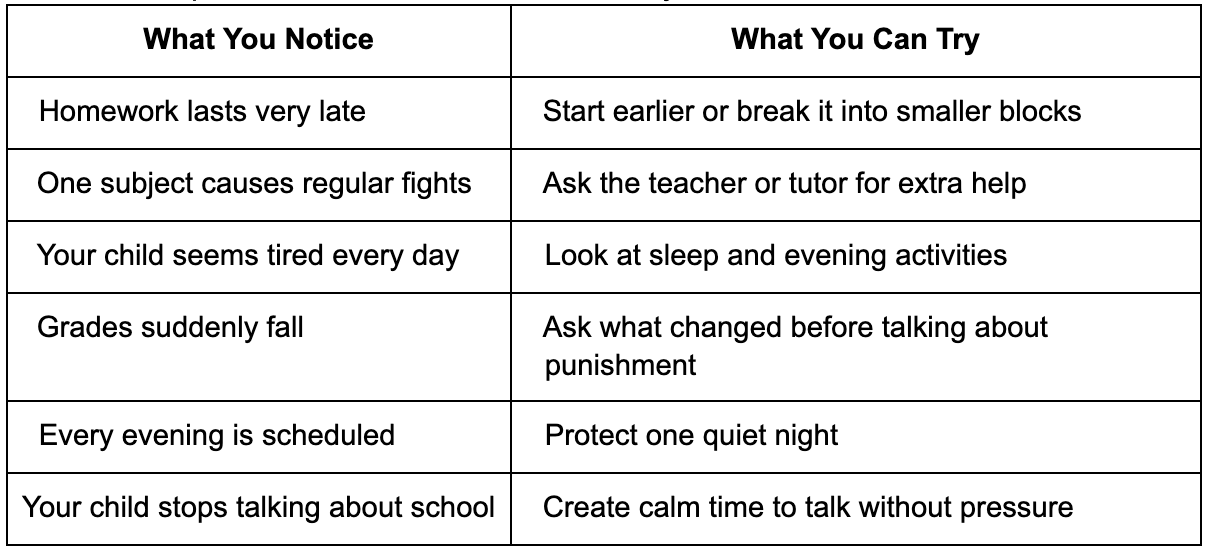
Use the table as a starting point, not a diagnosis. The same behavior can have many causes. A tired child may simply need more sleep, while another may be worried about something happening at school. Your job is to notice and ask.
Talk to the School Before the Problem Gets Big
You do not have to wait until report cards arrive. If your child is struggling in one class, contact the teacher and ask what they are seeing. A teacher may notice missing work, trouble with one skill, changes in attention, or stress around certain tasks. That extra view can help you understand whether the problem is mainly academic or part of something wider.
Keep the conversation focused on solving the problem rather than finding someone to blame. Ask what support is already available and what can be done at home. If there is a school
counselor, they may also be helpful when pressure has started affecting mood or attendance. Working together is usually easier than having home and school make separate guesses.
Watch Your Own Stress Too
Kids notice more than adults sometimes think. If every homework problem makes you tense, they may begin to treat the work like an emergency, too. You do not have to pretend everything is fine, but you can model a calmer response. A mistake is easier to fix when everyone in the room is not already upset.
Try not to solve problems while angry. Take ten minutes, get some water, or come back to the homework after dinner. Saying, “We are both getting frustrated, so we will try again in a bit,” teaches something useful too. Stepping away is not giving up.
Your Job Is Not to Become Another Teacher
When school pressure follows your child home, your most useful role is not always to teach the lesson or fix the grade. You can create calm, listen, help organize the week, find outside support, and remind your child that one difficult subject does not define them. Those simple things can lower the temperature at home. They also protect your relationship.
Dads do not need a perfect answer every time. Sometimes the best move is asking one good question, turning off the school talk for an hour, or finding someone else who can explain the lesson better. When home feels like a place to recover instead of another classroom, children have more room to handle the challenges waiting for them tomorrow. That is useful support - and it does not require you to know the answer to every homework question.
