
10 Factors to Consider When Investing in a Commercial Backup Generator
Power outages don't send a warning. One minute everything's running smoothly, the next, your equipment is down, your staff is scrambling, and customers are walking straight out the door. For any business that depends on reliable electricity (and honestly, what business doesn't?), the financial hit adds up faster than you'd expect.
The U.S. The Energy Information Administration reported that businesses averaged 11 hours of electricity interruptions, nearly double the annual average from the previous decade. At that rate, having a plan isn't a luxury. It's survival.
Why Your Business Needs a Commercial Backup Generator, Full Stop
Before you can choose the right generator, you need to get honest about what's actually at stake when the grid fails. Aging infrastructure, extreme weather, and record-high demand are all stretching the system thin. Outages are getting longer, not shorter.
If your business operates in New York, New Jersey, or Connecticut, that vulnerability is amplified. Nor'easters, coastal storms, and dense grid congestion make the Tri-State area especially susceptible to disruptions. For companies in that region, working with a trusted provider specializing in generator sales and service isn't just smart; it's the kind of decision that separates a minor inconvenience from a full operational collapse.
So now that we've settled why this matters, let's talk about what actually goes into making a smart purchase.
The Real Factors That Drive Investing in Commercial Generators
Picking the most powerful unit on the market sounds appealing, until you get the fuel bill. Real due diligence means honest self-assessment, careful comparison, and knowing exactly what questions to ask. Here's where to start.
Know Your Actual Power Demands First
This is the foundation. Before you talk to a single salesperson, you need to inventory everything that requires power to keep your business running, servers, HVAC, refrigeration, lighting, security systems, POS equipment, all of it. Add up the wattage. That number tells you what you actually need.
Here's what most people miss: account for growth. A generator that barely handles today's load will definitely buckle in two years when your operation expands. Build that buffer in from the start.
Fuel Type: There's No Universal Right Answer
Once you know your load requirements, you have to figure out what's going to fuel the thing. Each option has real tradeoffs:
- Diesel, High energy density, widely available, battle-tested in commercial settings
- Natural gas, Connects directly to municipal supply lines, no storage hassles
- Propane, Great for rural locations without natural gas infrastructure
- Dual-fuel systems, Flexibility when one source becomes unavailable or too expensive
Increasingly, businesses are also exploring hybrid setups and biofuel alternatives as part of sustainability goals. Worth a conversation with your provider.
Generator Sizing and Load Management, Don't Wing it
Getting the size wrong is one of the costliest mistakes a business can make. Too small, and the unit strains under load, risking equipment damage. Too large, and you're burning unnecessary fuel and paying for capacity you'll never use.
Smart transfer switches and automatic load management systems solve a lot of this by distributing power intelligently during an outage, prioritizing what matters most and reducing strain on the unit overall. It's a genuinely underrated feature.
A Practical commercial Generator Buying Guide: the Factors Most People Overlook
These next considerations don't always show up on the standard checklist. That's exactly why they trip people up.
Brand Reliability and Real-World Performance
Not every generator is built the same, and brand reputation genuinely matters here. Kohler, Generac, Cummins, and Briggs & Stratton each bring distinct strengths in reliability, parts availability, and warranty support. When you're evaluating the best backup generators for business, look past the spec sheet. Read user reviews. Ask about after-sales support. Find out how widely a brand is serviced by local technicians in your area, because the last thing you want is a unit that needs a specialist flown in from out of state.
Placement and Site Infrastructure Matter More Than You Think
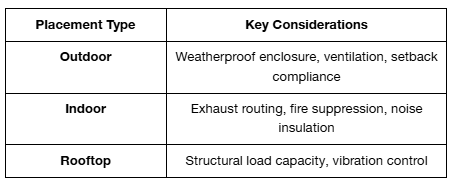
Where you physically put the generator has enormous implications. Outdoor units need weatherproof enclosures and proper ventilation clearance. Indoor installations require exhaust routing and strict fire safety compliance. Local zoning codes often set mandatory setback distances from property lines and structures, and skipping that research before installation is an expensive mistake to walk back.
Integration With Your Building's Existing Systems
Your generator has to work with your building, not just near it. Compatibility with your automatic transfer switch (ATS), building management system (BMS), and electrical panel configuration is non-negotiable. Modern commercial systems can even connect to IoT platforms for remote monitoring and performance analytics, which is enormously useful for facility managers who aren't on-site 24/7.
Noise Levels and Environmental Compliance
Generators aren't quiet. That's just the reality. Low-noise models and sound attenuation enclosures help, but local ordinances often set hard decibel limits, and emissions standards are tightening in many states. Non-compliance doesn't just mean a warning letter. It can mean fines, forced removal, and a very expensive do-over.
Maintenance is Where Most Businesses Cut Corners, Don't
A generator that sits untested for two years is not a backup plan. It's a liability. Routine maintenance, oil changes, coolant checks, scheduled load tests, is what keeps performance consistent when you actually need it.
Research from Lawrence Berkeley National Laboratory found that businesses installing backup generators experience an 18% reduction in costs associated with sustained interruptions. That number only holds if the unit is properly maintained.
Total Cost of Ownership Vs. Sticker Price
The purchase price is just the beginning. Factor in installation, ongoing fuel costs, service contracts, and eventual component replacements. Some businesses qualify for tax incentives or utility rebates tied to backup power systems, so before you sign anything, get a financial advisor who understands energy infrastructure in the loop. The full picture looks different once those variables are included.
Legal Requirements and Insurance Implications
NFPA and OSHA standards govern a significant portion of commercial generator use. Industries like healthcare, food service, and data centers face even stricter requirements. Your insurance carrier may also adjust your premiums, or your coverage terms, based on whether your backup power system meets compliance standards. This is not the area to improvise.
Smart Technology and What's Actually Changing in the Industry
The businesses making the smartest investments right now aren't just buying reliable generators, they're integrating technology that makes those generators smarter.
Iot Monitoring and Predictive Diagnostics
Remote access platforms let facility managers check generator health from anywhere with a signal. AI-driven diagnostic tools flag potential failures before they become actual failures, reducing unplanned downtime and extending equipment lifespan. Automatic testing cycles run the unit regularly without anyone having to remember to do it manually.
Sustainable Technologies Worth Considering
Solar hybrid systems and battery storage solutions paired with traditional generators are gaining serious traction. The appeal is obvious, reduced fuel consumption, lower emissions, and a meaningful step toward carbon reduction goals without sacrificing the operational security your business depends on.
Choosing the Right Partner for generator Sales and Service
The variables involved in selecting and implementing a commercial backup power system are genuinely complex. Working with professionals who specialize in generator sales and service takes a lot of that weight off your plate, and dramatically reduces the risk of costly errors.
Site assessments, load calculations, permitting, installation coordination, a qualified provider manages all of it. More importantly, they build solutions tailored to your industry, your building layout, and your actual budget, not a generic recommendation pulled from a catalog.
Frequently Asked Questions
Is a backup generator worth the investment?
Absolutely, especially if downtime directly translates to lost revenue. Commercial outages can cost thousands per event. A properly sized, well-maintained generator typically pays for itself within a few years.
What does a commercial backup generator cost?
It varies considerably. Smaller commercial units typically start in the $10,000–$15,000 range. Larger industrial systems can reach $100,000 or more fully installed. The gap is wide because the variables are wide.
What permits are needed to install one?
Most jurisdictions require electrical, mechanical, and sometimes zoning permits. Requirements differ by location and building type, so check with local authorities and your installation provider before any work begins.
Your Next Step Starts With the Right Decision Today
Choosing the right commercial backup generator isn't one decision, it's a sequence of informed ones. Load requirements, fuel type, brand reliability, compliance, lifecycle costs, placement, integration, every factor in this commercial generator buying guide shapes how the investment performs over time.
Partner with certified professionals. Plan for your future load, not just your current one. And stop treating backup power like an optional line item. The businesses still running when the next major outage hits won't be the ones who got lucky, they'll be the ones who prepared.
