
7 Insurance Eligibility and Benefits Verification Services, and What Each One Actually Checks
Eligibility and benefits verification are two different jobs, and most denials land in the space between them.
Last checked September 2026. Every rate and claim is quoted from the company's own website; the transaction standard is quoted from CMS.gov. Nothing here is estimated.
A physical therapy clinic outside Columbus checks eligibility on every new patient. In January one check came back the way everyone wants: active, in network, $40 copay. The patient finished an eleven-visit plan of care. In April the clinic learned the plan allowed 20 visits a year, that the patient had used 16 elsewhere before switching, and that visits 21 onward were not covered. Seven visits denied, and nobody made a mistake. The check was accurate. It was answering a different question.
That gap is written into the standard. CMS's companion guide for the HIPAA Eligibility Transaction System, which every Medicare check runs through, says the 271 response "is not intended to provide a comprehensive list of all benefits, but rather to indicate the eligibility status," and "should not be interpreted as a guarantee of payment." Commercial payers answer the same way, and what comes back is whatever the plan chose to send.
So the market splits three ways under one search term. Some sell a faster, cheaper 271. Some layer data on top to fill in what the payer left out. Some sell people who phone the plan. Prices run from ten cents a check to $5,000 a month, and a feature list will not tell you why. What follows is what seven companies publish themselves, in no particular order, with the same drawback section on each.
Eligibility, benefits, and the six things that actually get denied
Decide which of these your denials come from first. Most practices find they bought an answer to question one while losing money on three and five.
Eligibility. Is the policy active on the date of service, and is the member ID right.
Benefit detail. Deductible met and remaining, copay, coinsurance, out-of-pocket max.
Limits and exclusions. Visit caps, frequency limits, excluded diagnoses. Usually absent from the 271.
Network status for this provider at this location, which is not the same as for the practice.
Prior authorization for the specific CPT code, which most responses flag vaguely or not at all.
Coordination of benefits. Whether a second policy exists and which pays first.
A product that answers the first two and calls itself benefits verification is not being dishonest. It answers half, quickly and cheaply, and half is often enough. The trouble starts where the money sits in the other half.
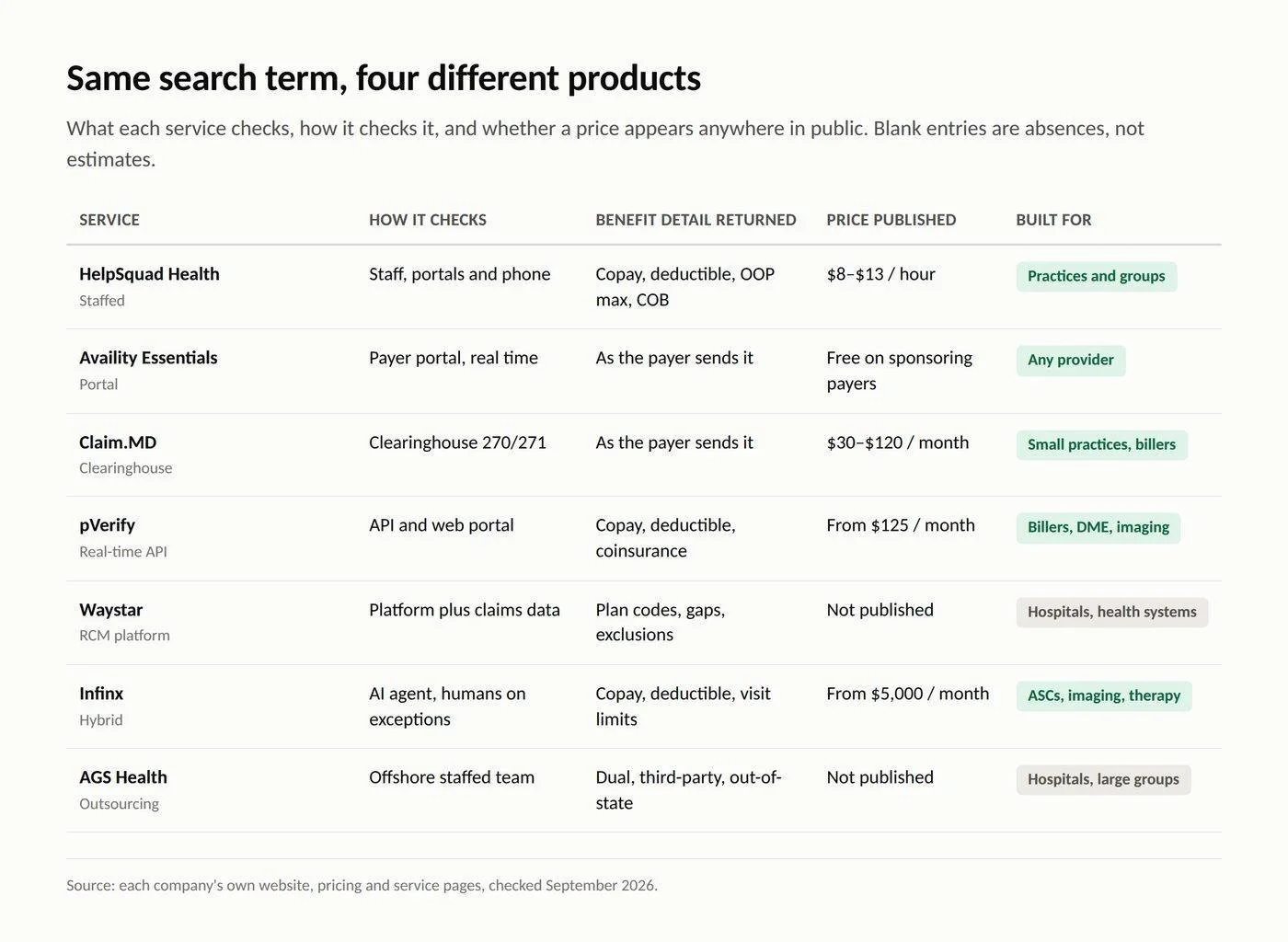
Same search term, four different products
HelpSquad Health
HelpSquad sells trained people rather than a transaction. Its verification page puts the work "24 to 48 hours ahead of every appointment," and what comes back covers all six questions above: "Active / inactive, effective date, termination date, plan type," then "Deductibles met, remaining, copays, coinsurance, out-of-pocket max," network flags, procedures "requiring prior auth identified at verification," and coordination of benefits.
Rates are published, which is unusual here: "$8-10 per hour" for back-office verification and "$10-13 per hour" for patient-facing voice work, with "$0 Upfront cost" and "$0 Implementation fees." Assistants are "primarily staffed from the Philippines" and India, "All managed from the US" out of Doylestown, PA. The BAA is "signed at the company level," with "no copy / paste / download of PHI." Verification sits inside broader healthcare bpo services.
Key strengths
Published hourly rates and a named staffing model, unlike four here.
Covers what a 271 does not carry: visit counts, COB rules, auth flags by code.
Names the portals and EHRs it works in, including Availity, Epic and Athena.
Best for
Practices whose denials come from benefit detail rather than dead policies.
Worth asking about
The minimum is published and real: "typically start at 20 hours per week" per assistant, on a "3-month initial agreement that then renews automatically in 3-month increments," more than a two-provider practice generates in verification alone.Managed teams essentially a form of healthcare call center outsourcing, are priced only as "Custom."
Availity Essentials
Availity is the pipe several others ride on: "3M Connected Providers," "95" direct payer connections and "over 13 billion clinical, administrative, and financial transactions annually." Essentials is "Availity's multi-payer provider portal that's sponsored by select payers," and the sentence that matters to a budget is blunt: "Providers can submit to payers on Essentials for free." Staff "Verify patient eligibility and benefits in real-time" and "Estimate patient costs."
The catch is the word sponsored. Free access covers the plans that pay Availity to be there. For the rest, "An Essentials Plus™ monthly subscription allows providers to check eligibility and submit claims for many non-sponsoring payers," and Availity does not publish what that costs. Essentials hands you the payer's answer as the payer composed it, so benefit depth changes plan to plan.
Key strengths
Free for sponsoring payers, covering several nationals and most Blues plans.
Real-time, so the answer reflects the policy at the moment of the check.
Already the mandated portal for many plans, so the login exists either way.
Best for
Practices that want coverage status at no cost and have staff willing to chase benefit detail.
Worth asking about
Which of your top ten payers sponsor Essentials, which need Plus, and what Plus costs, because Availity publishes that price nowhere. This is a portal, not a service: it delivers what the payer sends and stops.
Claim.MD
Claim.MD is the budget clearinghouse here, and it publishes its rate card publicly. "Unlimited" is "$120.00/month" with "Unlimited Claims" and "1,000 Eligibility (per month)." "Small Volume" is "$60.00/month" for "100 Claims, ERA, and Eligibility (per month)." "Basic" is "$30.00/month," or "Pay only for what you use." Setup fees are "none" on all three, and extra eligibility on Unlimited runs "Prime $0.02/ea Non-Prime $0.10/ea."
Two to ten cents buys a 270 out and a 271 back. Eligibility runs through "Web portal realtime eligibility checks" or batch, with "Over 400 payers supported," a far shorter list than the "1,000s of connections" the payer list claims for claims routing. The developer documentation is candid about the ceiling: "the Claim.MD API does not support a batch-style real-time eligibility submission."
Key strengths
A published rate card with allowances and overage rates, and no setup fee.
Real-time and batch eligibility from the same portal that routes your claims.
A $30 entry plan, the lowest published floor on this list.
Best for
Small practices and billing companies that want coverage status at volume without a sales call.
Worth asking about
What "Prime" means, because the page prints "Prime $0.02/ea Non-Prime $0.10/ea" and defines neither term nor which payers qualify. Eligibility reaches "Over 400 payers," not the thousands the claims side reaches. And nothing on the site separates eligibility from benefits verification.
pVerify
pVerify is built for developers and billing teams rather than front desks. It connects to "over 1,500 healthcare payers," exposes "50+ API endpoints" for integration with "EHRs, PMs, and billing software," and sells into medical, dental, vision, DME and imaging. The core product covers "benefits, copays, deductibles, and authorizations, all in a single workflow," with a deeper tier giving "in-depth views of maximum coverage amounts, co-insurance, and patient responsibility."
Pricing is published in tiers with transaction allowances attached. Advanced Eligibility is "Starting at $125/month" for up to 500 monthly transactions on a one-year term, or "Starting at $395/month" for up to 1,500. Insurance Discovery, which hunts for coverage the patient did not disclose, is "Starting at $120/month" for up to 80. Onboarding is billed separately, from "$495" on Standard and "$950" on Enterprise.
Key strengths
Published tier pricing with transaction counts, visible before any sales call.
1,500+ payers through an API designed to sit inside somebody else's product.
Insurance discovery and MBI lookup priced separately, not bundled.
Best for
Billing companies, DME suppliers and software teams that want eligibility in their own workflow, not another portal.
Worth asking about
Do the arithmetic before quoting the headline. A clinic running 700 checks a month sits on the $395 plan, not the $125 one, tiers are quoted on a one-year term, and onboarding adds at least $495.
Waystar
Waystar is the enterprise end. Founded in 2017, it publishes "1M+ providers" served, "7.5B+ annual healthcare payment transactions," "1.2K payer connections" and roughly "60% of U.S. patient population" in its claims database. Eligibility is one module in a financial clearance suite. Rather than passing the payer response through untouched, it says it "combs through vast amounts of payer data to curate the most accurate and comprehensive benefit information," returning "plan codes, coverage gaps, and exclusions."
The distinct product is Coverage Detection, which fires when a search returns inactive or a patient presents as self-pay. Its claim is specific: "30-40% of patients presenting as self-pay actually had active coverage found by Waystar." Waystar also publishes a "55% reduction in eligibility-related denials" and "55 FTE hours saved weekly," its own numbers, with no sample beside them.
Key strengths
Coverage detection that hunts undisclosed and secondary policies rather than reporting "not active."
Benefit responses enriched from a claims database instead of passed through raw.
Batch and real-time in one platform, which hospital registration volumes need.
Best for
Health systems and large multi-site groups with a patient access department and an integration budget.
Worth asking about
Price, which Waystar publishes nowhere: every pricing question routes to "Request a Demo." The platform sells as a suite, so eligibility may not be separable, and the percentages come from selected customers rather than audits.
Infinx
Infinx sits between software and staffing on purpose. Its eligibility agent will "retrieve eligibility and benefit information in real time, delivering structured data directly into your workflow without portal navigation or manual intervention," covering coverage status, "copay, coinsurance, and deductible amounts," visit limits and prior authorization indicators. The line worth reading twice is the handoff: "If the payer portal returns incomplete or incorrect data, the agent routes the case to our expert specialists."
It publishes a floor: "Annual engagements start at $5,000 per month," with pay-per-unit, dedicated-capacity, subscription and contingency models layered on. Buyers take the platform alone or add "dedicated specialists to support exceptions when payer rules or benefits create edge cases." Infinx reports "2M+ eligibility verification transactions processed annually."
Key strengths
A published price floor, so the budget conversation happens before the demo.
Automation with a named escalation path when the payer returns incomplete data.
Benefit detail and visit limits in scope, not just an active or inactive flag.
Best for
Surgery centers, imaging, infusion and therapy groups with the volume to justify $60,000 a year.
Worth asking about
That floor is the whole story for a small practice. $5,000 a month is a starting point, not a cap, and Infinx publishes neither where its specialists sit nor how many it employs.
AGS Health
AGS Health sells the function rather than the tool. Founded in 2011 and headquartered in Washington, DC, it publishes "Employees: 15,000+ (2025)," "Global Delivery Locations: India, Philippines, Mexico" and "more than 150 customers," says it works with "nearly half of the 20 most prominent U.S. hospitals," and holds HITRUST certification and a KLAS and Censinet rating of "MATURE."
Its verification service is scoped narrowly and usefully. AGS says it will "Confirm insurance coverage and benefits," naming three cases explicitly: "Dual- and third-party insurance eligibility," "Out-of-state verification" and "Direct connection with payer portals." Those are the hardest cases for any automated check, which is the honest argument for buying people instead of software.
Key strengths
Names dual and third-party eligibility and out-of-state checks as in-scope work.
15,000+ staff and HITRUST certification, which clears most hospital security reviews.
Verification bought inside a managed patient access function, with no tool to integrate.
Best for
Hospitals and large groups outsourcing patient access as a department rather than buying a checker.
Worth asking about
Nothing about price, turnaround or accuracy is published. The verification page names no SLA and no per-transaction figure, and there is no self-service tier, so a ten-provider group is unlikely to be the buyer. Delivery runs from India, the Philippines and Mexico, which matters if the work includes payer calls in US hours.
What the price difference is actually buying
Ten cents a check and $5,000 a month are not the same product at different price points. The cheap end returns the payer's own 271 quickly, which is right when denials come from terminated policies and wrong member IDs. The middle enriches that response with claims data, which pays off when you keep finding coverage nobody disclosed. The expensive end puts a person on the phone, the only thing that answers what the payer never encoded.
Practices get this wrong in one direction. They buy the cheapest option, watch denials stay flat, and conclude verification does not work. Read the codes instead. Coverage terminated is fixed by a $30 tool. Benefit maximum met was never going to be caught by an API.
What a published price actually commits you to
Ask to see a raw 271 for your three worst payers. Have the vendor pull a real eligibility response for a live patient on the plans that deny you most, and read what came back. Ten minutes tells you whether that payer returns service-level benefits or a bare active flag. If it is a bare flag, no software layered on top will produce visit counts, and you are shopping in the wrong category.
Questions to ask before you sign
For my top ten payers, does your check return service-level benefits or only coverage status? Show me one of each.
When the payer response is empty or contradictory, does a person pick it up, and is that included or billed separately?
Do you return visit limits, frequency limits and benefit maximums used to date, and for which payers specifically?
What is the total first-year cost including onboarding and overage, on my real volume rather than the tier headline?
Who signs the BAA, where do the people or servers touching PHI sit, and can I see your latest security report?
Where to start
Pull ninety days of denials and sort by reason code before you talk to anybody. Separate the ones meaning the policy was not active from the ones meaning the service was not covered under an active policy. The first bucket is a software problem, and the cheapest tools here close most of it. The second is a phone call problem that stays open until somebody is paid to make the call.
Then size it honestly. If you run a few hundred checks a month and your denials are policy-status denials, start at the free end and keep the money. If they are benefit-detail denials, price the staffing options against what those denials cost, including visits already delivered that you will never bill. The useful question is not which vendor is best but which half of the problem you have.
Every rate, staffing detail, certification and performance claim above is quoted from the named company's own website as published in September 2026, and the transaction standard language comes from the CMS HETS 270/271 companion guide at cms.gov. Vendor statistics are self-reported and labeled as such. Prices, minimums and contract terms change without notice.
