
8 Creative Therapy Activities That Support Client Mental Wellness

Most clients are already reaching for creative outlets on their own. They journal in fits and starts, pick up coloring books during anxious stretches, or lose an afternoon to rearranging art on their walls. A 2023 American Psychiatric Association Healthy Minds Monthly Poll of 2,202 adults found that 46% of Americans already turn to creative activities specifically to manage stress and anxiety - and those who engage creatively at least once a week report significantly better mental health than those who don’t.
That’s a gap therapists can work with. Clients don’t need convincing that creativity feels good. What they need is structure. When creative activities are framed deliberately, assigned with intention, and reflected on in session, they shift from casual coping to genuine therapeutic work.
None of the activities below require art therapy certification to recommend or introduce. They’re practical, low-barrier, and grounded in recent research. Some work best in session. Most are ideal between-session assignments that give clients something to bring back the following week.
1. Structured Paint-by-Numbers Kits
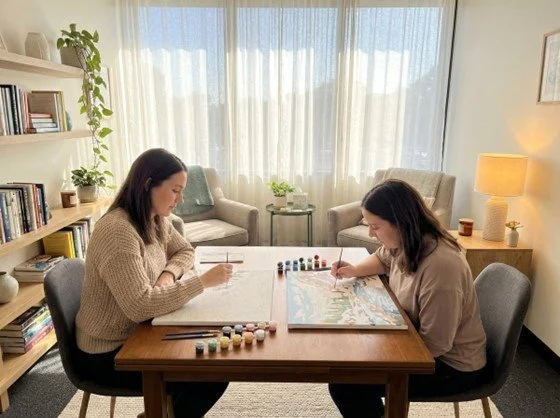
For clients who insist they “can’t draw,” a blank canvas is a non-starter. Paint-by-numbers removes that barrier entirely. The numbered sections guide attention one small area at a time, creating the conditions for what psychologist Mihaly Csikszentmihalyi described as “flow” - a state of full absorption that’s associated with reduced anxiety and improved mood.
There’s a reinforcement loop built in. Completing each section triggers a small dopamine release. Over the course of a painting, that adds up. Clients who feel like they never finish anything get to finish something. That experience of completion is itself therapeutic.
For clients who want a ready-made option, Number Artist DIY kits come in a wide range of subjects - animals, landscapes, portraits - so clients can choose imagery that feels personally meaningful rather than arbitrary. That choice adds a mild expressive element to what’s otherwise a structured activity.
A 2024 JAMA Network Open meta-analysis by Ronja Joschko and colleagues at Charite - Universitatsmedizin Berlin reviewed 69 visual art therapy studies across 2,766 participants in 21 countries and found measurable improvements in depression, anxiety, self-esteem, and quality of life. Structured visual activities like paint-by-numbers sit squarely in that category.
2. Expressive Writing and Journaling
Journaling works best when it’s given a container. Open-ended “write whatever you’re feeling” prompts often produce avoidance, not insight. Structured prompts are more productive: “What did today feel like as a color?” or “Write a letter to the version of yourself from five years ago.” These cues bypass the inner editor and surface material that’s harder to reach in conversation.
The research foundation for expressive writing goes back to James Pennebaker’s work in the 1980s and has held up remarkably well. Writing for 15 to 20 minutes over three or four consecutive days about emotionally significant experiences consistently produces mood improvements and reduced anxiety - effects that persist for months.
For clinicians who work within an expressive arts therapy framework, journaling pairs naturally with other modalities. A client might sketch before writing, or write in response to a piece of music. The multimodal combination tends to reach more of the experience than any single medium alone.
3. Music Listening and Simple Instrument Play
Music engages more of the brain simultaneously than almost any other activity. It activates reward circuits, regulates the autonomic nervous system, and influences mood within minutes of onset. For clients with trauma histories, it can be a way back into the body when verbal processing hits a wall.
Clinical music therapy requires specialized training. But therapists can encourage clients to use deliberate music listening as a self-regulation assignment without any specialized credentials. The key word is deliberate. Passive background music is different from choosing a specific piece and sitting with it for ten minutes with full attention.
A practical assignment: ask clients to build two short playlists between sessions - one that matches their current emotional state, one that points toward where they want to be. The act of choosing teaches something. Bring both lists to the next session and talk about what ended up on each one.
4. Collage-Making and Vision Boards
Collage requires no drawing skill and no prior experience. That low threshold makes it accessible to clients who shut down at the word “art.” It also engages two different cognitive modes at once: the analytical (selecting, cutting, arranging) and the associative (noticing what draws attention, what gets excluded, what pattern emerges).
In session, collage works well as a projective technique. What a client chooses to include - and what they leave out - often surfaces material that takes much longer to reach verbally. A client who describes their life as “fine” might produce a collage that tells a different story.
For between-session use, therapists can frame an ongoing collage as an “emotional weather map” - a running visual record of whatever the client is carrying. Clients who struggle with articulating feelings often find that pointing to an image is easier than finding the right word. That image becomes the entry point for the next conversation.
Digital collage tools (free apps, Pinterest boards, image folders) work just as well for clients who prefer screens over scissors.
5. Clay Work and Tactile Sculpting
Tactile engagement works through a different channel than visual or auditory input. Clay specifically offers resistance, temperature, and texture - all of which ground the nervous system in the present moment. For clients with PTSD-related hyperarousal, somatic tension, or dissociative tendencies, that grounding quality can be more regulating than conversation.
A 2025 PMC systematic review on crafts-based interventions found that just ten minutes of basic clay manipulation - forming a simple pinch pot - produced a measurable, immediate reduction in anxiety across multiple included studies. No artistic skill required. The act of working the material is the point.
Air-dry clay and polymer clay are both affordable and don’t require a kiln, making in-session use practical. Therapists using clay in session should pay attention to how clients engage with the material: do they press hard or gently? Control the shape tightly or let it go where it goes? Those choices carry projective data worth exploring.
6. Mandala Drawing or Coloring
Of all the specific structured art forms, mandalas have the strongest research support for stress and anxiety reduction. A 2024 Frontiers in Psychology study by Liu and colleagues applied the broaden-and-build theory to examine mandala-style structured drawing and found it consistently reduced stress and anxiety across participants - the combination of repetitive motion, bounded form, and geometric focus appears to have genuine regulatory effects.
Pre-printed mandala coloring pages remove any drawing barrier completely. For clients who resist the “art therapy” framing, therapists can introduce this simply as a focused attention exercise. The word “coloring” lands differently than “art” for a lot of clients, and that matters for buy-in.
For younger clients or those with attention challenges, the focused, repetitive quality of mandala work connects naturally to the same principles behind play therapy approaches designed to support sustained engagement. The structured, predictable format helps regulate attention rather than demand it.
7. Photography and Mindful Observation
Smartphone cameras make this assignment accessible to virtually every client. The clinical concept behind it, sometimes called PhotoVoice in community settings, asks clients to document their world through intentional image capture. The key is the intentionality.
A weekly assignment might look like this: photograph one thing that made you feel safe this week, one that made you feel curious, and one that felt overwhelming. Three images. Bring them to the next session.
That simple structure does several things at once. It trains attentional flexibility - clients have to actively look for specific emotional experiences rather than moving through their days on autopilot. It creates a concrete check-in artifact. And it often surfaces content the client didn’t know they wanted to talk about until the photo was sitting in front of both of you.
The assignment aligns well with CBT and ACT frameworks, where deliberate shifts in attention and perspective are core mechanisms of change. A 2023 APA poll found that Americans who rate their mental health as very good or excellent engage in creative activities at 71% frequency - compared to 46% for those with fair or poor mental health. The direction of that correlation is worth telling clients.
8. Knitting, Crocheting, or Repetitive Craft
Repetitive hand craft has been described anecdotally as meditative for decades. The research now backs that up. A 2025 PMC systematic review of 39 controlled studies covering 3,360 participants found that group arts and crafts interventions produced a moderate reduction in depression among older adults (Cohen’s d = 0.70, P < 0.001) and a comparable reduction in anxiety.
For clients who struggle with traditional sitting meditation - and many do - repetitive craft functions as a kinetic alternative. The hands are occupied. That rhythmic bilateral motion quiets the default mode network in ways that are genuinely similar to meditative states. It also connects naturally to recreational therapy frameworks that treat leisure and craft as legitimate clinical tools rather than afterthoughts.
The accomplishment factor is real. Clients who knit a row, finish a square, or complete a small project have something tangible to point to at week’s end. That matters for clients working through depression, where a sense of productive engagement is often one of the first things to go.
Conclusion
Therapists don’t need to become credentialed art therapists to make creative activity part of their clinical work. The evidence is clear enough to act on. The 2024 JAMA Network Open meta-analysis spanning 69 studies and nearly 3,000 participants found measurable improvements in depression, anxiety, and quality of life from structured visual art activities. The APA’s own polling data shows clients are already reaching for creative outlets, they just need guidance on how to use them well.
The common thread across all eight activities is a low skill threshold paired with real psychological engagement. Clients don’t need to make great art. They need to make something, notice what comes up, and bring that back to the session. Start with one activity, keep it simple, and let the reflection do the work.
Related:
