
Why choose an european Aalternative to DocuSign for your online contracts ?
The electronic signature market has largely coalesced around a dominant model: the monthly subscription per user. While this structure serves large teams managing hundreds of documents monthly, its suitability for small to medium-sized enterprises (SMEs), independent professionals, or businesses with fluctuating needs warrants closer examination. Indeed, the landscape is consistently evolving, with new methods for qualified electronic signatures (QES) becoming increasingly accessible across numerous countries, and compliance with the eIDAS regulation now a standard expectation in many sectors. This shift prompts a pertinent question: why choose a European alternative for your online contracts?
For European businesses, the decision goes beyond mere functionality. Concerns about data protection, the pursuit of better value, the need for developer-friendly APIs, and a solution specifically adapted to European regulatory requirements are driving many to explore options beyond established global players. This guide aims to illuminate the compelling reasons to consider a European provider, focusing on aspects like GDPR compliance, data sovereignty, developer tools, and features that hold particular significance for businesses operating within the European Union.
The evolving landscape of electronic signature solutions
The digital transformation has made electronic signatures indispensable for businesses worldwide. Initially, a few pioneers set the standard, establishing robust platforms for contract lifecycle management. However, the market is far from static. We observe a continuous evolution, driven by technological advancements, stricter regulatory frameworks, and a growing demand for specialized services.
One of the most significant developments is the widespread adoption and enforcement of the eIDAS regulation. This European legal framework for electronic identification and trust services has standardized the recognition of electronic signatures across member states, providing a clear legal basis for their use. Consequently, businesses operating in Europe increasingly require solutions that offer native support for advanced and qualified electronic signatures, ensuring legal validity and interoperability across borders. The availability of these high-assurance signature types in many countries underscores the maturation of the market and the increasing sophistication of available tools.
Prioritizing data sovereignty and GDPR compliance
For any organization handling personal data within the European Union, data protection is not just a best practice; it is a legal imperative. The General Data Protection Regulation (GDPR) sets stringent standards for how personal data is collected, processed, and stored. This is where European electronic signature alternatives often present a distinct advantage.
European providers typically ensure that all data is processed and stored within the EU. This commitment to data sovereignty means that your sensitive contract information remains under European jurisdiction, providing an additional layer of legal protection and peace of mind. Businesses can be confident that their data is not subject to the laws of other nations, which might have different, potentially less stringent, data protection policies. This localized approach simplifies compliance efforts and mitigates potential legal complexities for companies operating primarily within the EU.
"In the digital age, the location where data resides is as important as the data itself. For European businesses, ensuring data sovereignty and strict adherence to GDPR is paramount, not just for compliance but for building enduring trust with clients and partners."

Tailored features and support for European businesses
European electronic signature solutions are often designed from the ground up with the specific needs and regulatory environment of EU businesses in mind. This often translates into a more intuitive experience for users accustomed to European legal and commercial practices.
Many European alternatives excel in providing native support for the various types of electronic signatures defined by eIDAS, including advanced electronic signatures (AES) and qualified electronic signatures (QES). These are not merely add-ons but core functionalities, integrated seamlessly into the platform. This deep-rooted understanding of European requirements also extends to customer support, often offering assistance in multiple European languages and a nuanced understanding of local business contexts. This localized support can be invaluable when navigating complex legal requirements or integrating the solution into existing workflows.
Developer-friendly APIs for seamless integration
Modern businesses thrive on connectivity and automation. European electronic signature providers often offer robust, developer-friendly APIs (Application Programming Interfaces) that allow for seamless integration with existing business applications, such as CRM systems, ERP platforms, or document management solutions. These APIs are typically well-documented and designed to empower developers to customize the signing experience, automate workflows, and embed signature capabilities directly into proprietary software.
The focus on integration ensures that businesses can incorporate electronic signatures into their unique operational ecosystem without disruption. This flexibility is crucial for companies looking to optimize their digital processes and create a unified, efficient environment for managing contracts and agreements. The ability to tailor the solution to specific technical requirements is a significant benefit for organizations aiming for a highly customized digital transformation.

Value and flexibility for diverse needs
While some market leaders introduced the concept of electronic signatures, their pricing models, often based on high-volume, per-user subscriptions, may not always align with the diverse needs of all businesses. European alternatives frequently offer more flexible and transparent pricing structures that can provide better value, especially for SMEs, startups, or companies with variable signing requirements.
These alternatives often provide subscription tiers that cater to different scales of operation, from individual professionals to large enterprises, ensuring that businesses only pay for the features and volume they genuinely need. This adaptability can lead to significant cost efficiencies without compromising on functionality or security. When considering an alternative Docusign, businesses often find that European providers offer a compelling balance of advanced features, robust security, and a pricing model that reflects real-world usage patterns.
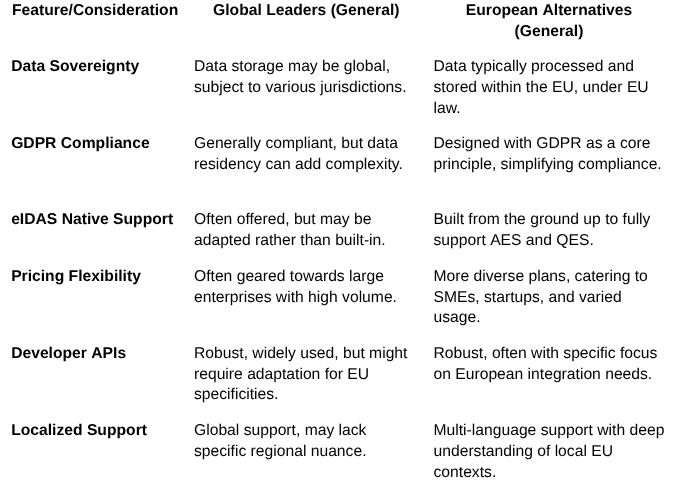
Here’s a comparative overview of typical considerations when evaluating electronic signature solutions:
A strategic choice for long-term growth and compliance
Choosing an electronic signature solution is a strategic decision that impacts not only operational efficiency but also legal compliance and data security. For businesses operating within the European Union, opting for a European alternative offers a compelling array of advantages that align with contemporary regulatory demands and business priorities.
The emphasis on data sovereignty and stringent GDPR compliance provides a solid foundation of trust and legal certainty. Furthermore, the native integration of eIDAS-compliant signature types ensures that your contracts are legally binding across all EU member states, streamlining cross-border operations. When considering how to transition or upgrade your digital contract processes, evaluating providers that inherently understand and cater to the European market's unique requirements is a judicious step.
Ultimately, a European alternative can offer a solution that is not only robust and feature-rich but also perfectly attuned to the specific legal, cultural, and operational landscape of the EU. This strategic alignment can lead to greater efficiency, enhanced security, and a stronger foundation for sustained business growth in a digitally interconnected world.
