
Automated Communication: A Smarter Approach for Modern Businesses

There's a moment every growing business hits. Suddenly, the manual stuff-replies, follow-ups, call routing, reminders-becomes a wall. Customers want answers now, your team is buried, and costs keep creeping up without any clear payoff.
Here's a number that should make anyone pause: knowledge workers now spend a staggering 88% of their workweek on communication tasks across channels. That's not just inefficient. That's a slow bleed. Automated communication is no longer some bold future experiment-it's the practical, right-now answer for businesses that want to stay sharp, responsive, and ready to scale.
Why the Benefits Are Genuinely Hard to Argue With
Once you see the challenges clearly, the upside of automation becomes almost obvious. But spelling it out matters, because the full picture is more impressive than most people expect.
Your Team Gets Real Time Back
Appointment reminders, status update emails, routine follow-ups-these tasks swallow hours every week. Business automation tools handle this background noise on autopilot, and the payoff for team morale shows up fast. People doing meaningful work perform better. It's that straightforward.
The Financial Case is Actually Compelling
Time reclaimed is great. But the financial argument for automation is where the skeptics usually go quiet.
Fewer errors, reduced staffing overhead, faster resolution cycles-these all stack up into measurable ROI. And with smart business solutions built around automation, businesses typically see that return in months, not years. When software handles what used to require a salary, those savings compound quickly.
Round-the-Clock Support Without Round-the-Clock Staffing
Beyond the numbers, automation delivers something operationally priceless: availability. Always.
Chatbots resolving questions at midnight. Order confirmations sent instantly. Calls routed intelligently without a human operator sitting at a desk. For businesses managing high call volumes, using an automated phone system for business means routine inquiries, appointment confirmations, and outbound notifications run efficiently on their own-so your team stays focused on conversations that genuinely need a human voice.
That kind of around-the-clock capability only holds up when the right technology is underneath it.
Rethinking How Your Business Actually Communicates
This shift didn't happen in a flash. Businesses have been outgrowing their communication tools for decades, patching gaps as they appear, then realizing the patch itself became the problem.
Understanding why automation matters is useful-but tracing how we got here reveals something even more valuable: the clear, unmistakable logic behind why this transformation was always inevitable.
From Memos to Machine Learning: the Long Road Here
It started with memos and landlines. Email changed everything-until inboxes became unmanageable. Chatbots helped a little. Now AI-driven platforms are redrawing the whole map. Every wave of change solved the problem the last one created. That pattern isn't slowing down.
The Real Costs Automation Was Built to Fix
Missed replies. Inconsistent follow-ups. Hiring three more people just to handle volume that software could manage. These aren't abstract inefficiencies-they're daily frustrations with real dollar amounts attached. Communication automation for businesses replaces that guesswork with reliable, repeatable processes that hold up regardless of how busy things get or what time zone your customer is in.
That evolution-handwritten notes to AI-powered workflows-isn't just an interesting story. It's a roadmap showing you exactly which problems automation was purpose-built to eliminate.
What a Strong Automated Communication Setup Actually Looks Like
Technology alone doesn't create good communication. The right tools working together do. Architecture matters as much as the platforms you pick.
One Unified View Across Every Channel
Customers hop between SMS, email, chat, social, and voice without thinking twice. A unified platform stitches these channels together so a conversation that starts on chat can continue by phone without anyone losing the thread.
A unified platform gets you reach. AI is what makes that reach feel genuinely smart.
AI That Actually Learns and Adapts
Predictive responses, sentiment analysis, intelligent call routing-these aren't sci-fi anymore. Today's leading platforms use AI that learns from past interactions and adapts over time. The difference between automation that feels robotic and automation that feels almost thoughtful? That's machine learning doing its job properly.
Cloud Infrastructure That Grows With You
Strong AI features only land well when the infrastructure holding them is flexible. Cloud-based systems connect to CRMs, ERPs, and third-party tools through APIs, building a communication ecosystem that scales with your business rather than fighting it.
With solid infrastructure underneath, the real question becomes: how do you roll all of this out well?
Deploying Automation Without Killing the Customer Experience
Smart deployment is the difference between automation that earns loyalty and automation that drives customers away. A few practices separate businesses that get results from those that just tick a box.
Personalization That Doesn't Feel Generic
Remembering a customer's name, their last purchase, their preferred contact method-that's what makes automated interactions feel human rather than transactional. AI-driven systems can apply that context to every touchpoint, so customers feel recognized instead of processed.
Get Ahead of Problems Before They Become Cancellations
Waiting for customers to complain is costly. Automated surveys, loyalty nudges, and well-timed retention campaigns reach customers before frustration sets in. A single check-in message, sent at exactly the right moment, can prevent a cancellation that seemed unavoidable.
Know When to Hand it Back to a Human.
Proactive outreach builds trust-but knowing when to escalate to a real person is what separates good automation from great automation. Emotionally charged complaints, high-stakes negotiations, complex issues-these deserve a human. Your automated system should recognize that and escalate gracefully, every time.
Weaving Automation Into Daily Operations
The real magic shows up when automation becomes part of how your business runs every day-not just in customer service, but across internal workflows too.
Workflows That Actually Stop Dropping Balls
Sales follow-ups, invoice reminders, HR onboarding, appointment scheduling-automation handles all of it consistently, without anyone forgetting a step or letting a deadline slip past. Business automation tools create systems where the cumulative time saved across a team becomes genuinely significant, fast.
Compliance Isn't Optional- Build It In From the Start
As data moves faster through automated systems, security and regulatory compliance become urgent. GDPR, CCPA, and emerging frameworks require that communication automation for businesses includes proper consent management, encryption, and audit trails. Platforms with built-in compliance features aren't a luxury-they're how you protect both your customers and your business.
Key Strategies for Growing With Automation
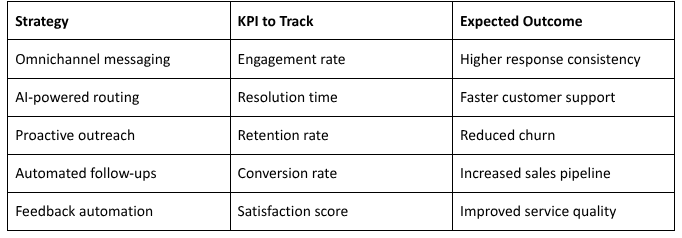
Measuring What's Actually Working
Response times, satisfaction scores, conversion rates, and engagement metrics all tell you whether your automation is performing or just running. Review these regularly. Refine what works. Fix what doesn't. The data usually tells a pretty clear story.
Scaling From Startup to Enterprise
Whether you've got five employees or five thousand, modern automation scales modularly. Start with one workflow. Prove the value. Then expand. The infrastructure cost doesn't rise proportionally with usage-that's one of the most compelling things about building on a cloud-based automation foundation.
Connecting Automation to Smarter Business Decisions
Scaling is transformative. But tying automation to business intelligence tools converts operational data into strategic insight. Real-time dashboards help leaders make faster decisions instead of acting on reports that were already outdated the moment they were generated.
What's Coming Next in Business Communication
The global Customer Communication Management market sits at USD 2.31 billion in 2025 and is projected to hit USD 5.29 billion by 2032 Quadient, 2025. Businesses investing now are building a meaningful head start.
Voice AI is Reshaping What Phone Automation Can Do
Thanks to advances in conversational AI, an automated phone system for business now offers intelligent call routing, multilingual support, and context-aware responses that feel far more natural than older IVR systems ever did. These capabilities are quickly becoming standard, and customer expectations are rising to match.
Automated Funnels That Turn Browsers Into Buyers
Automated sales funnels capture intent across every touchpoint-chatbots, email sequences, social DMs-and nurture leads without a rep manually managing each one. The conversion speed compared to traditional outreach is genuinely striking.
Predictive Engagement: Reaching Customers Before They Ask
Behavioral analytics now make it possible to send the right message before a customer has consciously registered a need. Predictive engagement isn't a flashy feature anymore-it's quickly becoming what customers expect from businesses they trust.
Picking the Right Tools for Your Specific Situation
What to Actually Look for in a Platform
Workflow flexibility, native integrations, analytics dashboards, and scalability are non-negotiables. Sentiment analysis and predictive routing are worth prioritizing if your interaction volume is high and your budget allows it.
A Quick Look at Leading Solutions
Platform
Best For
Standout Feature
Switchboard Cloud
SMBs & mid-market
No-code voice automation
Twilio
Developers & enterprises
Deep API customization
HubSpot
Marketing-focused teams
CRM-integrated workflows
Freshdesk
Support-heavy operations
Omnichannel ticketing
Klaviyo
E-commerce businesses
Behavioral email triggers
Planning Your Transition So It Actually Sticks
Choosing the platform is a milestone, not the finish line. Migrate data carefully. Train your team with real scenarios, not just feature walkthroughs. Set clear ROI benchmarks before you go live so progress is measurable and the business case stays defensible.
Getting Started Without Overthinking It
A Practical Checklist to Actually Move Forward
Define clear goals first-don't automate for automation's sake. Identify the three to five workflows that drain the most time right now. Choose a platform that fits today without boxing you out of tomorrow. Run a pilot on one workflow, measure honestly, then expand. Check in monthly for the first quarter.
What Real Businesses Have Actually Seen
A regional healthcare provider cut appointment no-shows by 40% using automated SMS reminders. A mid-sized e-commerce brand reduced support ticket volume by 35% after deploying AI chatbots. A logistics company reclaimed 20 hours per week by automating delivery notification calls. These aren't exceptional outcomes-they're what happens when automated communication is deployed with clear intent and the right tools behind it.
Common Questions Worth Answering Directly
What are the best business communication automation tools in 2025?
Top options include Switchboard Cloud for voice automation, HubSpot for CRM-integrated workflows, Twilio for developer-heavy needs, and Freshdesk for support teams. The best choice depends on your team size, industry, and existing stack.
How does automated customer support improve response time and service quality?
It eliminates wait times for common inquiries by handling them instantly. Customers get answers faster, agents deal with fewer routine requests, and satisfaction scores typically improve within weeks.
Can automated communication integrate with CRM and ERP systems?
Yes-most modern platforms offer API connectivity or native integrations with Salesforce, SAP, and similar tools. Customer data stays synchronized without manual entry across systems.
What compliance standards should businesses consider?
GDPR and CCPA are the primary frameworks in most markets. Prioritize platforms with consent management, data encryption, and clear opt-out mechanisms built in.
One Last Thing Before You Close This Tab
Automated communication isn't about replacing human connection-it's about protecting it. When business automation tools absorb the repetitive, time-consuming work, your people can focus on the conversations that actually matter: relationships, strategy, growth. The businesses winning right now aren't always the biggest ones. They're the ones communicating smarter. With the right smart business solutions doing the heavy lifting, every customer interaction becomes an opportunity instead of an obligation. You already know the problem is real. The only question is when you decide to actually fix it.
