

The right water filter company for your home depends on more than the filter itself. You need a system that addresses what's actually in your water, fits your space and comes with support you can rely on after the purchase.
For some Canadian households, the main concern is an unpleasant chlorine taste. Others are dealing with older plumbing, hard water or questions about per- and polyfluoroalkyl substances (PFAS). Those problems don't all call for the same solution. Your local water supply will help determine whether drinking-water filtration, whole-home treatment or a combination of the two makes sense.
Among the best water filter companies in Canada, Culligan, Aquatell and Enercare are worth comparing for whole-home treatment. For under-sink reverse osmosis (RO), look at illi Water, Waterdrop, iSpring and APEC. AquaTru is an option for countertop RO, Aquanest offers an installation option in the Greater Toronto Area (GTA), and Epic and Santevia cover pitcher filtration. The important next step is to compare specific models—not assume every product from a brand has the same certifications or capabilities.
How We Chose the Best Water Filter Companies in Canada
A good shortlist should tell you not just what a company sells, but what buying and maintaining its equipment will involve. We compared the companies on seven points:
- Canadian availability: Shipping coverage, regional restrictions and access to local service.
- Product selection: The types of water problems and household setups the equipment is designed to address.
- Installation and support: Whether professional installation is available, or you're expected to install the system yourself or hire a plumber.
- Warranty and returns: What's covered, what's excluded and the conditions attached to returns.
- Cost of ownership: Published equipment prices, replacement-filter availability and ongoing expenses.
- Certification and performance: Model-specific certification information and published treatment claims.
- Customer experience: Available feedback about installation, upkeep and technical support.
This guide is based on published product specifications, policies and other available information. It isn't a hands-on test of every filter listed. Customer reviews can reveal useful service and maintenance issues, but they can't verify contaminant reduction. Similarly, the price tiers below apply to the products discussed, not every item a company sells.
Why Choose a Canadian Water Filter Company
Buying from a company that serves Canada can make everyday ownership easier, especially when you need a replacement cartridge, warranty assistance or help arranging installation. Still, a Canadian website isn't the same thing as a Canadian warehouse or a local service dealer. It's worth checking exactly what support is available at your address.
Your water supply deserves the same attention. Conditions can vary even within a single province. For example, Delta reports soft water throughout Metro Vancouver, but that tells you little about an individual British Columbia well or a different municipal supply. Use your local water-quality report or test results as the starting point, rather than assuming all Canadian water has the same characteristics.
Comparison Table of Water Filter Companies in Canada
This side-by-side comparison can help you narrow the options by treatment type, installation needs and service area. Certification details refer only to the model or component identified. Where no particular listing was established from the public information reviewed, that doesn't mean the product failed certification testing.
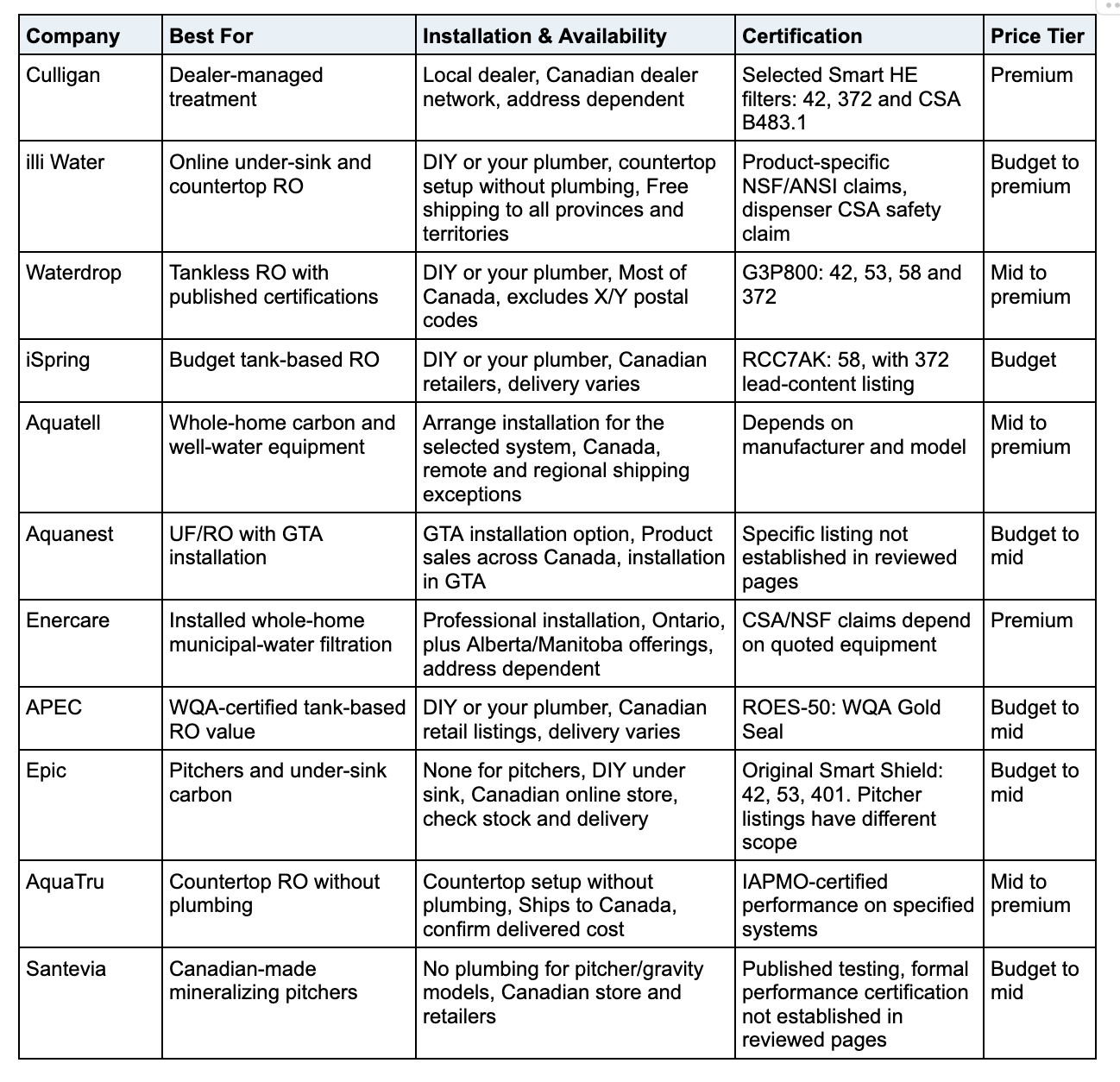
The budget, mid and premium labels indicate relative equipment costs. Installation fees, recurring cartridge purchases and rental terms can change the real cost considerably. And if a provider offers a free water test during a sales visit, don't assume it includes laboratory testing for lead, PFAS or microorganisms. Ask what's actually measured.
Culligan
Best for: Dealer-installed water treatment backed by a Canadian service network.
If you'd rather have someone assess your water, recommend equipment and help maintain it, Culligan's dealer-led approach is worth considering. Its range includes whole-home filtration, water softeners and RO systems for drinking water.
What you'll receive depends partly on the dealer serving your area. Culligan offers in-home water testing, but it's worth asking which measurements the visit includes before treating it as a full water analysis. Installation and ongoing service are also address-dependent.
Warranty terms aren't identical across Culligan products or components. For example, the Aquasential Smart HE filter documentation lists a one-year warranty for the complete system, with longer coverage on specified parts. Ask for the applicable Canadian warranty and labour conditions in writing.
Culligan makes the most sense when you value professional installation and continuing support. Get a second local quote and compare the total installed cost, service fees and equipment—not just the quoted monthly or upfront figure.
illi Water
Best for: Online under-sink and countertop RO options with free Canadian shipping.
illi Water gives buyers several ways to bring RO filtration into the kitchen without committing to a dealer-installed whole-home system. Its range includes four main RO options, from conventional under-sink setups to a refillable countertop dispenser.
The tankless RO system they offer is an 800-gallon-per-day membrane rating, plus app and Wi-Fi features, a smart faucet and alkaline remineralization. That 800-GPD figure reflects production under specified conditions; it isn't a recommendation for how much water a household should drink, nor does it describe the faucet's instantaneous flow.
For a different configuration, the standard RO system offers adjustable filtration-stage options. A Pentair-based four-stage configuration lists roughly 41% water recovery. If you don't want an under-sink plumbing connection, the hot and cold RO dispenser works with a refillable tank.
illi Water offers free shipping to all Canadian provinces and territories, along with phone, email and chat support. Under-sink systems can be installed DIY or by a plumber you hire. The company doesn't provide installation or in-home water testing.
Its systems carry a one-year warranty and a conditional 90-day satisfaction guarantee. Read the exclusions before ordering: consumable filters and membranes aren't covered by the ongoing warranty after initial delivery defects.
Pay attention to the precise certification language as well. Product pages for its RO systems make NSF/ANSI claims, while the hot and cold dispenser page cites CSA safety certification. An electrical safety certification should not be taken as proof that the unit is certified to reduce a particular contaminant.
illi Water is a practical option if you prefer to compare formats online and handle installation yourself. Its reverse osmosis systems collection lets you look at unit dimensions, features and replacement-filter requirements before buying, with free shipping across Canada.
Waterdrop
Best for: Tankless RO systems with published, model-specific certification details.
Waterdrop's Canadian store sells under-sink RO, countertop units and other filtration products. A useful model to examine is the G3P800, whose product page identifies NSF/ANSI 42, 53, 58 and 372 certification. The actual contaminant-reduction claims are limited to those listed in its performance data sheet.
Shipping is another detail to check early. Free economy shipping covers most Canadian addresses, but Waterdrop excludes postal codes beginning with X or Y, affecting buyers in the territories.
Tankless under-sink units need a plumbing connection and electricity. Buyers arrange their own installation, and the G3P800 carries a listed one-year warranty.
Waterdrop is worth comparing if a tankless setup appeals to you and you want detailed model information. Before choosing, price the proprietary replacement filters and check the certification for that exact model. The G3P800's listings don't automatically apply to every Waterdrop system.
iSpring
Best for: Lower-cost under-sink RO with a conventional storage tank.
iSpring is a useful comparison for households that want RO filtration without paying for a tankless format. Alongside its broader water-treatment range, the RCC7AK is a six-stage under-sink RO system with remineralization and a separate storage tank.
Canadian shoppers can find iSpring through retailers such as Home Depot Canada and Costco. Shipping coverage, returns and fulfilment depend on the retailer you choose.
The RCC7AK range supports DIY installation, though you can hire a plumber. A Canadian listing reviewed for this guide specifies a one-year limited warranty. NSF listings identify RCC7AK under Standard 58, with lead-content compliance under 372. Check the model suffix carefully, since retailer versions can differ.
If upfront equipment cost is a priority, iSpring deserves a look. Just make sure the storage tank and filter housings really fit in your cabinet—with the bin and cleaning products in place, not only in an empty measurement.
Aquatell
Best for: Whole-home carbon filtration and equipment tailored to well-water issues.
Aquatell carries a broad selection of treatment equipment: sediment filters, carbon systems, iron and sulphur treatment, ultraviolet units, softeners and RO. Its backwashing carbon-filter range, for instance, distinguishes standard chlorine treatment from catalytic-carbon options intended for chloramine.
The company is based in London, Ontario, and ships across Canada from Canadian warehouses. Some regional, remote and oversized orders are subject to shipping exceptions, so confirm the delivery terms for the system you're considering.
It's best to approach Aquatell primarily as an equipment supplier when weighing options. Before purchase, clarify who will install, commission and service your chosen setup. That matters especially for larger whole-home systems.
Coverage varies by product. The Atmos-AIO iron and sulphur filter, for example, lists five years of warranty protection against manufacturing defects, excluding the piston and seal/spacer.
Aquatell can be a good fit when you've already identified a water problem through testing and need to match it with specific equipment. With well water in particular, choose treatment capacity using your water-analysis results and household flow requirements.
Aquanest
Best for: UF and RO kitchen systems with an installation option in the GTA.
Based in Brampton, Aquanest sells ultrafiltration (UF) systems, RO units, dispensers and replacement filters. Its compact drinking-water products shouldn't automatically be described as whole-home filters. Ask where the system connects and what flow it is rated to deliver.
On its UF product page, Aquanest offers product purchases across Canada, while the associated installation package is restricted to the Greater Toronto Area.
Eligible purchases are covered by a one-year limited reseller warranty. Installation-related coverage applies when Aquanest carries out the work, so check the details if you're planning to use your own installer.
For GTA households looking for a local kitchen-filtration installation option, Aquanest is worth considering. Get the exact model number and its performance documentation before relying on any contaminant-removal statement.
Enercare
Best for: Professionally installed whole-home filtration for municipal water.
Enercare's whole-home filtration is designed to treat water entering the home through the main supply line. Its Ontario filtration page specifies municipal-water use and offers a free in-home assessment, water test and quote.
Ontario is an established service area. Enercare also publishes filtration offerings for Alberta and Manitoba, although availability depends on your address.
Professional installation is included in the service offering. Enercare advertises a 10-year manufacturer's warranty for its home water filter, while maintenance coverage under a rental follows the terms of the rental contract.
This may suit homeowners who want installation arranged for them. Compare the full rental obligation against a purchase quote, including maintenance, service coverage and exit conditions. Don't assume the municipal-water system is suitable for an untreated private well.
APEC
Best for: A WQA Gold Seal-certified, tank-based RO system at a relatively accessible equipment price.
APEC is a US brand with under-sink RO, countertop and whole-house offerings. The five-stage ROES-50 uses a separate storage tank and carries Water Quality Association (WQA) Gold Seal certification.
The ROES-50 is listed in Canadian dollars at Home Depot Canada. As with other retailer purchases, check delivery to your postal code and establish who will handle any warranty claim.
You can install it yourself or use a plumber. APEC's standard RO warranty is one year; eligible systems can receive two years of total coverage when registered within eight weeks of purchase.
APEC is a straightforward alternative if you want a traditional RO arrangement rather than apps or a tankless design. Leave enough room under the sink for the tank and for opening the filter housings during maintenance.
Epic
Best for: Pitchers and under-sink carbon filters that don't produce RO reject water.
Epic's Canadian online store carries pitchers, dispensers, water bottles and under-sink filtration products. Before ordering, check availability for the replacement cartridge as well as the filter unit itself.
Pitchers need no plumbing. For an under-sink option, the original Epic Smart Shield connects to your existing cold-water line and comes with a listed three-year warranty. Other Epic products have different terms.
It's especially important not to generalize certification across this range. The original Smart Shield lists IAPMO certification to NSF/ANSI 42, 53 and 401. Certain Epic pitcher filters have separate NSF component and lead-content listings, and Epic also publishes contaminant-reduction test results. Those are not all equivalent to full-system performance certification. You can't assume the original Smart Shield's certifications apply to Smart Shield Max or every Epic pitcher.
Epic is worth looking at if you want drinking-water filtration without RO and prefer to retain dissolved minerals. Choose a cartridge whose specific reduction claims match your water concern.
AquaTru
Best for: Countertop reverse osmosis without permanent plumbing changes.
AquaTru offers both countertop and under-sink RO systems. Its countertop formats are particularly relevant if you're renting or don't want to drill a faucet hole or alter the plumbing beneath your sink.
AquaTru confirms that it ships to Canada. Before comparing prices, check the checkout currency, shipping fees and possible import charges against the final cost from a Canadian retailer.
These countertop units require electricity and initial setup, but they don't need a permanent plumbing connection. You'll need to refill and clean their reservoirs. The standard warranty lasts one year and doesn't cover filters.
AquaTru says its specified countertop and under-sink systems are certified to reduce 84 contaminants. That's a claim to check against the performance sheet for the model you're considering, not a blanket guarantee covering the entire range.
AquaTru is best considered when you have enough counter space and avoiding plumbing work is a major priority.
Santevia
Best for: A Canadian-made mineralizing pitcher that requires no plumbing.
Santevia's range includes the Canadian-made MINA pitcher, gravity countertop systems and other filters sold through its Canadian store and retailers. The pitcher and gravity options require assembly, flushing and regular cleaning, but not a plumbing installation.
The MINA comes with a 90-day standard hardware warranty. Registering within 90 days can extend eligible hardware coverage under a limited lifetime programme. That programme defines lifetime as 10 years. Replacement filters have separate terms, and shipping charges may apply to extended-warranty claims.
If a mineralizing pitcher is what you're looking for, Santevia is one to compare. The company shares published testing results, but the pages reviewed for this guide did not establish a formal performance certification for the MINA. Published tests and formal product certification are not interchangeable.
There's also a reason to read mineral and pH results in context. In an independent MINA evaluation, laboratory testing found lower calcium and magnesium levels after filtration. The reviewer recorded different pH increases in separate tests. Those findings apply to the tested water and cartridge; they don't show that every current Santevia filter fails to add minerals or raise pH.
Types of Water Filters Sold in Canada
Water filters are often named for where they sit—on a counter, under a sink or at the main supply line. But placement doesn't tell you how the water is treated. Two under-sink systems, for example, might use carbon and RO respectively, with very different capabilities.
- Whole-house filters: Installed on the incoming supply to treat water before it reaches taps and fixtures. Depending on the media, they can address sediment, chlorine-related taste or more specific problems. Installation is more involved, and a typical carbon filter won't soften hard water.
- Countertop filters: A flexible choice for renters or anyone short on cabinet space. Gravity, carbon and RO versions work differently, usually with little or no plumbing. Refillable designs do, however, occupy counter space and require reservoir cleaning.
- Under-sink filters: Treat water used at the kitchen sink for drinking and cooking. They may use carbon, RO or another specified technology. Plan for plumbing connections and enough clearance to change the cartridges.
- Reverse osmosis systems: Push water through a membrane to reduce certain dissolved substances that ordinary sediment filtration leaves behind. They also create a reject-water stream and require cartridge and membrane changes.
- Pitcher filters: An affordable, installation-free starting point for taste improvement or particular certified reduction claims. The drawback is capacity: refilling small batches can become tiresome for larger households.
- Faucet-mounted filters: Attach to compatible taps and commonly use carbon filtration. They're convenient for basic drinking-water treatment, but many pull-out faucet designs aren't compatible.
- Tankless RO systems: Avoid a separate purified-water storage tank, freeing up cabinet space. Powered versions require an outlet, and an advertised daily production rating isn't the same as the rate at which water comes out of the faucet.
- Ultraviolet (UV) treatment: Inactivates microorganisms when properly selected, installed and operated. It can be part of a well-water treatment plan, but it needs electricity, maintenance and appropriate pretreatment. It doesn't remove dissolved chemicals.
- Ultrafiltration (UF): Uses a membrane to filter particles and certain microorganisms according to the unit's specifications. It generally retains dissolved minerals, unlike RO, and isn't a substitute for RO when dissolved-salt reduction is the goal.
If you're dealing with a private well, Health Canada's guide to well-water treatment explains why filtration may be needed before UV disinfection. The CDC's home-filter guide is another useful reference for comparing treatment types and their limitations.
How Reverse Osmosis Water Filters Work
RO works by pushing water through a membrane and directing rejected substances into a separate stream. Many systems combine the following five treatment functions:
1. Pre-filtration traps sediment such as sand and rust.
2. Carbon filtration reduces chlorine and helps protect the RO membrane.
3. The RO membrane reduces dissolved substances identified in the system's specifications.
4. Post-filtration helps improve the taste of the treated water.
5. Optional remineralization adds minerals for taste and pH adjustment.
Five functions don't necessarily mean five separate filter cartridges. Rather than choosing a system simply because it advertises more stages, compare the verified contaminant-reduction claims and the parts you'll need to replace.
Why Canadians Need a Home Water Filter
Canadian municipal tap water is generally safe, and local authorities manage its treatment and monitoring under applicable requirements. That means a home filter isn't a necessity for everyone. Many people buy one because they dislike the taste of their tap water or want to address a particular concern—not because their entire municipal supply is unsafe.
Health Canada develops drinking-water guidelines used to assess water quality. Your local advisory notices, supply conditions and household plumbing still matter, though. Here's where additional treatment may make a difference:
- Chlorine and chloramine: These disinfectants protect public water supplies, but some people notice their taste or smell. Look for a system rated for whichever disinfectant your utility uses.
- Lead from plumbing: Older service lines, solder and fixtures can introduce lead after treated water leaves the plant. Pre-1990s plumbing is a reason to investigate, not proof of a specific lead level at your tap.
- PFAS: If PFAS are a concern, check local test results and look for a filter with a reduction claim for the specific substances involved. Simply being an RO system doesn't prove it carries the relevant PFAS certification.
- Microplastics: Check product-specific particle-reduction evidence. Not all carbon filters can be assumed to remove microplastics, and a reduction claim by itself doesn't establish a specific health benefit.
- Hard water: Calcium and magnesium can leave scale on fixtures and appliances. A properly sized softener treats household hardness, whereas a kitchen RO unit treats only the outlet it's connected to.
- Different water sources: Private wells may have problems absent from a nearby municipal supply. Test the water before deciding on treatment equipment.
The benefit depends on the problem you're solving. A suitable carbon filter can improve taste, a softener can reduce scale, and using filtered tap water you enjoy may cut your bottled-water purchases. None of those benefits means a home filter overrides a drinking-water advisory. Always follow your local authority's instructions.
How to Choose a Water Filter Company in Canada
Start with your water, then choose the company. A well-matched filter from a smaller brand can be more useful than an expensive system that targets the wrong problem. Before placing an order or paying a deposit, work through these eight checks.
1. Contaminants removed and certification. Review your municipal water report or laboratory results. Ask for the exact model and cartridge, together with certification for the reduction you're looking for. Broad promises about “clean water” aren't enough.
2. Daily output and household size. Compare production capacity with actual usable flow. A tank-based RO filter may dispense stored water quickly even though its membrane refills the tank more slowly. For whole-home equipment, size the system for showers and appliances running at the same time.
3. Waste water ratio. Make sure you know which figure represents purified water. At a stated 2:1 pure-to-drain ratio, the system makes two litres of treated water for each litre sent to drain—about 67% recovery in that example. Ask what operating conditions the rating assumes and whether flushing is counted.
4. Space and installation. Measure the equipment, any storage tank and the clearance needed to remove cartridges. Check requirements for a separate faucet, drain connection, electrical outlet or landlord approval before you buy.
5. Filter replacement cost and frequency. Add up the filters and membranes you'll replace over several years, plus shipping. Compare the whole replacement set, not just the least expensive pre-filter, and find out whether the cartridges are proprietary.
6. Municipal versus well water. Confirm the equipment is suitable for the incoming water. A system intended for treated city water won't automatically address microbial contamination, iron or heavy sediment in an untreated well.
7. Warranty and support. Find out which parts are covered, whether you pay for labour or shipping and whether registration is required. If you buy from a retailer or marketplace, identify who actually processes the warranty claim.
8. Local certifications and installation rules. Ask your installer or local authority about applicable plumbing and electrical requirements. A valid product-performance certificate doesn't automatically mean a particular installation meets local rules.
NSF/ANSI and CSA Certifications to Look For
A certification number is useful only when you know what it certifies. Check the precise model and reduction claim in the listing. A system meeting a standard doesn't necessarily remove every contaminant addressed anywhere within that standard.
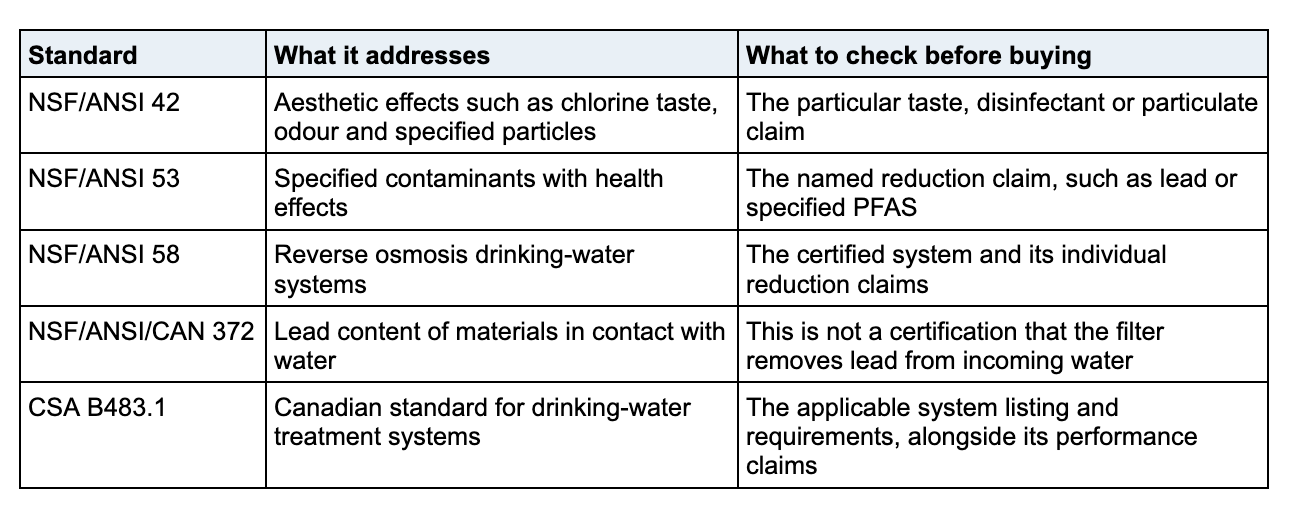
Also pay attention to who and what was certified. Accredited organizations such as WQA and IAPMO can issue certification to NSF/ANSI standards; the certification doesn't have to come directly from NSF. But a lab test performed to a standard, a certified component and a certified complete system are not equivalent. Likewise, a CSA safety mark on an electrical dispenser doesn't establish that the water it produces is certified for PFAS or lead reduction.
Frequently Asked Questions About Water Filters in Canada
Do I need a water filter if Canadian tap water is safe?
Not necessarily. Many Canadian homes don't need additional filtration. Consider a filter when you have a defined concern, such as chlorine taste or possible lead from household plumbing, and use your water report or test results to guide the choice. Continue following any local drinking-water advisory.
Does reverse osmosis remove PFAS?
Suitable RO systems can reduce PFAS, but check the exact claim. Choose a model certified to NSF/ANSI 58 for the specified PFAS reduction and keep to its replacement schedule. Certification doesn't promise zero PFAS or removal of every substance in the PFAS family.
Does reverse osmosis water taste better?
It can, especially when RO reduces the substances causing an unpleasant taste. Preference is personal: some people like water with fewer dissolved minerals, while others prefer remineralization. Higher pH alone doesn't guarantee a better taste.
How often do RO filters need replacing?
Follow your model's maintenance instructions. Many pre-filters and carbon cartridges are replaced around every 6 to 12 months; RO membranes often last longer. Poorer incoming water quality, heavier use or rated capacity limits can shorten those intervals. If you're filtering a health-related contaminant, don't wait until the water tastes different.
Are reverse osmosis systems worth the cost?
They can be when you have a confirmed need for RO or you'd otherwise spend money on bottled water. If chlorine taste is your only concern, a less expensive carbon filter may do the job. Compare installation, cartridge replacements and water consumption along with the purchase price.
Which water filter company has the longest warranty?
There isn't one simple winner for complete-system warranty coverage. Culligan provides lifetime terms for selected components, Enercare advertises a 10-year manufacturer's warranty on its home water filter, and Santevia's eligible extended programme defines product lifetime as 10 years. What's covered, excluded and charged for labour matters as much as the headline duration.
What is the best water filter for well water?
Start with current laboratory test results. Depending on the findings, a well-water plan may involve sediment filtration, iron or sulphur treatment, softening, disinfection and RO for drinking water. A basic kitchen filter isn't a substitute for investigating and correcting microbial contamination.
Are cheaper water filter brands as good as expensive ones?
They can be. A lower-priced filter may meet your needs if its certified reductions and treatment capacity match your water. Higher-cost models may offer faster output, extra powered features or installation support. Compare actual performance and long-term cost rather than using price as a shortcut for quality.
Which water filter is best for removing lead?
Look for a point-of-use unit with an explicit certified lead-reduction claim. Health Canada advises checking lead reduction and Class I particulate reduction under NSF/ANSI 53 and 42. NSF/ANSI/CAN 372 concerns the lead content of product materials; it isn't proof that the filter removes lead already present in the water.
How much does a water filter system cost in Canada?
It depends on the format. Basic pitchers, faucet filters and some tank-based under-sink RO systems sit toward the budget end. More advanced under-sink and countertop equipment tends to fall in the mid-range, while high-output tankless RO and professionally installed whole-home systems commonly cost more. Compare installed and ongoing costs within the same type of system rather than comparing a pitcher with a full-house installation.
Choosing the Right Water Filter Company in Canada
The most useful shortlist isn't necessarily the one with the biggest brand names. It's the one that matches your water-quality results, your kitchen or household setup, and the amount of service you want after installation.
For a whole-home system, request written quotes with comparable equipment, installation details and service terms. For drinking-water filtration, compare specific models, their certified reduction claims and replacement-filter costs. Then confirm the warranty and shipping availability for your address.
If illi Water is on your list, the Which System is Right for You? quiz on the illi Water website can help you narrow the formats, or you can browse its reverse osmosis systems directly. Compare what fits your kitchen and filtration needs, keeping in mind its free shipping across Canada, one-year limited warranty and conditional 90-day satisfaction guarantee.
