
How to Choose the Right Place to Raise Your Family
A neighborhood can look perfect during a Saturday afternoon visit and feel completely different during a Monday morning school run. For families, choosing where to live affects far more than the address on the front door. It shapes commutes, schooling, childcare, friendships, recreation, household costs, and how much time everyone actually gets together.
The challenge is that few places score equally well in every category. A larger home may mean a longer commute, while an excellent school district could come with higher housing costs. The goal is to identify which trade-offs your family can comfortably make and which factors should remain non-negotiable.
TL;DR: Family Location Essentials At a Glance
Start with family needs before comparing cities or neighborhoods.
Calculate everyday expenses alongside monthly housing costs.
Research individual schools instead of relying solely on ratings.
Check childcare and healthcare before committing to an area.
Evaluate neighborhood safety during different times and days.
Include school runs when calculating your household commute.
Experience shortlisted neighborhoods before making a long-term commitment.
Start With What Your Family Actually Needs
Before opening property listings, decide what a workable location looks like for your household. Separating necessities from preferences makes it easier to compare places without being distracted by features that matter less.
Separate Must-Haves From Nice-to-Haves
Write two lists. Your must-haves might include staying within a fixed housing budget, access to suitable schools, enough bedrooms, a manageable commute, or living close to relatives.
Nice-to-haves might include a larger yard, particular restaurants, a newer home, or being within walking distance of entertainment. If a location fails several essentials, attractive extras probably will not make it suitable.
Think About Your Family's Daily Routine
Picture an ordinary Tuesday rather than an ideal weekend. Who takes the children to school? How far is childcare from work? Can someone quickly reach the grocery store, pharmacy, sports practice, or grandparents?
Map these regular trips from any neighborhood you are seriously considering. A home that adds significant driving to several daily tasks can become inconvenient even when each destination appears reasonably close on a map.
Consider How Your Needs May Change
A location that works with a toddler may feel different once that child starts school or becomes a teenager. Think about whether the area provides suitable schools, recreation, transportation, social opportunities, and enough housing flexibility for later stages of family life.
Also consider changes that could affect the adults. Another child, a different job, remote work, or caring for aging relatives could change what you need from your location.
Work Out What You Can Realistically Afford
Start with the cost of housing, but do not stop there. Two areas with similar home prices can produce very different monthly household expenses.
Build a location budget that includes:
Rent or mortgage payments
Property taxes where applicable
Home or renters insurance
Utilities
Childcare
Transportation and fuel
Groceries
School-related expenses
Children's activities
Regular household services
Compare the total rather than asking only, "Can we afford this house?" Leaving some room in the budget can also prevent housing costs from limiting activities, savings, or other priorities important to your family.
Look Closely at Schools, Childcare, and Healthcare
For families with children, essential services can influence both children's experiences and parents' schedules. Research what is actually accessible from the specific neighborhood, rather than assuming that citywide options will be convenient.
Research Schools Beyond a Single Rating
A rating can be a useful starting point, but it cannot tell you whether a school fits your child. Look at curriculum, programs, class environment, extracurricular activities, transportation, special education services where relevant, and the schools children typically progress to afterward.
School boundaries deserve particular attention because an address can determine the assigned public school. NCES research also shows that parents consider factors including staff quality, safety, curriculum, academic performance, class size, extracurricular options, location, and special education when comparing schools.
Check Childcare Availability and Practicality
For younger children, find out which daycare, preschool, and after-school options would realistically work with your schedule. Check operating hours, location, availability, enrollment requirements, and how drop-off affects the journey to work.
A childcare center near home may be convenient for remote-working parents, while one near the workplace might make more sense for someone commuting daily.
Consider Access to Family Healthcare
Identify nearby pediatricians, family doctors, dentists, pharmacies, urgent care centers, and hospitals. If someone in the household needs regular specialist care, calculate the actual travel required rather than simply confirming that a provider exists somewhere in the wider area.
Healthcare access becomes particularly important when appointments are frequent or urgent care is needed outside normal office hours.
Calculate the True Impact of Your Commute
Do not measure commuting only from home to the office. A family's real travel pattern can include school, daycare, work, shopping, medical appointments, sports, and other weekly activities.
For context, the U.S. Census Bureau reported that the mean one-way commute for U.S. workers was 27.2 minutes in 2024. A seemingly small increase can become significant when it occurs twice daily and is combined with school or childcare trips.
Test important routes during the times you would actually travel. This provides a more useful picture than checking distance alone.
Look for Community, Support, and Things to Do
A family does not experience a location only through its house and school. Consider who will be nearby and what opportunities the community provides for children and adults.
Consider Your Existing Support Network
Living near grandparents, relatives, or trusted friends can make childcare, emergencies, school pickups, and busy weeks easier to manage. Think about how often you currently rely on these people and what would change if you moved farther away.
If moving away from your existing network, investigate how easily your family could begin forming new connections through schools, neighborhood groups, community organizations, or children's activities.
Check Recreation and Social Opportunities
Look for parks, playgrounds, libraries, sports facilities, swimming pools, community centers, clubs, trails, and age-appropriate activities. Focus on options your family would realistically use rather than counting amenities simply because they exist.
For example, a nearby public library with children's programs may provide more everyday value to a young family than a major attraction requiring a long drive.
Experience an Area Before Making a Long-Term Decision
Online research can narrow your options, but it cannot fully show what living somewhere feels like. Visit shortlisted areas during weekday mornings, school pickup times, evenings, and weekends.
Try your likely commute, walk around residential streets, visit local parks, explore grocery options, and see how long routine journeys actually take. If possible, spending several days in or near a neighborhood can provide a better sense of normal life than a short property viewing.
Family Relocation Real Estate Options At A Glance
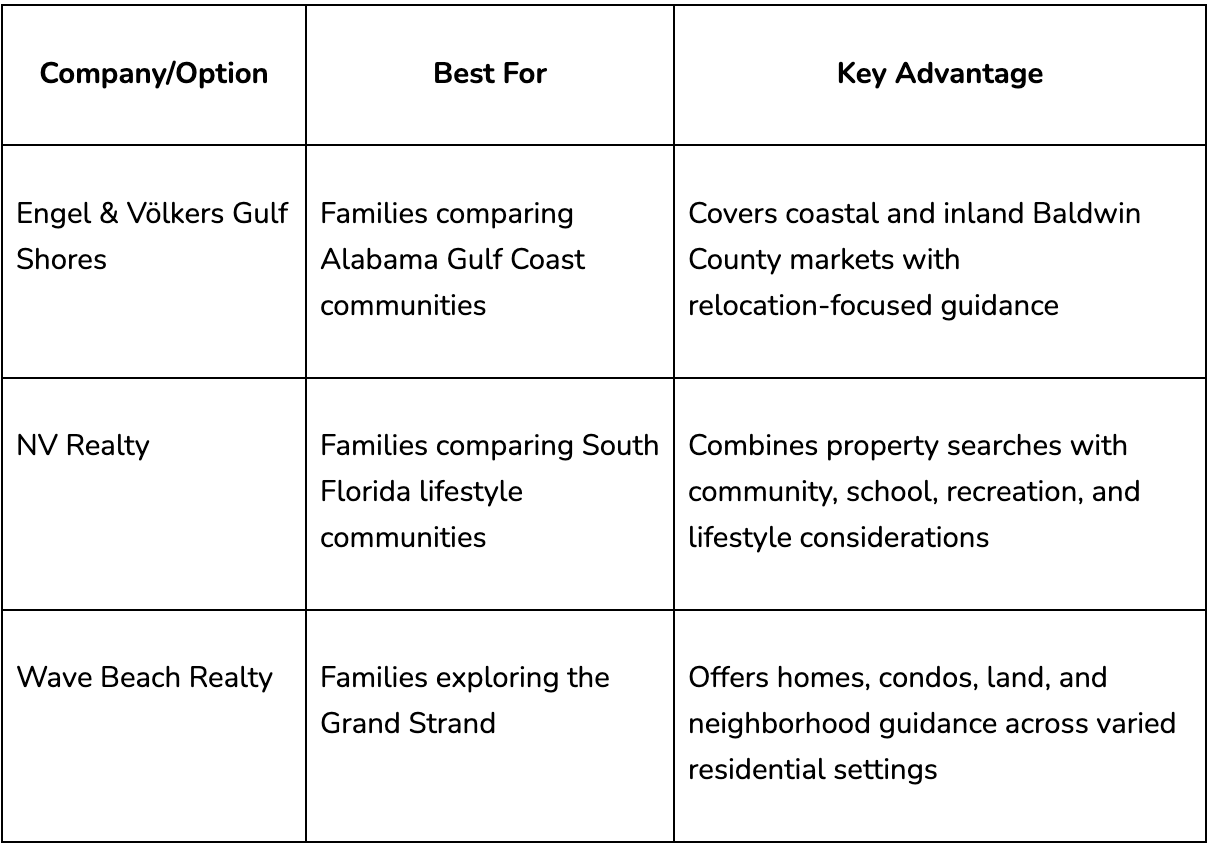
1) Engel & Völkers Gulf Shores: Coastal and Inland Home Search
Engel & Völkers Gulf Shores is a real estate brokerage serving Alabama’s Gulf Coast and Baldwin County, including Orange Beach, Gulf Shores, Daphne, Fairhope, Spanish Fort, Foley, and nearby communities.
For families considering a permanent move, the brokerage offers access to both coastal and inland residential areas. Its relocation-focused content also covers housing, community life, employment, family activities, traffic, daily services, recreation, and differences between coastal and inland living.
Key Highlights
Advisors provide local market knowledge, neighborhood guidance, property searches, and buyer representation services.
Property options include single-family homes, waterfront residences, condominiums, and inland residential properties.
Coverage includes coastal and inland communities throughout Orange Beach, Gulf Shores, and Baldwin County.
Relocation content explores family activities, daily services, housing, traffic, community life, and recreation.
Why Choose Engel & Völkers Gulf Shores
Engel & Völkers Gulf Shores combines local Gulf Coast property knowledge with coverage of both coastal and inland Baldwin County communities. This makes it useful for families comparing different residential settings and lifestyles before deciding where to buy a home.
2)NV Realty: Lifestyle-Focused Coastal Community Choices

NV Realty is a real estate company serving buyers and sellers across Florida and South Carolina, with extensive coverage throughout Palm Beach County and surrounding South Florida communities. Its residential options include single-family homes, condominiums, townhomes, waterfront residences, golf-community homes, gated properties, and land.
For families considering where to settle, the company provides community information alongside property searches, allowing buyers to compare locations according to housing and lifestyle preferences. Featured areas offer different combinations of family-oriented communities, outdoor recreation, beach proximity, healthcare, shopping, parks, and walkable neighborhoods.
Key Highlights
Buyers can prioritize location, schools, space, property features, price, and lot size.
Palm Beach Gardens combines gated neighborhoods, healthcare access, parks, recreation, and varied housing.
Jupiter provides family-oriented communities alongside beaches, parks, boating, fishing, golf, and outdoor activities.
Delray Beach combines varied residential choices with walkable areas, parks, recreation, and community events.
Why Choose NV Realty
NV Realty allows families to compare communities according to both available housing and the lifestyle surrounding each location. Its coverage is particularly useful for buyers exploring different residential settings across South Florida or its covered South Carolina markets.
3) Wave Beach Realty: Varied Grand Strand Living Options
Wave Beach Realty is a locally owned real estate brokerage based in North Myrtle Beach, serving the Grand Strand, Horry County, and nearby communities. Its property coverage includes homes, condos, land, coastal residences, golf-course communities, and more traditional residential neighborhoods.
For relocating families, the brokerage provides options across different living environments, from Myrtle Beach and North Myrtle Beach to quieter areas such as Little River and more inland communities such as Longs. Its neighborhood guidance also helps buyers understand the setting and lifestyle of different areas before narrowing their property search.
Key Highlights
Neighborhood guides help relocating families compare coastal, suburban, and inland Grand Strand communities.
Property choices include single-family homes, condos, residential neighborhoods, golf communities, and undeveloped land.
Little River offers quieter coastal surroundings with water access near North Myrtle Beach.
Longs provides an inland alternative with convenient access to nearby beaches and local attractions.
Why Choose Wave Beach Realty
Wave Beach Realty combines local Grand Strand knowledge with a broad selection of residential settings and property types. Families unfamiliar with the region can compare coastal, suburban, and inland communities while receiving hands-on assistance throughout their property search.
Compare Your Final Options With a Family Location Checklist
Once you have narrowed the search, compare locations using the same criteria. This prevents one impressive feature from overshadowing weaknesses elsewhere.
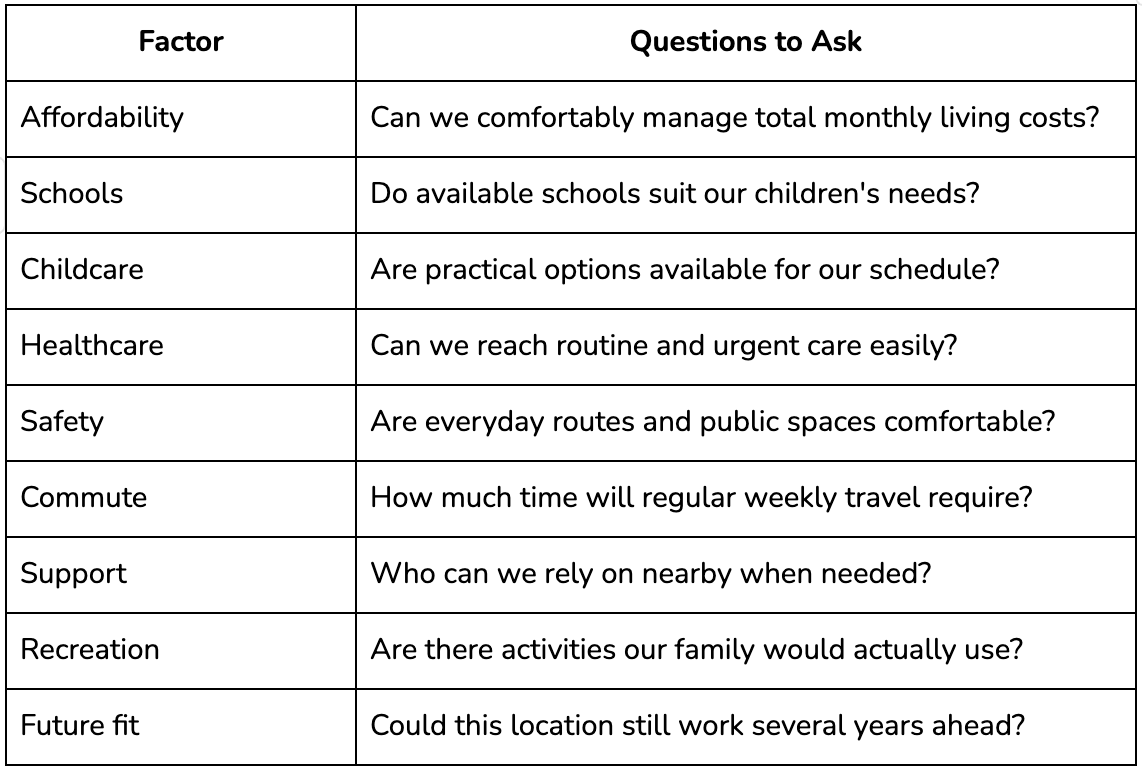
You do not need to give every factor equal importance. Weight the categories according to your family's priorities, then compare each shortlisted location using the same approach.
Choose a Place That Works Beyond Moving Day
A good family location should make ordinary life easier once the excitement of moving has passed. Think about the Wednesday school run, an unexpected doctor's appointment, Saturday activities, grocery shopping, and who can help when plans change.
The strongest choice is one that gives your family a workable combination of financial breathing room, useful services, manageable routines, supportive surroundings, and room for future changes. That may look very different from the place that ranks highest on someone else's list.
Frequently Asked Questions
Should you rent before buying when moving your family?
Renting first can give you time to experience neighborhoods before making a major property commitment. It can be especially useful when you are relocating somewhere you have visited only briefly.
How many neighborhoods should you compare before deciding?
There is no ideal number, but a focused shortlist makes detailed comparison easier. Keep locations that meet your main requirements, then investigate those areas more closely rather than continuously adding alternatives.
Is it better to live near family or have more affordable housing?
Compare the financial savings with the practical value of nearby support. Regular childcare help, emergency assistance, and easier family contact may justify higher housing costs for some households, while others may benefit more from additional financial flexibility.
When is the best time to move with school-age children?
A school break can simplify the transition, but the child's circumstances, housing availability, and parents' work schedules also matter. Contact the new school early to understand enrollment dates and what records or arrangements are required.
What should families check during a neighborhood visit?
Check traffic, noise, lighting, parking, pedestrian routes, and general activity at different times. Also test journeys you would make frequently, rather than limiting the visit to the property and its immediate street.
