
Does Joint Conservatorship Mean Equal Parenting Time in Texas?

When parents hear "joint managing conservatorship," many picture a strict 50/50 calendar. That is not how Texas law works. Conservatorship and possession sit in separate parts of a parenting order, and each answers a different question. If you understand early on how custody lawyers handle conservatorship, you can keep the two issues straight from the start.
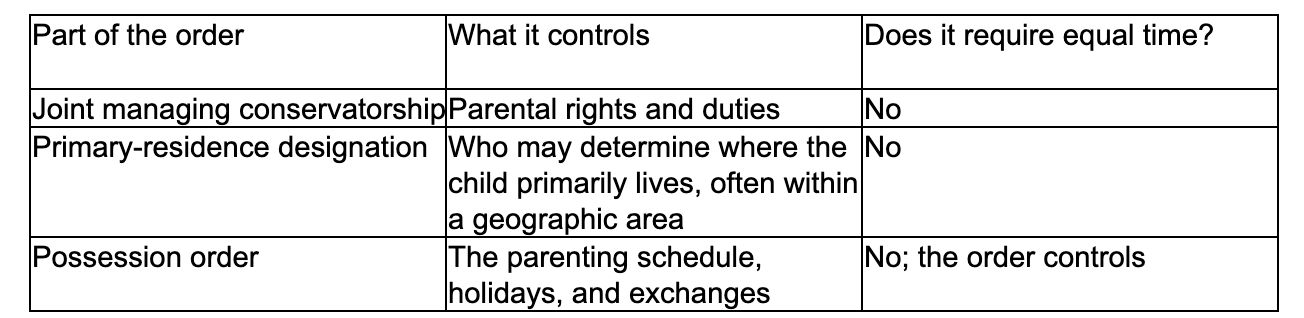
No. Joint managing conservatorship in Texas generally covers parental rights and decision-making; a separate possession order controls when the child is with each parent. So a court can name parents joint managing conservators, yet still give one parent more time, let one parent choose the primary residence, and order the other to pay child support.
How custody lawyers handle conservatorship and possession
Conservatorship covers the legal rights and duties involving your child. Possession and access set the parenting calendar. Much of the confusion starts with the word itself: Texas says "conservatorship" where most parents would say custody.
Joints conservators rarely hold every right equally. The Texas Family Code, Chapter 153 addresses this directly in §153.134: certain rights may be exercised independently, while others call for joint agreement or belong to one parent alone. A typical order might demand agreement on certain medical decisions, for instance, but let either parent pull school records without asking.
Section 153.135 puts it bluntly: joint managing conservatorship does not require equal, or even nearly equal, physical possession. The label can mislead you. When you read your order, set the decision-making clauses beside the separate calendar covering school nights and holidays. Figuring out which part controls what is often the heart of the matter when custody lawyers handle conservatorship disputes in Texas, and the distinction usually decides the outcome.
Can joint conservatorship still give one parent more parenting time?
Yes. A Texas court can appoint both parents as joint managing conservators and still award one of them substantially more possession time. Under §153.002, the child's best interest governs.
Under §153.134, a joint arrangement ordered by a court has to name the parent holding the exclusive right to determine the child's primary residence. The court can also restrict that residence to a specified geographic area. An agreed parenting plan may address the designation differently under §153.133(c).
A Standard Possession Order is a statutory scheduling framework under §§153.252 and 153.312. It is not another name for joint conservatorship, and it is not an automatic equal-time calendar. Parents may propose alternating weeks or a 2-2-5-5 schedule, subject to the court's best-interest review under §153.007.
Decision-making provisions determine who may make decisions. Possession provisions specify when your child stays with each parent, including during school breaks. One clause does not override the other.
How do primary residence and child support work with joint conservatorship?
Joint managing conservatorship does not prevent one parent from holding the exclusive right to determine the child's primary residence. It also does not automatically remove either parent's potential child-support obligation.
Equal time does not cancel support. Sections 154.001 and 154.125 address support authority and guidelines. Under §154.123, courts may consider the parents' resources and the child's needs when deciding whether guideline support would be inappropriate. Possession arrangements and health-insurance costs also factor in.
The residence designation does not determine who pays. You could share major educational and medical decisions yet have fewer overnights and owe support. Those provisions can legally coexist, so check the separate support terms for the amount and the payment deadline.
Which two managing conservatorship types does Texas recognize?
The two principal managing-conservatorship arrangements are joint managing conservatorship and sole managing conservatorship. Joint managing conservators share or divide rights as the order directs.
Section 153.131 creates a presumption that appointing the parents as joint managing conservators is in the child's best interest. A finding of a history or pattern of family violence removes that presumption. A sole managing conservator receives the exclusive rights listed in §153.132.
The other parent may be appointed a possessory conservator with court-ordered possession or access under §153.191. That is not a third type of managing conservatorship; it describes a different position within the custody order.
"Child custody" is the common conversational label for this parent-child arrangement. Parental conservatorship is not guardianship of an incapacitated adult or management of an adult's estate.
When can a Texas custody order be modified?
A court may modify a conservatorship or possession order when the statutory requirements are met and the requested change is in the child's best interest.
Under §156.101, a material and substantial change since the controlling order or agreement is a principal ground for modification. An inconvenient schedule alone does not automatically establish grounds for a change.
A child age 12 or older may express a preference in chambers about who should hold the exclusive right to determine the primary residence. The child does not decide alone. The judge retains final authority under §153.009.
Another ground is the voluntary relinquishment of primary care and possession by the conservator with the exclusive residence right for at least six months, subject to the statute's military-deployment exception.
Keep following the signed order until the court approves a modification, even if you and the other parent have agreed to replacement terms. Informal swaps leave you exposed if the disagreement returns.
Do you need a custody lawyer to obtain conservatorship?
No. A parent may bring a custody suit under §102.003(a)(1), and hiring counsel is not universally required. You are still responsible for following court procedures and presenting evidence. Consider legal advice when safety allegations arise or before a contested relocation.
Is a parent conservator financially responsible, and who pays?
The title alone does not make a parent responsible for every expense. The order allocates child support and healthcare obligations under Chapter 154, including medical and dental support. Parents are not paid simply for holding the designation. This answer concerns parents rather than compensation for a court-appointed guardian.
How is guardianship different from conservatorship?
Texas Estates Code, Chapter 1151 governs guardians' authority and its limits. Court supervision and reporting obligations under Chapter 1163 can add administrative work. A parent conservator instead operates under the Family Code and the custody order.
What drawbacks can come with legal guardianship?
Legal guardianship can involve court oversight, periodic reporting, recordkeeping, and limits on the guardian's authority. Those duties can take time and may continue until a court changes or ends the guardianship. These drawbacks concern guardianship under the Estates Code, not a parent's conservatorship under the Family Code.
Read the order, not just the label
"Joint managing conservators" is only the starting label. Read the signed order before planning exchanges or making decisions about school enrollment. Check residence restrictions separately from payment provisions. A shared title answers neither question. If the written schedule no longer fits your child's circumstances, document the problem and seek advice about modification rather than relying on an informal arrangement that conflicts with the current order.
