
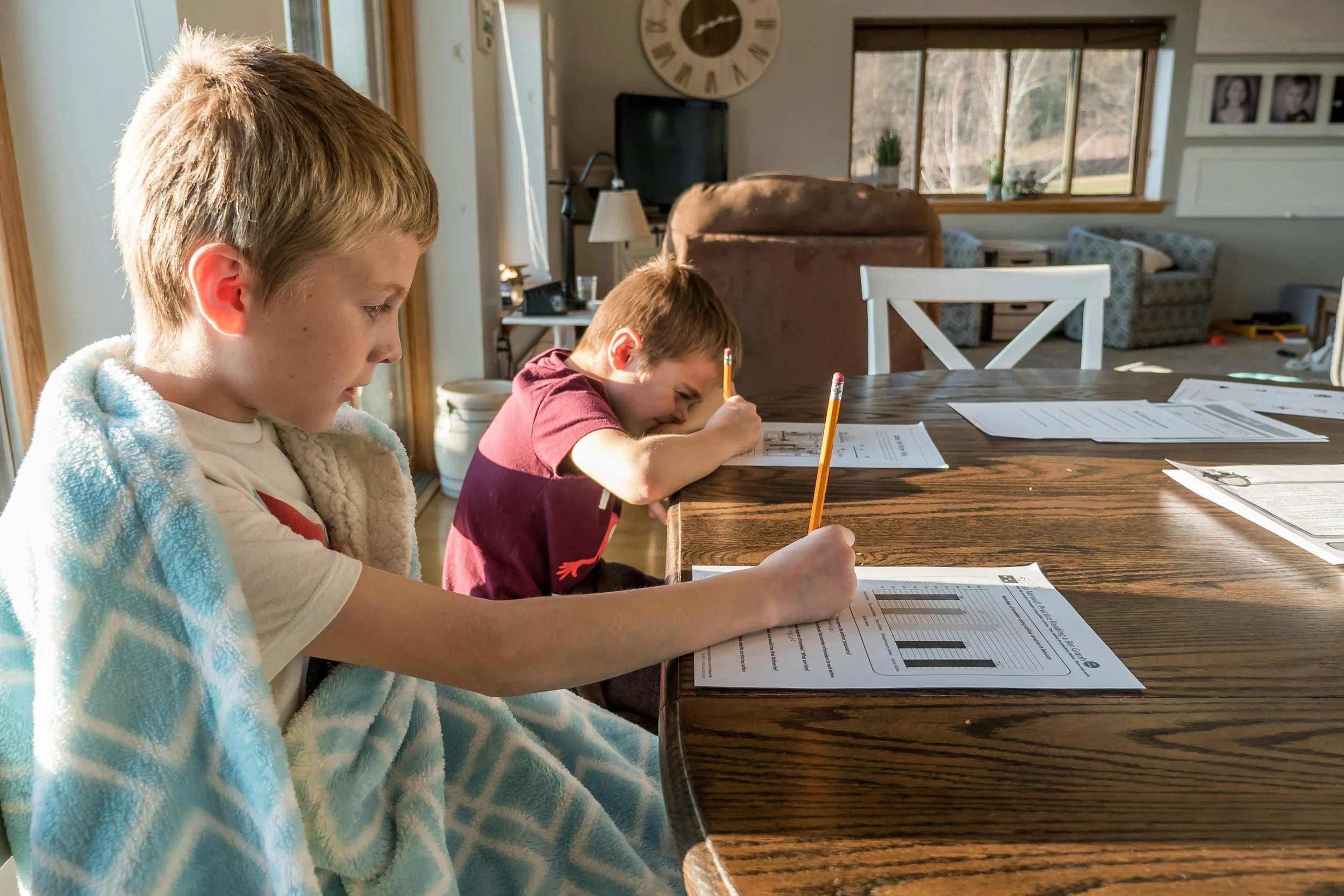
A parent pulls a nine-year-old out of third grade in October and sets up a desk in the dining room. The first week runs on the old clock. Work at eight, lunch at noon, something academic until three. By Wednesday the child is under the table and the parent is quietly panicking, because the math took eleven minutes and there are six hours to fill.
Nothing has gone wrong. Those six hours were never a measure of how long a child can concentrate. They measure what it takes to move, feed, supervise, and instruct a large group of children in one building.
What actually fills a school day
Count the parts of a class period that are not instruction. Attendance. Getting materials out and putting them away. Waiting while a teacher answers a question the other twenty-four already understood, then re-explaining what a third of the room missed. Transitions, lining up, announcements. Lunch, recess, and the settling that follows both. None of it is waste. It is the necessary overhead of running a group. But it occupies most of the clock.
One-to-one instruction removes almost all of it. A parent explaining long division to one child does not have to pitch the explanation at the middle of a distribution. They watch the child's face, stop when it lands, and move on. Parents who look at how the two settings differ in practice usually find the gap is not in the teaching itself. It is in everything arranged around the teaching.
How long a child can work before the returns fall off
Attention is finite, and it is shorter in younger children. Home schedules tend to ignore that anyway. Focused academic work is genuinely effortful for a five-year-old, and the effort is spent in minutes. Ten or fifteen minutes on one task is real work at that age. By eight or nine, twenty to thirty minutes on a subject is reasonable. A motivated teenager can hold forty-five minutes to an hour. Past that, most are still sitting but no longer learning much.
These are not rules. The same child varies by subject, by time of day, and by how well they slept. But the direction holds. The window is shorter than most parents assume, and it lengthens slowly with age. A five-year-old and an eleven-year-old are running two different clocks under one roof.
The second cost is switching. A child pulled out of a math problem to answer the door does not resume where they left off. They resume behind it, and the deeper the work was, the further back they land. A day with eleven small activities can feel busier and produce less than a day with three long ones. A younger sibling's interruptions are the main tax on an older child's morning.
What a day of sitting does, and what a day at home can do instead
Movement is the difference parents notice first. A child at school sits most of the day by design, since thirty bodies moving freely in one room does not work. Recess and gym are the scheduled release valves. At home there is no structural reason to sit still. A child can do a page of math standing at the counter, read on the floor, or run laps of the yard.
That freedom is worth spending on purpose. Physical activity affects how well anyone thinks, and children are not exempt. A short burst of real movement between blocks does more for the next one than ten more minutes of pushing through the last. Fifteen minutes outside is often what makes the second half of the day possible.
Sleep is the same argument on a longer cycle. Teenagers tend to fall asleep later than younger children do, and start times are set by bus routes rather than by anyone's body clock. At home that constraint disappears. A fourteen-year-old who begins at nine instead of seven often finishes earlier, because the work is being done by a rested brain.
Why the school timetable does not transplant
The most common early mistake is to rebuild the schedule at home. Six subjects, forty-minute periods, a fixed start and end. That timetable was built around the overhead, and the overhead is gone. What remains is a set of blocks far larger than the work that goes in them, so the day gets padded with busywork. Children learn that finishing early produces more assignments, and they slow down accordingly.
The advice most often given to families making the move from a classroom is to spend the first few weeks watching rather than scheduling. Note when each child's attention is sharpest. Note what a subject takes when nobody is waiting on anybody. Those numbers are the only sound basis for a schedule.
A day built on two or three blocks
What tends to hold up is a small number of protected work blocks with movement between them. The first goes early, while attention is best, and takes the hardest subject. Then the body gets involved for fifteen or twenty minutes. Then a second block. For a young child that may be the whole academic day, ninety minutes in total. A high schooler adds a third block after lunch.
A block is only worth the name if it is defended:
A clear end, so the child works toward something rather than into an open horizon.
No incoming interruptions, including a parent's phone and a sibling's questions.
One subject at a time, finished or stopped cleanly, never half-abandoned for another.
Practical guidance on structuring the day around attention rather than around hours reverses the usual order. Decide what the work is. Then decide how long it honestly needs. The clock comes last.
The families who settle into this quickest are the ones who stop counting hours. A morning with two blocks of real concentration, a body that has been used, and a child still willing to sit down tomorrow is a longer day than any timetable can describe.
