
How Physicians Can Pivot to Non-Clinical Careers

Medicine asks a lot from you. The long shifts, the shrinking autonomy, the emotional toll that never fully lifts; for many doctors, it eventually becomes unsustainable.
A 2018 Physicians Foundation survey found that 78% of physicians sometimes, often, or always experience burnout, and 46% are actively considering a career change. If that sounds familiar, here's something worth knowing: your medical degree is far more versatile than you've probably been told.
The Current State of Non-Clinical Careers for Physicians
Something significant is happening right now. Doctors are leaving traditional practice in record numbers; not because they failed, but because the healthcare landscape has fundamentally shifted beneath their feet. The platforms and structured pathways supporting nonclinical careers for physicians have expanded dramatically, giving physicians access to resources that simply didn't exist five years ago.
Major Industry Trends Reshaping What's Possible
Healthcare tech, remote-first work culture, and a swelling pharmaceutical pipeline have created real, sustained demand for medical minds outside the clinic. Alternative careers for doctors aren't niche experiments anymore; they've gone mainstream.
Private equity investment in physician practices hit roughly 6.5% in 2024, generating entirely new categories of operational, strategic, and leadership roles. These are positions that favor exactly the kind of person who understands clinical realities from the inside.
What Changed After the Pandemic
The pandemic forced a reckoning. Physicians who'd spent years quietly tolerating the system suddenly stopped tolerating it. Flexibility, genuine autonomy, and impact that extends beyond a single patient encounter moved to the top of the priority list, and that's precisely what non-clinical roles consistently deliver.
Understanding why doctors are seeking change matters. But understanding what the opportunity landscape actually looks like right now? That's where things get genuinely interesting.
Key Challenges Physicians Face When Leaving Clinical Practice
The opportunities are real. Pharma is expanding, health tech is booming, and remote roles are multiplying fast. But knowing the landscape exists and successfully navigating it are entirely different propositions.
The Identity Problem
Leaving clinical medicine can feel like losing yourself. That's not dramatic; it's genuinely how many physicians experience it. But here's the reframe that changes everything: your clinical experience isn't a professional limitation. It's a business asset. Once you internalize that, the transition starts to feel less like an ending and more like a strategic move.
Networking and Rebranding Barriers for Jobs for Doctors Outside Medicine
Most physicians have built networks almost exclusively within healthcare. Breaking into consulting, tech, or pharma requires deliberate outreach into unfamiliar territory. And jobs for doctors outside medicine are frequently filled through connections before a posting ever goes public. Rebranding yourself for these audiences takes focused effort, and most physicians genuinely don't know where to begin.
Once you understand what's in your way, it becomes much easier to plan around it.
Top Sectors for Non-Clinical Physician Jobs in 2024 and Beyond
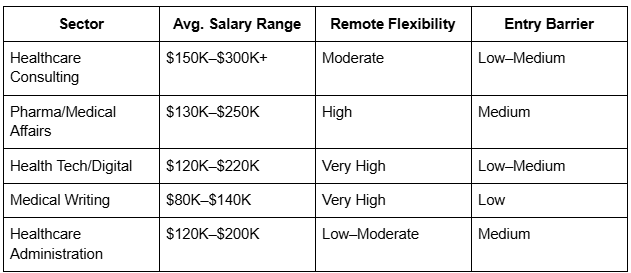
The range of well-compensated, high-impact roles available to physicians might honestly surprise you. Here's a useful snapshot:
Consulting and Strategy
Physician consultants bring something pure business professionals can't fake: clinical credibility. Firms like McKinsey, Huron, and Deloitte actively recruit physicians for roles spanning hospital operations to payer strategy. The work is intellectually demanding differently, and many doctors find it quietly addictive.
Pharma, Biotech, and Health Tech
Non-clinical physician jobs in medical affairs, drug safety, and clinical development offer strong compensation with real growth trajectories. Health tech companies building AI-powered clinical tools or digital therapeutics are hiring physician advisors at an accelerating pace, and they're not slowing down.
Knowing where opportunities exist is powerful. Knowing how to position yourself to actually land them? That's what separates doctors who dream about transitioning from those who do it.
Strategies That Actually Work During a Physician Career Transition
A successful physician career transition doesn't happen by accident. It requires deliberate positioning, intentional networking, and occasionally a new credential or two.
Translating What You Already Know
Diagnostic reasoning. The ability to synthesize chaotic, incomplete information under pressure. Clear communication with people who are scared and confused. These skills are enormously valuable outside clinical settings; the challenge is translating them into language that resonates with hiring managers who've never stepped inside a hospital.
Rebuilding Your Resume and LinkedIn Presence
Your resume needs more than minor edits. It needs a full reframe. Lead with outcomes, quantify your impact wherever possible, and tailor every application to the specific role. Generic clinical CVs don't translate.
Upskilling and Negotiating Your Worth
Health informatics certifications, an MBA, or targeted AI coursework can accelerate your timeline meaningfully. And when an offer lands, negotiate. Physicians routinely undervalue themselves in non-clinical salary discussions, often leaving 10–20% on the table without realizing it.
Physicians Who Made the Pivot and What They'd Tell You
Real people. Real transitions. An emergency medicine physician landed a medical director role at a telehealth startup within eight months. A hospitalist completed a focused networking push and secured a remote position in pharma medical affairs with a top-five biotech. A pediatrician now consults for hospital systems on quality improvement and hasn't looked back once.
Every one of them will tell you the pivot was possible, and every one of them also wishes someone had flagged the mistakes that nearly derailed them.
Mistakes That Cost Physicians Time and Momentum
The costly errors aren't dramatic. They're quiet. Physicians routinely underestimate the timeline; six to twelve months is realistic; six weeks is not. Many skip networking entirely until desperation sets in. Resumes read like academic CVs rather than business documents. LinkedIn sits ignored until opportunities have already passed to someone else.
Knowing the pitfalls is genuinely half the battle.
Resources and Where the Field Is Heading
Communities like the Physician Non-Clinical Career Hunter Facebook group, the American Association for Physician Leadership, and podcasts like Doctors Unbound offer actionable, grounded guidance from people who've actually done this.
For future opportunities, watch digital therapeutics, AI-assisted medical training, and precision medicine firms closely; these sectors will generate significant physician leadership demand over the next five years.
The Next Chapter Is Closer Than You Think
If you're seriously exploring nonclinical careers for physicians, know this clearly: these are not backup plans. They're deliberate, frequently fulfilling career choices that thousands of physicians are making right now, with intention.
Your training is a genuine competitive edge across pharma, tech, consulting, writing, and beyond. The transition takes planning and patience, but it's entirely within reach. Download a career transition checklist. Connect with one non-clinical physician this week. Take one concrete step toward the career that actually excites you. That's how it starts.
Your Most Pressing Questions, Answered
What other jobs can a physician do?
Pharma, health tech, consulting, medical writing, hospital administration, insurance, legal consulting, and policy all value your clinical background, and most don't require additional degrees to get started.
How do you transition out of clinical medicine?
Identify your transferable skills first. Then rebuild your resume and LinkedIn for non-clinical audiences, network deliberately within your target industry, and give yourself an honest six-to-twelve-month runway.
Are there remote or flexible options?
The data says yes; emphatically. Flexible schedules were reported by 69% of physicians already working in non-clinical roles, which remains one of the most compelling arguments for making the move.
