
How to Choose Dog Supplements for Joint, Skin, and Gut Health
The pet supplement aisle can feel overwhelming. Bottles promise shinier coats, easier movement, and calmer stomachs, but it is not always clear which claims are supported by useful evidence. Start here: a supplement may support a specific need when it is chosen carefully and used alongside veterinary care. It does not cure, treat, or prevent disease.
One safety note comes first. Never give your dog human gummies or chewables. Many contain xylitol, a sweetener that is dangerous to dogs, and suspected ingestion is an emergency. Contact your veterinarian or an animal poison-control line right away. This guide explains how to read labels, what the evidence says for joint, skin, and gut support, and how to run a safe trial with your vet.
Key Takeaways
Supplements support, they do not cure. Treat them as helpers for lean body weight, appropriate activity, and a targeted diet, not as replacements for veterinary care.
Talk to your vet first. AAFCO advises pet owners to speak with their veterinarian before adding supplements and to follow label directions and any prescribed dosing.
Pet supplement regulation is different. DSHEA, the U.S. law for human dietary supplements, does not apply to animal food. Pet products are regulated as animal food or as drugs depending on intended use.
Labels matter more than front-panel claims. Check active amounts per dose, probiotic strains, guaranteed CFU at the end of shelf life, fiber type, storage instructions, and caution statements.
Watch interactions. Fish oil can interact with anticoagulants and NSAIDs, so let your vet guide its use.
When to Call Your Vet First
Supplements are not the right response to an urgent problem. Contact your veterinarian promptly, before reaching for any product, if your dog shows:
Sudden lameness or a hot, swollen joint
Bleeding, or vomiting that contains blood
Persistent itching paired with repeated skin infections
Ongoing diarrhea or unexplained weight loss
These signs can point to conditions that need diagnosis and treatment. A supplement chosen without that context may delay care your dog actually needs.
How Pet Supplements Are Regulated
Many owners assume pet supplements follow the same rules as their own vitamins. They do not. In the U.S., the Dietary Supplement Health and Education Act, often called DSHEA, applies to human dietary supplements, not animal food. Depending on intended use, a pet supplement may be regulated as animal food or as an animal drug. Products that claim to diagnose, treat, cure, or prevent disease generally need approval as animal drugs.
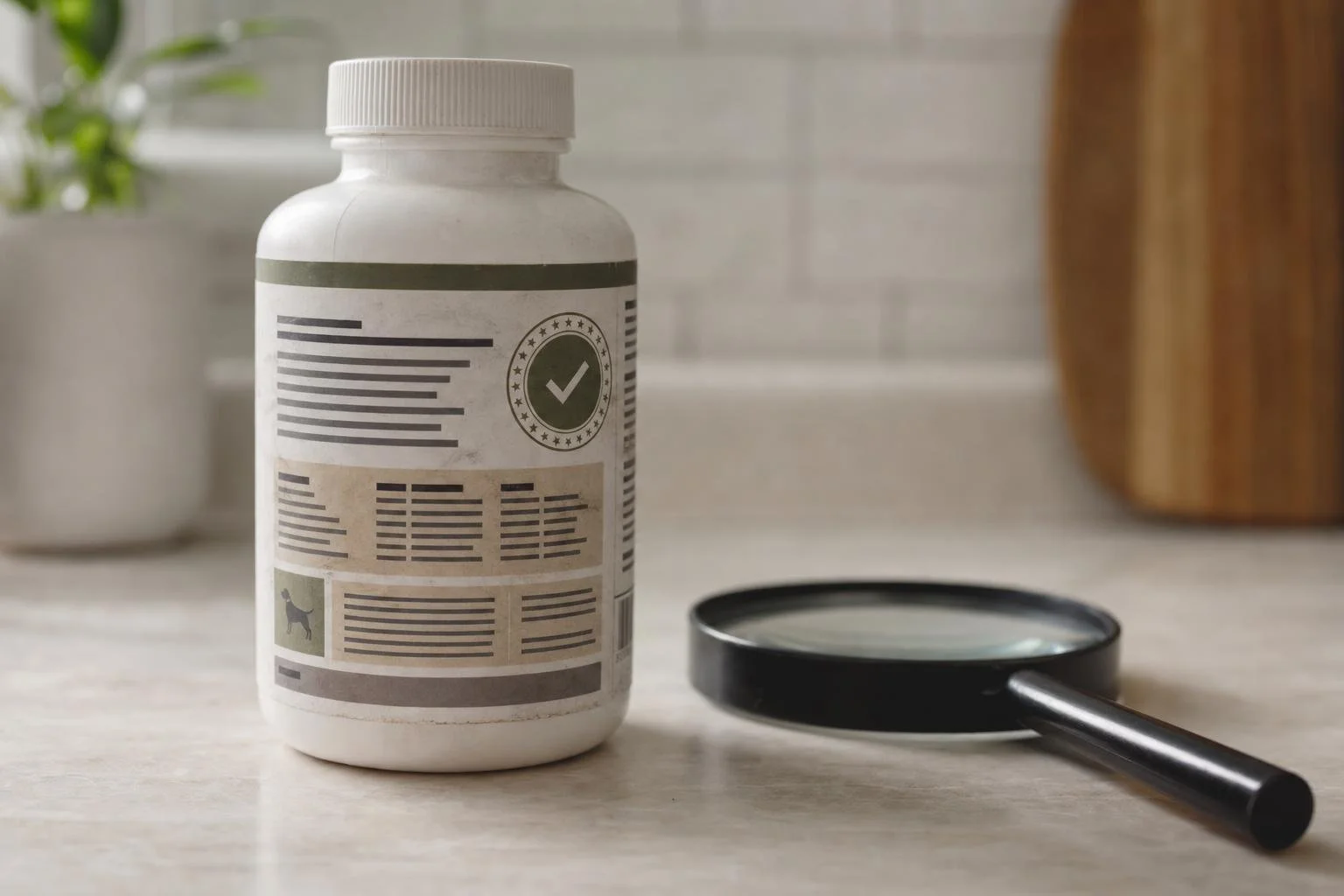
Because oversight and claims can vary, label transparency and voluntary quality programs become useful signals. The NASC Quality Seal indicates that a company has passed an independent audit and maintains systems for quality control, adverse event reporting, labeling compliance, and random product testing.
A quick way to read the seal:
What it shows: the company follows audited quality and reporting processes.
What it does not show: proof that any specific product works.
How to use it: treat it as a baseline for manufacturing seriousness, not as a guarantee of results.
How to Read a Supplement Label
Most of the useful information sits on the back of the bottle, not the front. Before you buy, check these details:
Active ingredients per dose, listed in milligrams or CFU, not just named on the front.
EPA and DHA amounts for omega-3 products, since fish oil strength can vary widely.
Strain-level IDs for probiotics, plus a guaranteed CFU count at the end of shelf life rather than only at the time of manufacture.
Fiber type, soluble or insoluble, with clear dose guidance.
Storage instructions and a lot number, which support freshness and traceability.
Caution statements and interactions, especially the note that fish oil can interact with NSAIDs and anticoagulants.
Joint Support: What the Evidence Supports
Start with the foundation: keeping your dog at a lean body weight and maintaining appropriate activity does more for joints than any bottle. From there, omega-3 fatty acids, especially EPA and DHA, have the strongest evidence base for osteoarthritis support. A 2025 review reported osteoarthritis-support dosing ranges around 48 to 100 mg/kg of EPA and 20 to 32 mg/kg of DHA for dogs, which can help your vet calculate a practical target. Benefits are gradual, often taking six to twelve weeks, and depend on adequate EPA and DHA rather than fish oil alone.
Other joint ingredients deserve even-handed summaries:
Glucosamine and chondroitin: widely used, with mixed evidence for measurable benefit.
Green-lipped mussel lipids: emerging and variable evidence. Some blinded and randomized studies suggest benefit for certain products, while results have not been consistent across all joint ingredients.
Undenatured type II collagen: early data, still being studied.
Products come in many formats, and availability differs by country. In Australia, some pet owners browse category pages such as 4CYTE for Dogs & Cats to compare joint-support formats, then confirm suitability with their veterinarian. U.S. readers should treat this as a region-specific example of how category pages present options, not as a claim about efficacy.
Skin and Coat Support: Focus on Fatty Acids
For skin and coat, essential fatty acids, especially EPA and DHA, are the most commonly discussed supportive option. Guidelines and trials suggest they can help coat quality and may reduce itch for some dogs as part of a broader plan. As with joints, expect gradual change over several weeks, not overnight results.
Supplements are only one part of skin care. Regular grooming, appropriate topical care, parasite control, and diet all matter. Any persistent or worsening skin problem belongs in front of a veterinarian, especially if there is hair loss, odor, sores, or repeated infection.

Gut Health: Fiber and Probiotics
Gut support usually comes down to two categories: fiber and probiotics.
Fiber
Fiber can firm or soften stool depending on type and dose. Soluble fiber ferments in the colon, and the short-chain fatty acids produced there help support the colon lining. The Merck Veterinary Manual notes that these fatty acids supply roughly 70% of colonocyte energy in dogs. Psyllium, sometimes used in the range of one to six teaspoons per feeding, can improve diarrhea in many dogs with colitis, but the right amount depends on dog size and the problem being treated. Beet pulp is another commonly used, moderately fermentable fiber source. Start conservatively and adjust with your vet.
Probiotics
With probiotics, the label details do the heavy lifting. Look for strain-level identification and a guaranteed CFU count at the end of shelf life. Randomized controlled data with Enterococcus faecium SF68 has shown a shorter time to resolution of acute diarrhea versus placebo, and a randomized, double-blind, placebo-controlled study of an anti-diarrheal probiotic paste reported improved outcomes in acute cases. Evidence is stronger for short-term acute situations than for chronic disease, so keep expectations realistic and let your vet interpret results.
If you shop dog supplements online, compare labels rather than front-panel claims. For example, when comparing omega-3 drops for skin support or a measured fiber powder for stool consistency, check the active amount per dose, storage instructions, and caution statements. Make one change at a time, and keep a simple stool log for one to two weeks so you can judge the effect clearly.
Safety Essentials
A short checklist keeps a supplement trial safer:
Avoid human gummies and chewables, which may contain xylitol.
Confirm fish oil is appropriate if your dog takes anticoagulants or NSAIDs, and ask about pancreatitis risk in predisposed dogs.
Introduce one product at a time.
Start low and increase slowly per label directions.
Track changes in writing rather than relying on memory.
Store products as directed and check expiration and lot numbers.
Report any adverse reaction to your veterinarian.
Stop and call your vet if symptoms worsen.
How to Run a 4 to 12 Week Trial
A structured trial tells you whether a supplement is actually helping. Define one clear goal, set a realistic timeline, record a baseline, and reassess with your vet.
Goal: something observable, such as easier stair climbing, less scratching, or more consistent stool.
Timeline: fiber effects may appear in about two to three days, probiotics over one to two weeks, and omega-3s over six to twelve weeks.
Baseline: note current behavior, stool quality, or itch level before you start.
Tracking: keep a five-line log with date, product, dose, what you observed, and any side effects.
Review: bring your notes to your vet to decide whether to continue, adjust, or stop.
Putting It Together
The smartest approach is not chasing the flashiest bottle. It is pairing good basics, lean body weight, steady activity, and a diet suited to your dog, with a carefully chosen, label-transparent supplement and your veterinarian's guidance. Read the back of the label, favor products that report strains and end-of-shelf-life CFU, respect known interactions, and change one thing at a time. Do that, and you will be able to judge honestly whether a supplement earns a permanent place in your dog's routine.
