
How to Find Affordable Moving Companies for Real Estate Clients

Moving expenses can catch buyers and sellers off guard, especially when they have already spent money on closing costs, home repairs, deposits, and utility connections. A moving quote that initially looks affordable can become expensive once packing, storage, and additional handling charges are included.
Real estate agents can help clients control these costs without taking responsibility for hiring movers.
By explaining pricing factors, sharing comparison tools, and helping clients plan around closing dates, agents can make the search for affordable moving companies more manageable.
The goal is to help clients find reasonably priced services that meet their relocation needs without sacrificing reliability.
Why Moving Costs Matter During a Real Estate Transaction
Buying or selling a home involves several expenses beyond the property itself. Moving costs can place additional pressure on households managing a limited relocation budget.
According to NerdWallet's guide to moving costs, local moving expenses depend on factors such as household size, transportation distance, and whether professional labor or rental equipment is involved.
Agents can help clients understand these variables before they request estimates.
Providing a Real Estate Agent Moving Guide gives buyers and sellers access to practical relocation resources, moving checklists, and tools that support quote comparisons.
These materials are particularly useful when clients need to coordinate moving expenses with closing costs and other financial commitments.
Rather than recommending the lowest-priced mover, agents should encourage clients to compare the complete cost of services and verify what each estimate includes.
8 Ways to Help Real Estate Clients Find Affordable Movers
1. Establish a Realistic Moving Budget
Before contacting moving companies, clients should identify how much they can reasonably spend on relocation.
A moving budget should account for transportation, packing supplies, professional labor, storage, and possible additional services.
Clients may also need to budget for travel expenses, utility deposits, or temporary accommodation when moving between properties.
Agents can provide a simple worksheet that separates essential services from optional conveniences.
For example, professional transportation may be necessary, while full-service packing might be something the household can complete independently.
Encourage clients to reserve some flexibility in their budget for legitimate changes in inventory or scheduling.
This helps them evaluate estimates based on affordability rather than focusing exclusively on the initial price.
2. Request Multiple Written Moving Quotes
Comparing estimates is one of the most effective ways to identify reasonably priced moving services.
Clients should request at least three written quotes when possible, using the same inventory and service requirements for each company.
Without consistent information, the estimates may not be directly comparable.
A quote should identify transportation charges, labor, packing materials, specialty handling, and any additional fees.
For interstate moves, clients should also understand the distinction between binding and nonbinding estimates.
Agents can encourage clients to question unusually low prices rather than assuming they represent exceptional value.
A detailed written quote provides more useful information than an advertised starting rate or verbal promise.
3. Compare Moving Services Based on Actual Needs
Not every household requires a full-service moving package.
Some clients need professional packing, loading, transportation, and unloading. Others can pack independently and hire movers only for transportation and heavy lifting.
Discussing these differences helps clients avoid paying for unnecessary services.
For example, a seller moving from a small condominium may need fewer crew members than a family relocating from a large detached home.
Clients should also compare whether companies provide furniture disassembly, temporary storage, or specialty item transportation.
Choosing the appropriate service package can reduce expenses without compromising essential moving requirements.
Agents should present available options without promising that a particular service arrangement will always be less expensive.
4. Consider Moving Dates and Scheduling Flexibility
Moving prices can change according to demand, location, and available transportation capacity.
Weekends, holidays, and popular relocation periods can be more expensive in some markets.
Clients with flexible schedules can ask moving companies whether alternative dates offer lower rates.
However, real estate transactions introduce additional timing considerations.
Buyers must confirm when they can legally take possession, while sellers need to understand their agreed move-out obligations.
Booking transportation before these details are clear can lead to rescheduling charges or temporary storage expenses.
Agents can help clients coordinate moving plans around confirmed transaction milestones while encouraging them to review the mover's scheduling terms.
5. Reduce Household Inventory Before Requesting Estimates
Moving costs often depend partly on the amount of furniture and belongings being transported.
Clients may be able to reduce expenses by selling, donating, or responsibly disposing of items they no longer need.
This is particularly useful for long-distance moves where shipment weight or volume can influence pricing.
Encourage clients to inspect storage rooms, garages, closets, and outdoor areas before requesting quotes.
A complete inventory helps companies prepare more accurate estimates.
Clients should also identify unusually heavy or oversized belongings that could require specialized equipment.
Removing unnecessary items before the estimate can be more useful than attempting to renegotiate charges after transportation arrangements are finalized.
6. Identify Additional Charges Before Booking
An affordable base estimate does not necessarily represent the complete moving cost.
Some companies charge separately for packing materials, stair carries, long walking distances, storage, or additional pickup locations.
Access conditions can also affect labor requirements.
For example, moving furniture from an upper-floor apartment without a suitable elevator may take longer than loading a comparable household from a ground-floor residence.
Agents should encourage clients to describe these conditions accurately when requesting estimates.
Clients should ask movers to explain potential additional charges in writing.
This makes it easier to distinguish legitimate pricing differences from unclear or incomplete estimates.
7. Verify Credentials Before Choosing a Lower-Priced Mover
Affordability should never replace basic provider verification.
Clients should confirm that movers have the registration or operating authority required for their type of move.
Interstate carriers and brokers are subject to federal requirements, while intrastate regulations differ by state.
Customer reviews, complaint histories, and clear contractual terms can provide additional information.
The New York Attorney General's consumer guidance recommends obtaining estimates from different movers, checking company credentials, and carefully reviewing moving agreements.
Although specific state requirements vary, these comparison practices are useful for clients across the country.
Agents should direct clients toward the appropriate regulatory authority and avoid guaranteeing a moving company's performance.
8. Look for Discounts Without Ignoring Service Quality
Some moving companies offer discounts for flexible scheduling, qualifying customer groups, or specific service arrangements.
Clients can ask whether any current promotions apply to their relocation.
However, discounted pricing should still be evaluated against the complete estimate.
A reduced hourly rate may offer limited value if additional fees make the final cost higher.
Clients should also verify whether a promotion applies to transportation, labor, packing, or only selected services.
Encourage them to obtain discount terms in writing.
The most affordable option is the one that provides the required services at a reasonable total cost with clear contractual conditions.
How to Compare the True Cost of Moving Quotes
Real estate agents can share a comparison worksheet that evaluates more than the advertised price.
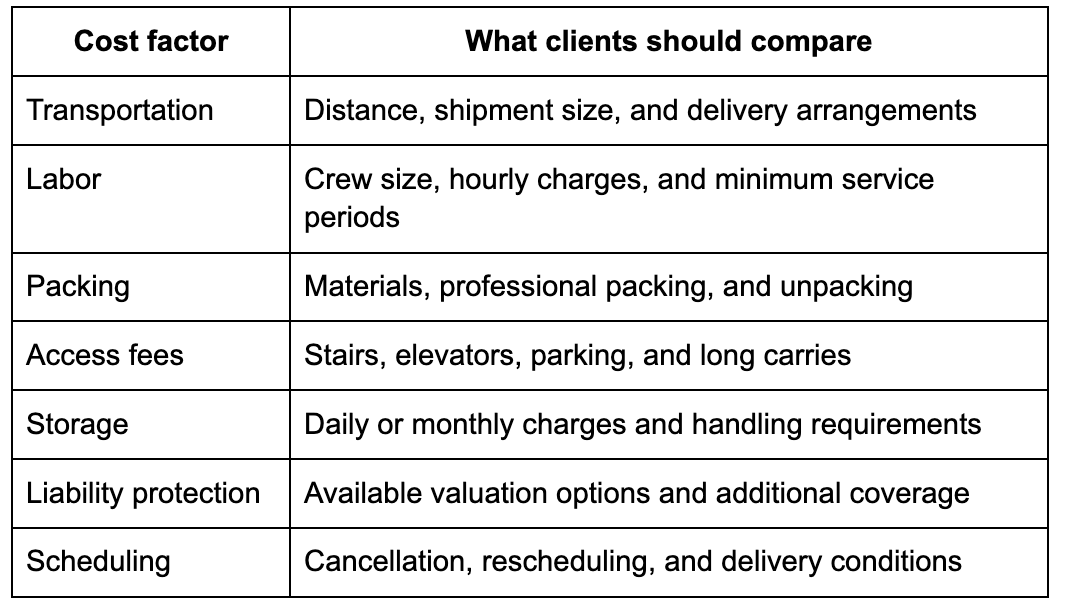
Clients should request clarification whenever a fee appears in one estimate but not another.
The worksheet can also identify services the household can handle independently.
This creates a fairer comparison and helps clients make budget decisions using documented information.
How Agents Can Provide Affordable Moving Resources
Moving resources for real estate agents can help buyers and sellers prepare without requiring agents to become relocation coordinators.
Useful materials include budget worksheets, quote comparison templates, utility transfer guides, and packing inventories.
A co-branded moving checklist can organize these tasks while keeping the agent's contact information accessible throughout the relocation.
Agents may also evaluate a moving company referral program that allows clients to request estimates through a shared resource.
Any referral compensation should be reviewed against applicable laws, disclosure obligations, and brokerage policies.
The objective is to give clients convenient access to relevant information while preserving their freedom to select a mover independently.
Conclusion
Finding affordable moving companies requires more than searching for the lowest advertised price.
Real estate agents can help clients manage relocation expenses by encouraging detailed estimates, explaining cost factors, sharing comparison resources, and helping households plan around property possession dates.
A practical moving budget and clear service requirements can reduce confusion before booking.
Agents should provide clients with a moving cost comparison worksheet and planning checklist early in the transaction. These resources support informed decisions while keeping responsibility for choosing the moving company with the client.
Frequently Asked Questions
How can real estate agents help clients find affordable movers?
Agents can share moving cost worksheets, comparison resources, and scheduling guidance. They can also encourage clients to request multiple written estimates, review additional charges, and verify provider credentials before selecting a moving company.
Is the lowest moving company quote always the most affordable?
No. A lower estimate may exclude packing, storage, specialty handling, or access-related charges. Clients should compare the full service scope and contractual conditions to determine which moving option offers reasonable overall value.
What moving resources should agents provide to clients?
Useful resources include a co-branded moving checklist, moving budget worksheet, quote comparison template, packing inventory, and utility transfer guide. These materials help clients plan expenses and organize important relocation tasks.
