
How Madison Families Can Plan a Stress-Free Home Move With Kids
Moving with children is not just a logistics puzzle. It is a full emotional event for everyone in the family, and the youngest members often feel it the hardest.
Packed boxes, unfamiliar streets, new schools, and disrupted routines can turn what should be an exciting milestone into weeks of anxiety. The good news? Most of that stress is preventable with the right plan.
Here is what this guide covers:
When and how to tell your kids about the move
Practical packing and moving day strategies tailored to families
How to help your children settle into life in Madison faster
TL;DR
Tell your kids early and match the conversation to their developmental stage.
Timing your move around Madison's school calendar makes a significant difference in how kids adjust.
Involve children in packing with age-appropriate tasks so the move feels like something happening with them, not to them.
Moving day needs its own family plan, including a kid zone, a moving adventure kit, and protected routines.
Re-establishing routines quickly in the new home is the single most effective way to help kids feel settled.
Tell Your Kids Before the Boxes Come Out
The biggest mistake families make when relocating is waiting too long to tell the children.
Kids who feel blindsided by a move tend to act out more during the transition. They lose trust in the process, and often in the adults managing it. Giving them advance notice is not just considerate. It is one of the most effective things you can do for their emotional wellbeing during this period.
According to child psychologists at the Child Mind Institute, children thrive on predictability and routine. A major disruption like a home move can trigger anxiety, withdrawal, or behavioral regression, especially when kids feel excluded from the decision-making process.
Match the Conversation to Their Age
How you frame the move matters as much as when you announce it.
Toddlers and preschoolers (ages 2 to 5): Keep it simple and grounded in what they know. "We are moving to a new house. Your bed is coming. Your toys are coming. Your family is coming." Reassurance is the entire job here. Young children do not need logistics. They need to know their world is not falling apart.
School-age kids (ages 6 to 12): This age group responds well to honest explanations. Tell them why the family is moving. Answer their questions directly. Let them be frustrated or sad without immediately trying to fix it. Acknowledging emotions validates kids and keeps communication channels open throughout the process.
Teenagers: Teens have the most to lose socially. Their identity, friendships, and sense of belonging are all tied to their current school and community. Involve them in real decisions wherever possible: Which neighborhood are you considering? Can they help research the new school? Can they pick an element of their new room? Giving teenagers genuine agency transforms them from reluctant passengers into invested participants.
One underrated strategy: create a moving countdown calendar with stickers or small daily milestones. Even teenagers respond well to visual timelines because it makes the moving date feel concrete rather than indefinitely looming.
Choose Your Moving Date Strategically
Timing a family move in Madison is not a random decision. It directly affects how smoothly your children adjust.
Summer moves work best for families. Moving between June and August gives children a full runway before the school year begins. Madison has over 270 parks and a wealth of outdoor programming through Madison Parks, making summer an ideal time for new families to get oriented through activities and community events.
Get Kids Involved in the Packing Process
Packing is stressful for adults. For children, watching familiar rooms get dismantled box by box can feel genuinely unsettling. The solution is not to shield kids from the process. It is to bring them into it.
When children have an active role in the move, their perspective shifts. It stops being something happening to them and starts being something they are part of. That distinction carries enormous psychological weight.
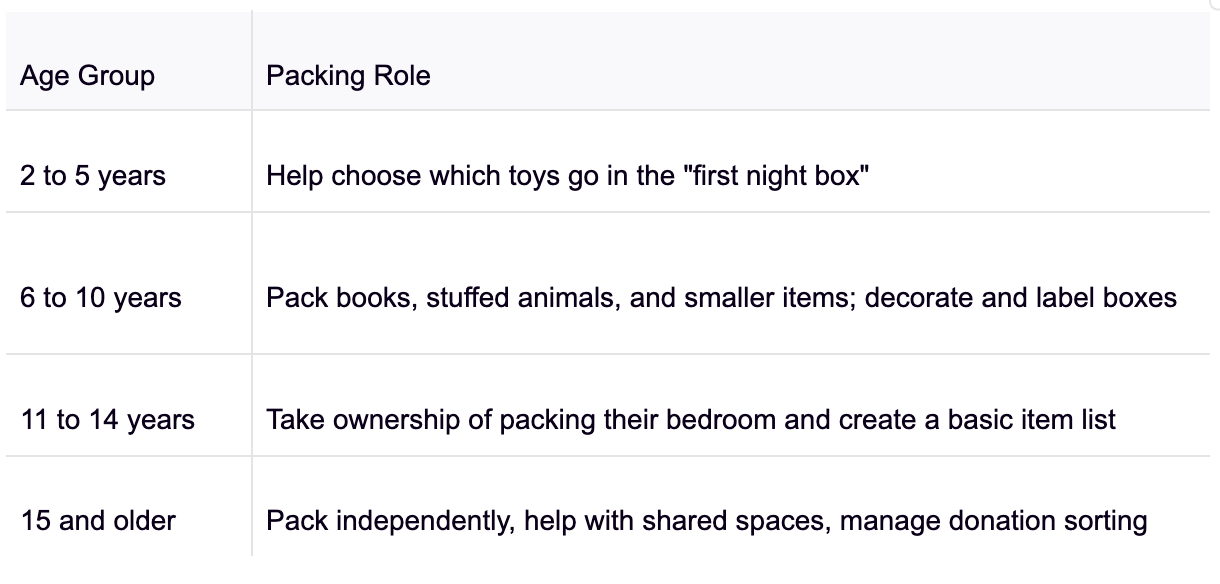
Age-Appropriate Packing Roles
Use this as a general framework for assigning tasks that match what each age group can realistically manage:
The "Keep, Donate, or Toss" Game
A home move is one of the most natural decluttering windows a family ever gets. Turn the sorting process into a structured game. Challenge kids to donate a set number of items before anything gets packed. This reduces the physical volume of your move and teaches children a lesson about letting go at a moment when they are naturally focused on holding on.
Build a Moving Day Plan That Accounts for Kids
Moving day with children present is categorically different from moving day without them. The emotional temperature is higher, the margin for error is smaller, and the safety stakes are real. Planning for this specifically, rather than hoping it works out, makes a measurable difference.
Arrange Childcare for the Youngest
For families with children under five, arranging a few hours of childcare on moving day is genuinely worth the effort. A toddler underfoot while movers carry heavy furniture is not just an inconvenience. It is a safety risk.
Ask a trusted neighbor, family member, or friend to take the youngest children for the peak hours of activity. They come back to a mostly settled house, which feels like an adventure rather than controlled chaos.
Set Up a Dedicated Kid Zone
If childcare is not possible, designate one room as the "kids zone" from the start of the day. Stock it with snacks, a device or two, games, and the moving adventure kit from the earlier step. Communicate this clearly to your moving crew so they know which room to leave untouched.
Protect the Routines You Can
Moving day is inherently disruptive, but routines around meals and bedtime function as stabilizing anchors for children. Skipping lunch because things are running behind, or letting bedtime slip past midnight because boxes are still everywhere, adds unnecessary stress to kids who are already overstimulated.
Pack snacks and easy meal options with the car essentials. Plan for an actual dinner, even if it is takeout on the floor of the new house. The ritual matters far more than the setting.
Brief Your Moving Crew Early
At the start of the day, let your movers know that children are present. Good professional moving crews will factor this into their workflow and navigation. Knowing where kids are stationed helps movers move safely through the property without constant redirecting.
Finding a Family-Friendly Mover in Madison
Not every moving company is equipped to handle the complexity that comes with a family relocation. Families in Madison should look for a mover that offers flexible scheduling, transparent upfront pricing, and a crew trained to work carefully and communicate clearly throughout the day.
StraightLine Moving serves Madison and the surrounding greater Madison area, including communities like Middleton, Verona, Waunakee, Sun Prairie, Fitchburg, and Cottage Grove, among others. The company has been operating since 2016 and holds a documented 98% customer referral rate, a figure that reflects consistent execution on the ground, not just a good first impression. Every mover on their crew averages 4.7 years of experience and completes more than 80 hours of training before their first job.
"Jamie, Gus and StraightLine Moving were great to work with. They helped me move my dad into an Independent Living community and it was smooth and uneventful. After originally scheduling his move a week out, circumstances changed and they were able to move him with two day's notice. They arrived on time, loaded quickly and carefully, hit the limited 'move-in' time-frame and also unloaded quickly and carefully. Jamie and Gus were kind and courteous throughout. It was a very trying and difficult few days and their professionalism was greatly appreciated. Highly recommend." – Carolyn Myers (Google Review)
Help Your Kids Settle Into Madison Life
The work does not end when the last box leaves the truck. Helping children feel genuinely at home in their new space and community is the final, most often overlooked piece of a family move.
Unpack the Kids' Rooms First
This single strategy makes one of the biggest differences in early adjustment. Children sleep better, feel calmer, and settle faster when their personal space looks and feels familiar. Even if the rest of the house is still a maze of half-opened boxes, a child who walks into a bedroom that looks like their room has immediate grounding.
Let them set it up themselves wherever possible. Choosing where things go restores the sense of control that the move temporarily took away.
Re-Establish Routines as Fast as Possible
Routines are a child's internal compass. The faster you rebuild the familiar rhythms of daily life at the new address, the faster your kids will stop grieving the old one.
Restart morning routines and school drop-off patterns within the first week. If your family had a Friday pizza night at the old house, have it at the new one too. If Saturday mornings meant pancakes and cartoons, keep that. Continuity of routine communicates something essential to children: while the location changed, the family did not.
The Best Moves Start With the Right Plan
Relocating as a family is one of the most significant events your household will navigate together. The families who come through it well are not the ones with unlimited time or budget. They are the ones who planned intentionally, communicated early, and built a game plan that accounted for the humans who mattered most.
Start the conversation early, tailored to each child's developmental stage, so no one feels blindsided.
Time your Madison move strategically around the school calendar to give kids the best possible runway for adjustment.
Get kids actively involved in packing through age-appropriate roles and their own moving adventure kit.
Protect moving day routines and safety by designating a kid zone, briefing your crew, and treating meals and bedtimes as non-negotiables.
Moving to or within Madison does not have to be the thing your family dreads. With the right preparation, it becomes the beginning of a chapter your kids will look back on with genuine pride.
FAQs
How far in advance should I tell my children about the move?
Give children at least four to six weeks' notice before moving day. This window allows them to process the change, ask questions, and take part in age-appropriate preparations. More advance time is better, particularly for school-age children with established routines and friendships.
What is the best time of year to move with kids in Madison, WI?
Summer is typically the most family-friendly season for a Madison move. Relocating between June and August gives children time to explore the new neighborhood and settle in before the school year starts, significantly reducing back-to-school anxiety and social disruption.
How do I help my child adjust to a new school in Madison?
Visit the new school together before the first day to reduce anxiety about the unknown. Contact the classroom teacher or school counselor in advance to introduce your child's situation. Most Madison-area schools have structured support for incoming students, and a brief parent email helps staff prepare a warmer, more informed welcome from day one.
Should young children be present on moving day?
Children under five are generally safer and less stressed when cared for by a trusted adult away from the heaviest activity. Older children and teenagers can participate actively, but benefit from having a clearly defined role and a designated space that keeps them out of the way of the moving crew.
