
Smart Home Upgrades that Reduce Energy Consumption

Rising utility bills can be frustrating, especially when it feels like you're paying more without using more energy. The good news is that many homes waste energy through everyday habits and outdated systems, and fixing those issues is often easier than most homeowners think. Smart home energy saving solutions can help reduce energy costs, improve energy efficiency, and make your home more comfortable at the same time.
From smart thermostats and lighting controls to simple automation tools, the right upgrades can help you use less energy without sacrificing convenience. In this guide, you'll discover practical ways to save money and create a more efficient home.
The Smart Home Technologies Worth Your Attention
The best upgrades share one quality: they operate in the background, doing the work so you don't have to micromanage your own house. Start here.
Smart Thermostats: The Single Upgrade With the Fastest Return
If you only make one change, consider upgrading to a smart thermostat. It's one of the simplest and most effective ways to improve home comfort while reducing unnecessary energy use. Smart thermostats allow you to create schedules, adjust temperatures remotely, and help ensure your heating and cooling system only runs when needed. Over time, this can lead to better efficiency, more consistent indoor temperatures, and lower energy costs with very little effort on your part.
Now, Everett, WA, sits in Pacific Northwest territory: long, damp winters followed by summers that are getting warmer every year. Your HVAC system works hard here, full stop. A smart thermostat is a powerful tool, but it cannot compensate for an underperforming system beneath it. That's why scheduling routine hvac service in Everett, WA, with a trusted provider like Home Comfort Alliance matters; a well-maintained system is what makes smart technology actually deliver on its promise.
Connected Lighting: Low Effort, Consistent Savings
With your thermostat handled, turn your attention to lighting. While switching to LED bulbs is a great first step, smart lighting systems can take both comfort and convenience to the next level. Features such as occupancy sensors, scheduling, and adaptive dimming help ensure lights are only used when needed, reducing energy waste while creating a more comfortable living environment.
Many smart lighting systems also integrate seamlessly with popular smart home platforms, allowing you to control lighting through voice commands, mobile apps, or automated routines. This makes it easy to adjust brightness, set schedules, and create the perfect atmosphere throughout your home with minimal effort.
Smart Power Strips: Stopping the Silent Energy Drain
Here's something that surprises most people: devices that appear off aren't really off. Televisions, gaming consoles, and phone chargers all draw standby power continuously. These phantom loads can represent nearly 10% of your home's total electricity consumption.
Smart power strips and programmable outlet controls let you monitor and cut power to idle devices remotely. If you have a home office or a sprawling entertainment setup, this is a particularly high-value fix. Small change, real impact.
Upgrades That Take Efficiency to Another Level
Got the basics running? Good. Here's where you start seeing serious performance gains.
Intelligent Appliances That Manage Themselves
Modern Energy Star smart appliances, refrigerators, washers, dryers, and dishwashers use load-sensing technology and adaptive cycles to eliminate unnecessary energy consumption. Many allow you to schedule operations through a smartphone app, so your dishwasher runs during off-peak rate windows without you lifting a finger. That kind of passive optimisation adds up noticeably over a year.
Smart Shades: Passive Climate Control You'll Forget Is Working
Windows are often the most overlooked energy factor in a home. Unmanaged heat gain in summer and heat loss in winter quietly force your HVAC system to work harder than it should. Smart blinds automatically respond to sunlight intensity and room temperature, reducing that demand before your system ever has to compensate.
Solar-powered smart shades are especially compelling, no wiring required, and they integrate smoothly with most home automation ecosystems. It's passive efficiency that genuinely works without any ongoing effort from you.
AI-Powered HVAC: Where the Biggest Gains Live
Pairing smart shades with a modernised HVAC system is where efficiency really compounds. AI-powered climate control offers zoned temperature management, predictive maintenance alerts, and real-time air quality monitoring. Inverter-based systems, compared to conventional non-inverter models, continuously modulate output, consuming only what's actually needed. That typically translates to 30–40% less energy overall.
To keep even the most advanced system performing at that level, regular HVAC service in Everett, WA, is non-negotiable. Calibrated sensors, clean components, and properly functioning controls are what allow smart systems to hit their efficiency benchmarks, not just on installation day, but every month after.
Extending Smart Technology Beyond Your Front Door
Smart devices for energy savings work indoors and out. Extending your setup to yard management and whole-home monitoring multiplies the overall impact considerably.
Smart Irrigation: Saving Water and the Energy Behind It
Your outdoor irrigation system uses more electricity than most homeowners realise, and more water. Weather-sensing controllers automatically skip watering cycles when rain is detected or when soil moisture is adequate. Less water used, less energy spent running pumps and controllers throughout the season.
Home Energy Management Hubs: Seeing the Full Picture
Individual smart devices create savings. But a centralised home energy management system (HEMS) gives you visibility across everything, real-time consumption tracking, peak usage alerts, and personalised optimisation recommendations. Many newer platforms also connect with smart grid programs, automatically shifting energy usage away from peak utility periods.
Homeowners can maximize these benefits by coordinating their energy usage with their utility provider, including services such as dominion gas ohio, to better manage household energy costs. As smart home technology continues to advance, integrated energy management systems will play an increasingly important role in improving efficiency, convenience, and long-term savings.
Solar, Battery Storage, and Smart Integration
Once you know exactly where your energy goes, the next logical step is changing where it comes from. Smart solar panels paired with home battery storage and bi-directional EV chargers create a near-self-sustaining energy loop. Federal tax incentives and utility rebates, including options through providers like Puget Sound Energy, have made the ROI on these systems more accessible than most people realise.
Building a Strategy That Actually Sticks
Powerful tools without a coherent strategy behind them only go so far. The most effective approach to reducing home energy consumption starts with a baseline energy audit to identify your biggest waste points. From there, automate the repetitive stuff, lights off at bedtime, thermostat setbacks during work hours, and irrigation scheduling based on weather data. When selecting devices, prioritise open standards like Matter to ensure long-term compatibility as technology continues to evolve.
What's Coming Next: Trends Worth Watching
Voice-Activated AI and Predictive Automation
Generative AI is changing how homeowners interact with their systems. A single voice command, "Away Mode", can now trigger the thermostat adjustment, lights off, and security arming simultaneously. Predictive controls take it further, anticipating needs before you act on them.
Virtual Power Plants and Community Energy Sharing
Homeowners with solar and battery storage can now join neighbourhood energy networks, contributing surplus power, earning utility credits, and turning a personal upgrade into a community asset. It's one of the more exciting developments in residential energy management right now.
Why Professional Installation and Maintenance Matter
Smart technology performs best when it's correctly installed and consistently maintained. Working with qualified professionals for both device integration and HVAC service in Everett, WA, through trusted firms like Home Comfort Alliance, ensures your setup is matched to your home's specific layout and energy profile. Transparent pricing, satisfaction guarantees, and solid warranty terms reduce friction and give you confidence in the long-term investment.
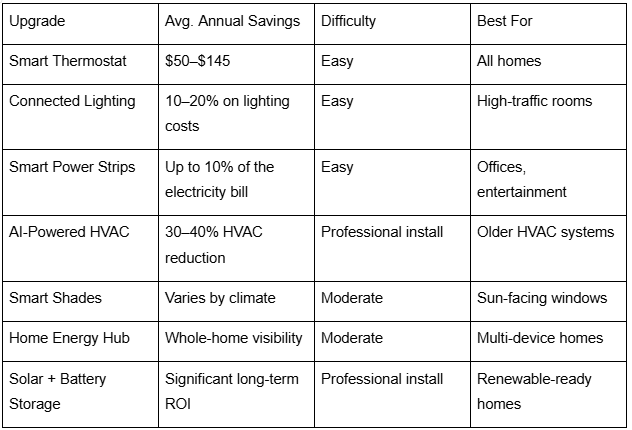
Smart Home Upgrades: Side-by-Side Comparison
The Bottom Line
You don't have to overhaul everything at once. Each upgrade you add compounds the one before it. Smarter lighting builds on a smarter thermostat, AI-powered HVAC builds on better shading, and renewable energy builds on all of it.
The technology has matured significantly. The financial incentives are real. The professional support exists. There's no better moment to take meaningful control of your home's energy use and start watching those monthly bills reflect it.
Frequently Asked Questions
What smart home upgrade saves the most energy?
A smart thermostat is usually the best first upgrade because heating and cooling use a large share of home energy. It helps control temperature schedules, reduce unnecessary HVAC use, and improve comfort with minimal daily effort.
Are smart home energy upgrades worth the cost?
Yes, many smart home upgrades are worth it when chosen based on your home’s biggest energy waste points. Smart thermostats, LED lighting, power strips, and energy monitoring tools can reduce monthly bills and improve long-term efficiency.
Do smart devices work without professional installation?
Some smart devices, such as power strips, bulbs, plugs, and basic thermostats, are easy to install yourself. Larger upgrades like AI-powered HVAC systems, solar panels, battery storage, and full energy management systems usually require professional installation.
