
What Does It Mean to Intellectualize Your Feelings? Learning How to Feel Your Feelings Again
Have you ever been able to explain exactly why you're upset? Like you know why you're upset, you can name every reason to be sad. But you still feel the hollowness. As if you're disconnected from the emotion itself.
You're so self-aware, you know exactly what childhood trauma you have and the defensive mechanism you subconsciously use. Yet when someone asks, "How do you feel?" your mind immediately starts analyzing instead of just sharing.
This is known as intellectualization, a psychological defense mechanism that protects us from emotional pain by turning feelings into ideas and theories. While it can feel productive and even insightful, staying in your head all the time may prevent genuine emotional processing.

What Does It Mean to Intellectualize Your Feelings?
Intellectualization can look like this:
Analyzing (thinking what would be logical to feel rather than to actually feel)
Explaining (recounting logical events that upset you rather than admitting that you're upset)
Theorizing (being psychologically educated, but not turning these concepts into practice)
Avoiding (not speaking about yourself and using collective pronouns instead of personal pronouns)
For example, someone grieving a loved one might spend hours reading about the neuroscience of grief while avoiding the sadness itself.
Intellectualization as a defense mechanism can be used to avoid vulnerability. Recall what emotional traumas you had to explore your cognitive profile and think about whether avoiding emotions could be your potential coping mechanism.
For many people, intellectualization develops for a good reason. Living in an environment where emotions were dismissed, you could have learned that emotions are not welcome. But what is? Being rational. Finding logical explanations then became your way to stay in control.
Examples of Intellectualization Defense Mechanism
Hard to recognize intellectualization? It really is because it can look like healthy self-reflection from the outside. The difference is that reflection brings you closer to your emotions, while intellectualization keeps you at a distance from them.
Here are a few examples of what this defense mechanism can look like in everyday life:
Explaining a breakup through pop psychology instead of acknowledging heartbreak.
You spend hours identifying your ex's attachment style, red flags, and the use of the theory of first loves. You try to explain that you would never work together, but still feel heartbroken. That's grief that you never let out playing out.
Researching childhood trauma instead of mourning your childhood.
Yes, you understand how early childhood is crucial for early development. And yes, you understand that you didn't get that safe environment. But it's hard for you to stop feeling sad, angry, or disappointed about what happened.
Talking about burnout as a productivity problem.
Rather than admitting you're emotionally exhausted, you focus on time-management techniques and on optimizing your schedule.
Analyzing everyone else's psychology.
You become highly skilled at understanding other people's behavior, avoiding your own emotional experiences, and unmet needs. It's much easier to observe others from a safe distance and disconnect when (or if) things go south.
Why Is Intellectualizing as a Defense Mechanism Harmful?
Intellectualization is not inherently unhealthy. In fact, it can be incredibly helpful during overwhelming situations or in decision-making when we need a second away from our emotions.
If not for intellectualization, healthcare workers, first responders, and therapists wouldn't be able to cope with the crises they deal with every day.
The problem arises when analyzing emotions becomes your only way of dealing with them. Imagine it is your only coping strategy. What happens then?
You become less emotionally aware.
Emotional intelligence is as important as intellectual intelligence. It's only half a deal when you can identify why you feel a certain way. But what's more important is to recognize what you're actually feeling in the moment.
This is important because without emotional intelligence, it's harder to respond to your emotional needs and those of others.
It becomes harder to be intimate with others.
Close relationships depend on vulnerability. Vulnerability in a relationship deepens trust and creates an authentic connection. If you always explain your emotions instead of expressing them, others may perceive you as distant, even if you care deeply about them.
You cannot identify your needs.
If you didn't know, emotions are messengers of our needs. Loneliness is a signal that you need to feel belonging, fear means lack of safety, and anger appears when your boundary is crossed.
When you immediately analyze them away, you may miss what your emotions are trying to tell you. Hence, you may feel less authentic.
You start getting unexplained physical symptoms.
Unprocessed emotions do not disappear. Sometimes they show up physically as headaches, muscle tension, fatigue, digestive problems, insomnia, etc. All because unprocessed emotions turn into stress, and chronic stress is a ticking time bomb.
Mental health professionals emphasize that emotions rarely disappear simply because we ignore or outsmart them. They wait for a calm period until they can be expressed in another way. It can explain why you can feel anxious or sad in the most peaceful time in your life.

Intellectualizing Emotions vs Feeling Them
Thinking and feeling are both valuable psychological processes. Problems arise only when one starts to outweigh the other. Let's see how intellectualization of emotions compares to feeling them through.
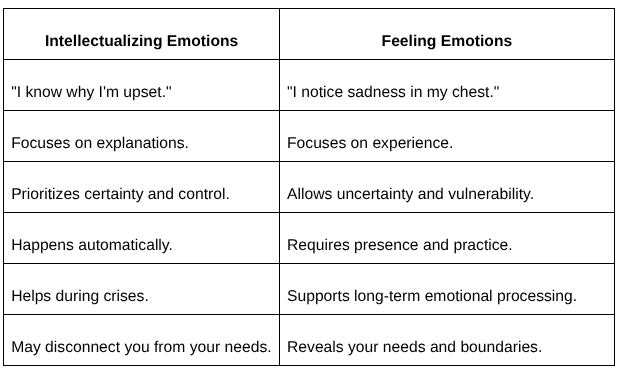
Neither approach is inherently "better." In the long run, psychological well-being depends on both understanding your emotions with your mind and experiencing them with your body.
How Not to Intellectualize Feelings?
"Just feel your feelings." It's not going to happen. After years of relying on intellectualization, "feel your feelings" might sound like "go climb Everest without preparation."
Emotional awareness is a skill that can be trained. You do not have to stop thinking or analyzing. Instead, do this to live through your emotional experience before immediately explaining it away.
Accept and Don't Discriminate Against Any Emotion
One of the biggest barriers to emotional processing is believing that some feelings are wrong. Anger, sadness, fear, disappointment, jealousy, and shame are all part of being human.
Imagine that you're the sky. Your emotions are clouds in the sky. Clouds can be small and nice, or big and mighty, but they eventually go away. Emotions are the same. Even the hardest emotion is temporary; it doesn't define you.
Practice Emotion Naming
A helpful way to move from your head into your emotions is the RAIN mindfulness technique:
Recognize: What exactly am I feeling?
Accept: Can I allow this emotion to exist without fighting it?
Investigate: What happened before I felt this way? What might this emotion be trying to tell me?
Non-identification: Remind yourself, "I am experiencing this emotion, but I am not this emotion."
If you struggle with reflecting in your own mind, try using a mood-tracking app.
Check In With Your Body
Emotions appear first as physical sensations: tight shoulders, a racing heart, butterflies in your stomach, or a lump in your throat. Try slowing your breathing by inhaling for 4 counts, holding for 4, and exhaling for 4.
Create Space Before Acting
Strong emotions push us to react immediately. No matter how hard it seems, try using the STOPP technique recommended by the American and British Health departments:
Stop for a moment.
Take a slow breath.
Observe what you're thinking and feeling.
Pull back by reminding yourself that thoughts are not facts.
Proceed in a way that aligns with your values rather than your immediate emotional impulse.
Reflect on What You Need
Emotion is information. Whenever you feel angry, sad, frustrated, etc., ask yourself, "What is this emotion asking of me?"
A more effective way would be to free-journal because that's how you can actually see your emotions. It's just easier to be more objective when you can re-read your records from time to time.
