
What Is an RBT and Why the Career Matters
If your child has ever worked with a behavior therapist, you have likely met an RBT without knowing the title. And if you have ever wanted work that genuinely helps kids, this may be the role you have been looking for. It sits at the front line of a fast-growing field.

Whether you are a parent or a career-changer, the path is more accessible than most expect. A structured option like the Behavior Tech Course RBT program can take a newcomer from zero to certified. This guide explains what an RBT does and why the work matters.
What Exactly Is an RBT?
It is an entry point into a respected clinical field. The title is specific, and so is the training behind it.
An RBT, or Registered Behavior Technician, is a certified paraprofessional who delivers behavior-analytic services under supervision. They work directly with clients, often children, carrying out plans designed by a supervisor. The credential is overseen by the field's certifying body, whose BACB RBT requirements set the standard for training and conduct.
The role is hands-on and human. An RBT spends the day working with people, not paperwork, which is a large part of the appeal.
What Does an RBT Actually Do?
They turn a plan into daily practice. The therapy happens in the small, patient moments.
Applied behavior analysis, or ABA, is a therapy that uses learning principles to build helpful skills and reduce harmful ones. An RBT runs those sessions, tracks progress, and adjusts within the plan. For families who have read an autism assessments explained guide, the RBT is often the person who delivers the support that follows.
A typical day can include these 5:
Skill-building. Teaching communication or daily living.
Data collection. Tracking what is working.
Play-based work. Learning through structured play.
Behavior support. Responding calmly and consistently.
Team updates. Reporting to the supervising analyst.
Each task is small but meaningful. Progress in this field is measured in patient, incremental steps.
Who Is a Good Fit for This Role?
More people than you might think. The core traits matter more than a specific background.
Patience, empathy, and consistency are the real prerequisites. Experience helps, but so does the everyday practice of supporting a child's behaviors that many parents already know. The field welcomes career-changers, recent graduates, and parents returning to work alike.
How Do You Become One?
The path is clear and relatively quick. It rewards commitment more than a particular degree.

Most candidates need to be at least 18 with a high school diploma, then complete a 40-hour training course. After that comes a competency assessment and a certification exam. Working under a qualified supervisor is central to both the training and the job itself.
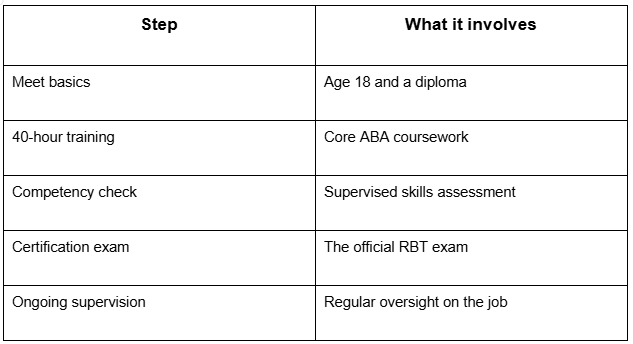
The sequence is straightforward. What it asks for most is reliability and genuine care.
Why Does This Work Matter So Much?
Because demand is real and rising. About 1 in 31 children are identified with autism, according to CDC autism data. Support services remain stretched thin.
Qualified RBTs help meet that need directly, one child and one family at a time. It is a career with a clear purpose, a defined path, and room to grow toward advanced roles like a board-certified analyst. For the right person, the meaning of the work is the whole point.
What to Remember
An RBT delivers ABA therapy under professional supervision.
The role is hands-on, working directly with clients.
Patience and empathy matter more than a specific degree.
Certification needs 40-hour training, a check, and an exam.
Demand is high, with about 1 in 31 children affected.
It offers a clear path toward advanced clinical roles.
A Career With Real Purpose
Becoming an RBT is one of the more direct ways to turn care into a profession. The training is accessible, the work is meaningful, and the need is genuine. Whether you are a parent who has seen this support up close or someone seeking work that matters, it is a field worth exploring. Just approach it as the serious clinical role it is, and lean on qualified training and supervision every step of the way.
Frequently Asked Questions
What Does RBT Stand For?
RBT stands for Registered Behavior Technician. It is a certification for paraprofessionals who deliver applied behavior analysis, or ABA, therapy under the supervision of a qualified analyst. RBTs work directly with clients, frequently children, carrying out treatment plans, teaching skills, and collecting progress data. The credential is overseen by the field's certifying board, which sets the training, exam, and ethical standards that every RBT must meet.
How Long Does It Take to Become an RBT?
For many people, it can be a matter of weeks to a few months. The main requirement is a 40-hour training course, which can often be completed online at your own pace, followed by a competency assessment and a certification exam. You also need to be at least 18 with a high school diploma. The timeline depends largely on how quickly you complete the coursework and schedule the assessment and exam.
Do You Need a Degree to Be an RBT?
No, a college degree is not required. The standard requirements are being at least 18 years old and holding a high school diploma or equivalent, plus completing the 40-hour training, a competency assessment, and the exam. This accessibility is part of why the role appeals to career-changers and parents returning to work. Many RBTs later pursue further education to move into advanced, higher-paid analyst roles.
Is Being an RBT a Good Career?
For the right person, yes. It offers meaningful, hands-on work helping children and families, a clear and relatively fast path to entry, and strong demand driven by the growing need for autism services. It also provides a stepping stone toward advanced roles like a board-certified behavior analyst. The work requires patience and emotional resilience, but many find the sense of purpose deeply rewarding and well worth it.
