
Understanding Compounding Pharmacy Benefits in Canada
This is a contributed post.

A compounding pharmacy is a specialized practice where licensed pharmacists create personalized medications to meet individual patient needs that can’t be addressed by commercially available drugs. This may include adjusting dosages, changing forms (like turning a pill into a liquid), removing allergens such as dyes or preservatives, or even combining multiple medications into a single dose. It’s particularly valuable for patients with sensitivities, rare conditions, or specific therapeutic requirements that standard pharmaceuticals don’t accommodate.
For many Canadians, the standard medication aisle doesn’t hold the right answer. Maybe a child refuses to swallow pills, an adult has a severe allergy to a common filler, or a required drug has been discontinued by manufacturers. In these cases, the question isn’t just what is a compounding pharmacy - it’s how this tailored approach can restore access to safe, effective treatment.
Compounding pharmacy bridges the gap between mass-produced pharmaceuticals and real-world patient diversity. By working closely with healthcare providers, compounding pharmacists formulate custom medications that align precisely with a person’s health profile. Whether it’s hormone therapy, pain management, or pediatric formulations, the flexibility of compounding ensures therapy fits the patient - not the other way around. If you’ve ever wondered how does compounding work in pharmacy, it begins with a prescription and a conversation, leading to a solution crafted just for you.
Now that you understand the foundation, let’s explore what compounding pharmacy like Create Compounding truly entails.
What Is a Compounding Pharmacy?
At its core, what is a compounding pharmacy if not a return to pharmacy’s roots - where medications were made by hand, for the individual, not the masses? While today’s drug manufacturing prioritizes scale and standardization, compounding reclaims the art of personalization. It’s a regulated, science-backed practice in which licensed pharmacists prepare custom medications based on a prescriber’s specifications and a patient’s unique needs.
Unlike generic or brand-name drugs produced in factories, compounded formulations are made in accredited pharmacy labs using pure-grade active ingredients. These preparations aren’t mass-distributed; they’re created one prescription at a time. This means every capsule, cream, troche, or liquid is tailored - whether to omit gluten, adjust potency, or deliver medication through a more suitable route (like a topical gel instead of an oral tablet).
It’s important to note that compounding isn’t experimental. It operates under strict provincial pharmacy regulations and adheres to standards set by bodies like the National Association of Pharmacy Regulatory Authorities (NAPRA). Pharmacists who specialize in this field undergo additional training to ensure sterility, stability, and accuracy - especially when handling hormones, biologics, or pediatric doses.
How Compounding Pharmacy Works: A Closer Look
Understanding how does compounding work in pharmacy requires looking beyond the prescription pad. It’s a collaborative, multi-step process that blends clinical insight, pharmaceutical science, and patient-centred care. Unlike picking a pre-packaged medication off the shelf, compounding begins with a dialogue - between patient, prescriber, and pharmacist - to identify a therapeutic gap that standard drugs can’t fill.
When Standard Medications Aren’t Enough
There are many reasons why off-the-shelf pharmaceuticals may not work for everyone. Some patients can’t tolerate common excipients like lactose, dyes, or preservatives. Others need a dose that doesn’t exist commercially - say, 7.5 mg instead of the standard 5 mg or 10 mg. In pediatric or geriatric care, swallowing pills may be impossible, necessitating a liquid, chewable, or transdermal alternative. Even drug shortages or discontinued formulations can leave patients without options - until compounding steps in.
The Role of Licensed Compounding Pharmacists
Compounding isn’t done by technicians alone; it’s led by specially trained, licensed pharmacists who assess the prescription’s clinical rationale, select appropriate ingredients, and determine the best delivery method. They calculate precise dosages, ensure chemical compatibility, and verify stability and shelf life. Many compounding pharmacies in Canada operate in cleanrooms that meet ISO standards, especially when preparing sterile products like eye drops or injectables.
Common Customization Options
Compounding offers remarkable flexibility. Here are some of the most frequent customizations:
Dosage adjustments: Tailoring strength for infants, seniors, or sensitive individuals
Allergen-free formulations: Removing gluten, dyes, lactose, or parabens
Alternative delivery forms: Converting pills to liquids, creams, gels, suppositories, or lozenges
Flavouring: Adding palatable flavours for children or pets
Combination therapies: Merging multiple drugs into one dose to improve adherence
To illustrate how compounding adapts to real needs, consider the following comparison:
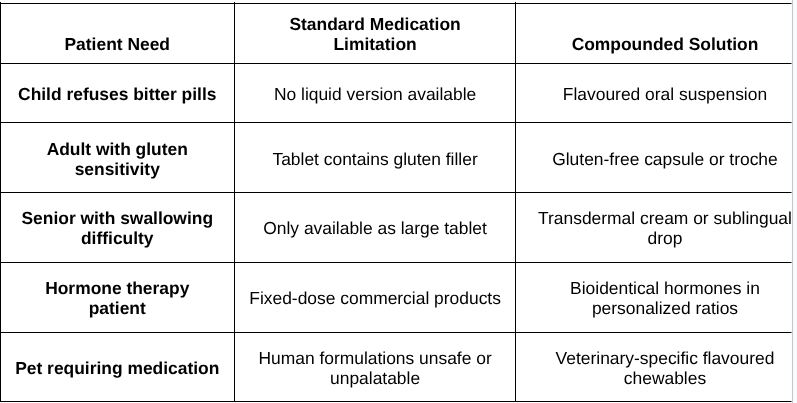
This adaptability is central to the benefits of compounded medication - not just in efficacy, but in safety, convenience, and compliance. When treatment fits the person, not the product, outcomes often improve.
Who Can Benefit from Compounded Medications?
While compounding pharmacy might sound niche, its applications span a wide range of patients across the lifespan and health spectrum. The key isn’t just what is a compounding pharmacy, but who stands to gain when medications are designed with individual biology and lifestyle in mind. Below are some of the groups that frequently benefit from custom medications:
Children: Many pediatric patients struggle with swallowing pills or reject bitter-tasting drugs. Compounding pharmacists can create colourful, flavoured liquids or gummies with precise dosing - making treatment not only possible but more agreeable.
Older adults: Polypharmacy (taking multiple medications) is common in seniors. Compounding can simplify regimens by combining compatible drugs into a single capsule or transdermal gel, reducing pill burden and improving adherence.
Individuals with allergies or sensitivities: Commercial medications often contain fillers, dyes, or preservatives that trigger reactions. Compounding allows for hypoallergenic formulations - free of lactose, gluten, soy, or artificial colours.
Patients undergoing hormone therapy: Whether for menopause, andropause, or thyroid support, many seek bioidentical hormone replacement tailored to their lab results and symptoms. Compounding enables customized dosing in creams, troches, or capsules that match physiological needs more closely than one-size-fits-all options.
Veterinary patients: Animals often require different dosages or delivery methods than humans. A cat might absorb medication better through the skin, while a dog may only accept a meat-flavoured chewable. Compounding bridges this gap in veterinary care too.
People facing drug shortages or discontinued products: When manufacturers discontinue a medication - sometimes due to low profitability - compounding pharmacies can recreate the formula, ensuring continuity of care.
Chronic pain or dermatology patients: Topical pain creams that combine anti-inflammatories, anesthetics, and muscle relaxants can target discomfort locally without systemic side effects. Similarly, custom dermatological preparations can blend multiple actives (like antifungals, steroids, and antibiotics) into one easy-to-apply formulation.
The unifying thread? These patients share a need that mass-produced pharmaceuticals can’t meet. Compounding doesn’t replace conventional medicine - it fills the gaps with precision, empathy, and science.
Real-World Applications and Practical Examples
To truly appreciate the value of compounding, it helps to see it in action. The benefits of compounded medication become clearest not in theory, but in everyday situations where standard treatments fall short. Below are real-life scenarios - common across Canadian households - where compounding makes a tangible difference.
A Child with Seizures Needs a Precise Dose
A two-year-old is prescribed an anti-seizure medication, but the lowest commercial dose is still too strong. Rather than risk side effects or inconsistent splitting of tablets, the neurologist works with a compounding pharmacy to prepare a liquid formulation at exactly 3.25 mg/mL - allowing for accurate, safe dosing with an oral syringe.
An Elderly Patient Struggles with Pill Overload
An 82-year-old manages diabetes, hypertension, and arthritis with seven different pills daily. Some cause stomach upset when taken together. A compounding pharmacist collaborates with their family doctor to combine three compatible medications into a single morning capsule and reformulate another as a topical gel - reducing gastrointestinal irritation and simplifying the routine.
A Woman Seeks Relief from Menopausal Symptoms
After trying several commercial hormone therapies with unwanted side effects, a patient opts for bioidentical hormone replacement. Based on her saliva and blood tests, a compounding pharmacist prepares a transdermal cream with customized ratios of estradiol, progesterone, and testosterone - adjusted monthly as her symptoms evolve.
A Pet Owner Can’t Administer Bitter Medication
A cat with hyperthyroidism refuses the standard oral medication due to its bitter taste. The veterinarian recommends a compounded version in a tuna-flavoured liquid that the owner applies to the cat’s ear - where it absorbs transdermally - ensuring consistent treatment without stress.
A Patient with a Rare Metabolic Disorder
Someone diagnosed with a rare condition requires a drug that was discontinued years ago. Through Health Canada’s Special Access Programme (SAP), their physician requests a compounded version. The pharmacy sources the active ingredient and produces a small batch under strict quality controls, restoring access to essential therapy.
Final Thoughts: Why Personalized Medicine Matters
In a healthcare landscape increasingly driven by efficiency and scale, compounding pharmacy stands as a quiet but vital counterbalance - prioritizing the individual over the average. It’s not about rejecting conventional medicine, but about recognizing that biology doesn’t conform to factory molds. Whether it’s a child who finally takes their medicine because it tastes like berries, a senior who regains independence with a simplified regimen, or a patient who finds relief after years of trial and error, compounding restores agency to both prescribers and patients.
Related:
