
Which Clinical Tasks Can an AI Medical Scribe Automate?

Here's something that probably sounds familiar: a physician finishes a long day of patient visits, sits down at 7 PM, and spends the next two hours catching up on notes. That's not an edge case, it's the norm. Documentation has quietly become one of the heaviest burdens in modern medicine, and it's driving burnout at every level of the clinical workforce.
Clinicians didn't choose this career to stare at EHR screens. They chose it to help people. And yet, research shows that physicians spend approximately 36.2 minutes documenting in the EHR for every 30-minute office visit. More time charting than treating. That imbalance deserves real attention, and fortunately, it's starting to get it.
Platforms built around clinical task automation are gaining serious traction. Commure, for instance, has developed tools that connect clinical workflows, reduce administrative friction, and hand providers back something they rarely get enough of: time. When healthcare professionals explore a capable ai medical scribe, the breadth of what's actually automatable tends to surprise them, and the efficiency gains follow quickly.
AI Medical Scribe Overview: How It's Reshaping Clinical Work
Using ambient voice capture and natural language processing, an ai medical scribe listens to clinical conversations as they unfold, transforms them into structured documentation in real time, and, critically, understands clinical context rather than just transcribing words. That distinction matters more than it sounds.
Adoption is accelerating across the board. Cloud infrastructure that's both scalable and HIPAA-compliant has made these tools accessible not just to large hospital systems but to smaller independent clinics too. The barrier to entry has dropped considerably.
So, what exactly can these tools do? Let's get specific.
Clinical Documentation Tasks AI Medical Scribe Tools Can Handle
The range is broader than most providers initially expect. Here's a breakdown of where medical scribe technology genuinely moves the needle.
Automated Charting During Patient Visits
The AI captures the consultation in real time, pulls out clinically relevant details, structures the note, and pushes it directly into the EHR. No typing. No end-of-day catch-up. No separate login or copy-paste ritual.
For physicians seeing a full day's patient load, this integration alone changes everything.
Documentation of Patient Histories and Chief Complaints
Beyond what's said today, the AI can surface relevant history from prior records at the right moment. Chief complaints and symptom patterns get documented consistently, reducing the gaps that tend to accumulate across visits. It keeps the full clinical picture intact, automatically.
SOAP Notes and Progress Notes, Generated Automatically
SOAP notes are notoriously time-consuming. AI tools generate structured drafts using captured visit content, complete with prompts for any missing exam findings, assessments, or plans. Providers review and approve rather than write from scratch. When you're seeing 20-plus patients in a day, that distinction is enormous.
Orders, Referrals, and Follow-Up Instructions
When a clinician says "order a CBC and follow up in two weeks," the AI flags it for documentation or order entry. Referral summaries and discharge instructions can be drafted automatically, based entirely on what was discussed during the visit. Care coordination keeps moving without piling on paperwork.
Billing and Coding Support
This one has direct financial implications. Relevant ICD and CPT codes get flagged in real time as documentation is generated. Fewer missed codes. Fewer claim rejections. It's one area where tools designed to automate clinical documentation pay for themselves faster than people expect.
Beyond Notes, The Expanding Scope of AI Medical Scribes
Today's AI medical scribe solutions have grown well beyond note generation. They're becoming true workflow tools.
Telemedicine and Virtual Care Documentation
Remote visits carry the same documentation burden as in-person ones. AI scribes handle video, phone, and chat-based care equally well, capturing and structuring notes regardless of the channel. As telemedicine cements itself as a permanent care delivery model, this capability matters enormously.
Task Management After the Visit
Post-visit follow-up is where things slip through the cracks. AI tools generate checklists automatically, labs to order, referrals to send, and and patient calls to schedule. Think of it as a tireless, exceptionally organized assistant who never forgets a single task.
Decision Support and Care Gap Detection
Some platforms embed clinical guidelines directly, flagging potential care gaps in real time. Providers catch issues earlier. Documentation of clinical decisions becomes more thorough. This is where AI for healthcare professionals starts to feel less like a convenience and more like a genuine transformation.
Features That Make AI Medical Scribes Indispensable
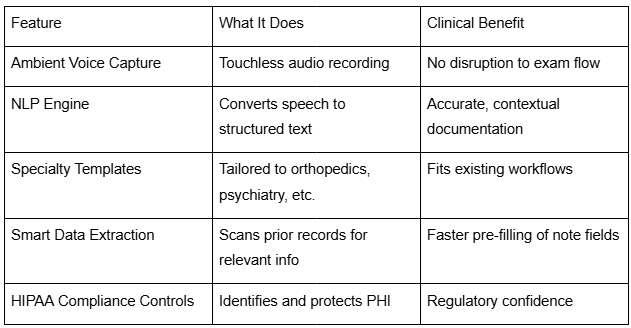
Customizable templates mean a psychiatrist's workflow isn't forced into an orthopedic surgeon's format. Good platforms adapt to how you actually practice, and the best ones use analytics to refine templates over time based on your individual preferences.
On the compliance side, HIPAA-ready AI engines identify protected health information automatically. No extra manual review required.
What Real Implementations Are Showing
The numbers coming out of actual deployments are hard to ignore.
A pilot study at Texas Oncology found that 77% of providers adopted ambient AI scribing, saving an average of 1.5 hours per provider per week. Those hours compound fast. Less evening charting. More personal time. Measurably lower burnout.
On the patient experience side, nearly half of patients in one study noticed their physician spent less time looking at a screen, while 39% reported more direct conversation during the visit. That's not a small thing; presence matters in clinical care.
Financially, the medical scribe technology market reflects this momentum, projected to reach $5.08 billion by 2030. The business case holds up: fewer denied claims, higher throughput, lower administrative overhead.
What to Consider Before Adopting
The benefits are compelling, but thoughtful implementation makes the difference between a smooth rollout and a frustrating one.
Integration with your existing systems is the starting point. The strongest platforms offer plug-and-play compatibility with major EHRs and telehealth tools. Friction during setup is one of the most common reasons adoption stalls.
Security and compliance certifications deserve careful scrutiny. SOC 2 and HITRUST certifications signal a platform treats data protection as a core commitment, not an afterthought.
Measuring outcomes is what drives continuous improvement. Track documentation time, note quality, and clinician satisfaction on a regular basis. Feedback loops help the AI learn your preferences and get sharper over time.
Common Questions
1. What does an AI medical scribe typically cost?
Most tools range from $99 to $299 per month per provider. AAFP research estimates the average at around $150–$200 monthly, though pricing varies based on usage volume and included features.
2. How does it actually work?
The clinician–patient conversation is recorded securely, in person or virtually. AI transcription software trained on clinical language converts speech to text. The system then organizes that content into structured draft notes ready for provider review.
3. Can AI medical scribes replace human medical scribes?
AI medical scribes can automate much of the documentation process, including capturing patient conversations, generating clinical notes, and suggesting billing codes. However, they are designed to assist clinicians rather than replace human judgment. Providers still review, edit if necessary, and approve documentation before it becomes part of the patient's medical record. In complex or highly specialized clinical settings, some organizations may continue to use human scribes alongside AI to handle unique workflow or documentation requirements.
The Bottom Line
Clinical task automation isn't on the horizon anymore. It's here, it's working, and it's scaling across specialties. For any provider still spending evenings buried in charts, the tools available today are mature, secure, and ready to deploy. The time savings are real. The burnout reduction is real. And the difference it makes, both for you and for your patients, is absolutely worth a serious look.
