
Navigating a North Carolina Divorce: Protecting Your Wealth and Your Family

Going through a divorce is one of the most stressful transitions you will ever face. It represents a massive shift in your family dynamic and a complete restructuring of your financial reality. You are not just ending a marriage. You are actively laying the groundwork for your future stability.
Navigating North Carolina's strict separation requirements and complex property laws can feel overwhelming without the right guidance. A single misstep regarding how you value a business or handle joint debts can affect you for decades. You need clear advice tailored to your specific situation and location.
Partnering with a local divorce attorney in Cary, NC ensures you understand your rights in plain language and can approach this transition with confidence. With a knowledgeable advocate by your side, you can protect your assets, shield your children from unnecessary conflict, and take control of your next chapter.
Key Takeaways
Understand the Separation Rule: North Carolina requires a strict one-year-and-one-day physical separation before you can finalize a divorce.
Prepare for Equitable Distribution: State law divides marital property fairly but not necessarily equally, making professional asset valuation essential.
Explore Out-of-Court Solutions: Mediation and collaborative divorce save money, preserve your privacy, and reduce family hostility.
Rely on Local Experience: An attorney familiar with Cary courts and judges provides a distinct strategic advantage for your case.
Making Sense of North Carolina’s Unique Divorce Laws
Every state handles marriage dissolution differently. If you live in North Carolina, you cannot simply file for divorce the moment you decide the marriage is over. You must navigate specific timelines and legal boundaries first.
Understanding these foundational rules prevents costly delays. It also gives you a clear roadmap of what to expect over the coming year.
The Mandatory One-Year Separation Rule
North Carolina enforces a strict one-year-and-one-day separation rule. You and your spouse must live completely apart for this entire duration before either of you can legally file for an absolute divorce. This means maintaining entirely separate residences. Moving into the guest bedroom or the basement of the family home does not satisfy the court's requirements.
During this waiting period, your financial and parental obligations do not just pause. This is why drafting a legally enforceable separation agreement early in the process is so highly recommended. A formal agreement establishes clear boundaries for your finances, debt management, and property access while you wait out the mandatory year.
Without a separation agreement, you leave yourself vulnerable to sudden financial disputes or confusion over bill payments. Establishing these terms right away protects your credit score and provides peace of mind. It allows both spouses to transition into separate lives with a defined set of rules.
Protecting Your Financial Future: How "Equitable Distribution" Works
Dividing the life you built together is rarely as simple as splitting the bank accounts down the middle. North Carolina uses a specific legal framework to determine who walks away with what. Knowing how the court views your property is the first step in defending it.
Properly identifying, categorizing, and valuing your assets requires a meticulous approach. A generalized guess is never enough when your financial independence is on the line.
Fair Does Not Always Mean Equal
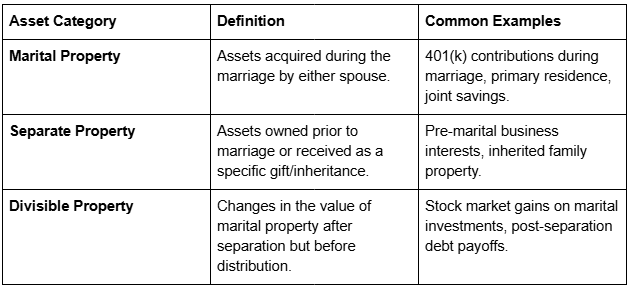
North Carolina is an "equitable distribution" state rather than a "community property" state. This means the court aims to divide marital property in a way that is fair, but fair does not automatically mean a 50/50 split. A judge will look at a variety of factors, including the length of the marriage, the income of each spouse, and contributions to career advancements.
Legal and financial experts often highlight this critical distinction. In equitable distribution states, marital property is divided 'fairly' based on various factors, which does not always mean an exact 50/50 split. You have to advocate for your rightful share by presenting a compelling case.
Common marital assets require careful division. These often include the family home, investment real estate, retirement accounts, and pensions. You must also be vigilant about marital debt and the potential for hidden assets, which can unfairly shift financial burdens if not properly uncovered.
Strategies for High-Asset and Business Divorces
If you own a privately held business or a professional practice, divorce introduces a new layer of risk to your life's work. Valuing a business is a highly complex process. It requires examining cash flow, physical assets, goodwill, and future earning potential.
Protecting your business interests and intellectual property means preventing your spouse from taking an unearned stake in your company's future. A specialized divorce strategy ensures the business can continue operating smoothly without being forced into liquidation. This often involves negotiating a buyout or trading other high-value physical assets (like real estate) to keep business ownership intact.
Your attorney will coordinate closely with forensic accountants and financial experts. Together, they structure property settlements that protect your bottom line and minimize negative tax implications. Smart planning ensures you do not inadvertently trigger massive capital gains taxes during the asset transfer process.
Securing Your Family's Foundation: Custody and Support
Your children are your priority. Ensuring their well-being during a divorce means establishing routines that minimize disruption and promote stability. The North Carolina family court system shares this goal, prioritizing the best interests of the child above all else.
Developing a customized, flexible parenting plan is essential. A good plan goes beyond standard weekend visitations. It accounts for school schedules, extracurricular activities, and nuanced holiday rotations that prioritize the child's needs while respecting both parents' time.
Child support is calculated fairly under North Carolina guidelines, but it is rarely a simple math equation. The formula factors in the income of both parents, the number of overnight visits, and the specific costs of healthcare and education. Ensuring these numbers are accurate prevents you from overpaying or receiving less than your child requires.
Spousal support (also known as alimony) is handled separately from child support. It is determined based on the financial needs of the dependent spouse and the ability of the supporting spouse to pay. The court looks closely at the standard of living established during the marriage to decide both the amount and duration of these payments.
Keeping It Out of Court: The Value of De-escalation
Courtroom battles are stressful, public, and incredibly expensive. Taking your divorce to trial means handing control of your finances and your family's future over to a judge who does not know you. Fortunately, litigation is not your only option.
Choosing to resolve disputes outside of the courtroom gives you greater control over the outcome. It also protects your privacy and your wallet.
Collaborative Divorce and Mediation in Cary
The financial toll of a litigated divorce can easily drain the savings you are trying to protect. Lengthy court battles can push those costs significantly higher.
Collaborative divorce and mediation offer a much smarter alternative for pragmatic couples. In mediation, a neutral third party helps you and your spouse negotiate the terms of your separation agreement privately. Collaborative divorce takes this a step further, with both parties and their attorneys signing an agreement to resolve all issues without going to court.
These methods provide incredible benefits. They offer complete privacy, unmatched flexibility in designing your settlement, and drastically lower legal fees.
More importantly, mediation promotes a "family-focused advocacy" approach. Instead of escalating hostility and tearing each other down in public records, you work to resolve conflict thoughtfully. This builds a foundation of respect that makes future co-parenting much easier for everyone involved.
Why Local Cary Experience Matters
When choosing legal representation, geographic proximity offers more than just convenience. Family law is heavily localized. The way a case is handled can vary wildly from one county courthouse to the next.
Hiring an attorney with specific familiarity with Cary, NC courts and local Wake County judges is a major strategic advantage. Knowing how specific judges historically rule on complex equitable distribution or alimony cases allows your attorney to build a highly tailored strategy. They understand local procedures, filing quirks, and the most effective ways to present evidence in your jurisdiction.
A local firm also provides holistic, face-to-face support. Divorce rarely happens in a vacuum. You will likely need to update your estate plans, adjust local business filings, or handle local real estate transfers. A well-connected Cary attorney can coordinate your divorce planning seamlessly with other local professionals.
Finally, having a local advocate means having someone who explains complex North Carolina legal jargon in straightforward, plain language. You should never leave a meeting confused about what happens next. A hometown attorney ensures you are fully informed and confident at every step of the process.
Conclusion
Divorce requires you to make permanent decisions during a temporary period of high stress. Proactive planning is your best defense. By moving quickly to draft a separation agreement, accurately value your equitable distribution assets, and establish a fair child custody plan, you protect the life you have worked so hard to build.
You do not have to face this complex transition alone. Partnering with experienced, local legal counsel ensures your business interests are shielded and your family relationships are preserved. They will guide you toward out-of-court solutions that save you time, money, and unnecessary hostility. With the right pragmatic support, divorce becomes less about what you are losing. Instead, it becomes entirely about the secure, independent foundation you are ready to build next.
