
Why Learning to Tolerate Boredom Matters in Addiction Recovery

Most of us have a pretty straightforward picture of the challenges that arise during addiction recovery. We connect them to resisting cravings, breaking old patterns, and avoiding situations that may trigger another episode.
However, reality is painfully calm and boring at times, too. There is that quiet afternoon or the weekend with no plans. These ordinary moments can be surprisingly difficult to deal with, bringing restlessness and an urge to seek the stimulation/escape the substance once provided.
Data from 2024 showed that while 27.1 million US adults had alcohol use disorder, only 2 million (roughly 7.5%) received proper treatment. What makes recovery particularly challenging, and ultimately rewarding, is not only learning to handle the major cravings but also the boring moments in between.
Let's explore the role of boredom in addiction recovery a bit more closely. This article will explore why boredom feels so uncomfortable during addiction recovery and practical ways to overcome it for meaningful progress.
The Palpable Discomfort of Boredom During Recovery
Boredom is a universal experience, and not all of it is bad. Healthline shares an entire list of potential benefits that boredom brings. In most cases, boredom is harmless, but it can be a door to vulnerability during addiction recovery.
Think of the recent data about overdose deaths and what experts have to say. About 70,000 Americans died of overdose in 2025. This number remains high despite being 14% lower than the previous year.
Brandon Marshall, a researcher of overdose trends from Brown University, said he is “cautiously optimistic” about the whole situation. He believes that government policy changes and a shift in drug supply can turn things around again.
He further added that “If deaths are going down rapidly, that means they can increase just as rapidly if we take our foot off the gas.” After all, it's not just about removing the substance that caused and is fueling the addiction. Back in the time of the pandemic, overdose deaths rose primarily due to social isolation and difficulties in accessing treatment.
Legends Recovery Centers acknowledges that there are very few people able to properly cope with the stress of being alone and isolated for any amount of time. This is why recovery also has to do with finding meaningful ways to spend time, reconnecting with others, and learning to cope with boredom. What feels like simple boredom often involves the following uncomfortable emotions:
Restlessness: The urge to fill the space immediately, even without knowing how.
Irritability: Getting frustrated because nothing seems to be interesting or satisfying.
Loneliness: Longing for people or social situations connected with past substance use.
Emotional discomfort: The resurfacing of difficult thoughts or feelings when there is no substance to push them aside.
A need for stimulation: Craving something exciting because ordinary activities feel unusually flat.
Essentially, the individual is not just having nothing to do. Most likely, they haven't figured out how to be comfortable with still and silent moments.
How Boredom Becomes a Path Back to Substance Use
Before we begin, let's clarify that not every individual falls back into their addiction due to boredom. However, it's a matter of concern if using a substance was the go-to response for having nothing to do.
In a 2026 study, 18 qualitative interviews with people experiencing homelessness in three Canadian cities were analyzed. Participants described substance use as a way of responding to boredom in several ways, including creating stimulation, managing unpleasant emotions, and filling unoccupied time.
The study was not designed to measure relapse or represent a universal answer for boredom and its link to substance use disorder. Yet, it confirms that if someone has used a substance to overcome moments of boredom, it's easier for them to keep going back.
Some signs that boredom may be connected to an old substance use pattern include:
Romanticizing the past to an extent that the consequences of substance use fade into the background
Feeling drawn to places, people, or situations associated with previous substance use
Thinking that using the substance just once more would not undo previous progress
Feeling uncomfortable when nothing is engaging to do
Losing interest in activities, responsibilities, or relationships that once provided structure to the day
As mentioned earlier, several uncomfortable emotions or thoughts go into the mix of boredom. This is why it's important to explore addiction recovery and treatment options that address more than the substance use itself. Support should also be directed towards helping the individual develop healthier ways and alternatives to handle uncomfortable emotions.
How to Build a Life That Does Not Need Constant Stimulation
There is a reason why it's said that the ordinary moments of life end up being the most extraordinary. Chasing the next exciting thing is not sustainable, especially during addiction recovery. Here are ways to build a meaningful life that does not need constant stimulation:
Make Ordinary Activities Part of Your Day
The more your brain gets accustomed to the fact that ordinary is the new normal, the faster you can overcome boredom. Simple activities can give your day a natural rhythm without making every hour feel planned or exciting.
Have a few enjoyable activities lined up each day that you look forward to. These can include cooking a favorite dish, taking a serene walk, or reading an engaging novel. Without staying busy every minute, you can gradually learn to become comfortable with the ordinary moments of daily life.
Practice Staying Still and Quiet for Short Periods
Constant stimulation can quickly become a habit. Phones, social media, television, music, and other distractions can make it easy to avoid sitting with your own thoughts. Recovery can include practicing short periods of uninterrupted quiet.
That may involve sitting outside without reaching for your phone or drinking coffee without turning to another form of entertainment. At first, quiet may feel uncomfortable. However, this does not mean something is wrong. Gradually, an uneventful moment will feel exactly like it should: normal.
Give Your Time a Sense of Purpose
Purpose does not have to mean a major life goal. It can come from relationships, family responsibilities, learning, volunteering, helping others, and contributing to a community. Social connection matters here too.
A 2025 Pew Research Center report found that 16% of US adults said they felt lonely or isolated from those around them all or most of the time. Another 38% said they feel lonely sometimes. This national survey included 6,204 US adults.
The findings do not mean loneliness causes substance use or that social activity prevents relapse. It does show why meaningful connections can be an important part of creating a fuller daily life. Having people to talk with, responsibilities to care about, and activities that matter can give empty hours a sense of direction.
FAQs
Why can boredom feel so difficult during addiction recovery?
Boredom can bring restlessness, loneliness, irritability, or difficult emotions to the surface. If substance use previously provided stimulation or escape, ordinary quiet moments may feel especially uncomfortable. Learning to tolerate these moments can help make everyday life feel more manageable.
Can boredom increase the risk of returning to substance use?
Boredom does not automatically lead to substance use, but it can activate an old pattern. This means if using a substance was a familiar way to fill empty time or uncomfortable feelings, boredom can trigger that. Identifying warning signs, maintaining healthy routines, and seeking appropriate support can help break that pattern.
How can someone become more comfortable with daily life during recovery?
Start with simple routines and enjoyable activities such as cooking, walking, reading, or hobbies. Gradually practice short periods without constant stimulation, while maintaining meaningful relationships and responsibilities. Over time, ordinary moments can become more comfortable without needing to be filled with excitement.
Quick Insights From the Article
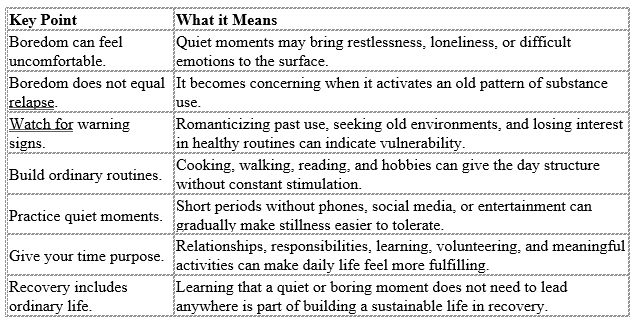
Although overcoming boredom seems like a small part of addiction recovery, it can have a meaningful place in learning how to live differently. There is reason to recognize that recovery and addiction-related outcomes can change over time.
The Centers for Disease Control and Prevention (CDC) reported that estimated drug overdose deaths in the US fell from 80,391 in 2024 to 72,722 in 2025. That’s a decrease of about 9.5%. Opioid-involved overdose deaths also declined during the same period, from an estimated 52,296 to 44,564.
Recovery is not measured only through statistics. What’s most important is to learn to sit with an ordinary evening and discover that boredom does not have to lead anywhere. Allowing an ordinary moment to be ordinary is part of recovering fully.
