
Why Smart Businesses Are Betting on Nearshore Recruiting Partners

Finding the right talent is one of the biggest challenges for growing businesses. Hiring delays, skill shortages, and rising recruitment costs can slow projects and limit business growth. That's why many companies are partnering with nearshore recruiting experts to access skilled professionals while maintaining close collaboration and similar working hours. This approach helps businesses build strong teams faster, improve communication, and reduce hiring risks. In this guide, you'll learn why smart businesses are choosing nearshore recruiting partners and how this strategy supports faster hiring, better project outcomes, and long-term business success.
The Real Strategic Edge Nearshore Recruiting Offers Today
The hiring playbook has been rewritten not once, but repeatedly over the past decade. Remote work didn't just normalize distributed teams; it forced companies to confront a harder truth. Not every outsourcing model works equally well, and the differences matter more than most leaders initially expect.
Nearshore staffing carved out its distinct advantage through something deceptively simple: proximity. Shared time zones, overlapping work hours, and genuine geographic closeness make collaboration feel natural, not forced. You get the cost benefits of global hiring without the operational friction that typically comes with offshore arrangements.
Companies exploring nearshore recruitment services often arrive at the same conclusion this model threads a needle that most hiring strategies can't. It delivers real cost efficiency without compromising talent quality. That balance matters enormously when you're making decisions that affect product velocity and growth trajectory.
Time Zones Actually Matter More Than You Think
Here's something hiring managers often underestimate until it bites them. Working across a 10-hour time difference creates compounding friction: delayed approvals, missed stand-ups, and project momentum lost overnight while half the team is asleep.
Nearshore teams typically operate within one to three hours of U.S. time zones. Sprint reviews happen live. Questions get answered the same afternoon. Nobody's waiting on a response that won't arrive until tomorrow morning. That kind of daily rhythm isn't a small perk; it fundamentally changes how quickly teams iterate and improve.
Strong Talent Exists. You Just Need to Know Where to Look.
Real-time collaboration only matters if the people you're collaborating with are genuinely skilled. Fortunately, Latin America has become one of the fastest-growing hubs for tech, finance, marketing, and operations professionals. Eastern Europe is producing engineers and developers at scale. These aren't emerging talent pools anymore; they're established ones.
Experienced nearshore recruitment partners have already built deep pipelines in these regions. They know which cities produce the strongest fintech talent, where to find senior product managers, and how to identify candidates who will genuinely thrive on U.S.-aligned teams. That regional fluency compresses hiring timelines dramatically.
What Nearshore Hiring Actually Does for Your Bottom Line
Strategic advantages sound compelling in a pitch deck. But every founder and hiring leader eventually lands on the same question: what does this actually mean for growth and profitability?
The Cost Argument Is Hard to Dispute
Latin American professionals still earn 40–60% less than their U.S. counterparts. That gap delivers measurable ROI without the quality tradeoffs companies typically fear when exploring cost-reduction strategies. The savings don't disappear into overhead; they get reinvested into product development, marketing infrastructure, or operational capacity. That's a genuinely strategic outcome, not just a budget line item.
Scaling Becomes a Real Option, Not a Fantasy
Cost efficiency gets the headlines, but scalability deserves equal attention. Nearshore staffing makes rapid team expansion genuinely achievable. Need to double your engineering headcount before a product launch? A strong nearshore partner can build that pipeline without the six-month domestic hiring timeline that typically derails launch plans.
The flexibility runs both directions, too. When market conditions shift, nearshore arrangements frequently allow for more agile team adjustments compared to traditional employment structures. For high-growth companies navigating uncertainty, that two-way flexibility is invaluable.
Cultural Fit Comes More Naturally Than Most Expect
Latin American professionals, particularly those working with U.S. companies, tend to align well on communication norms, professional expectations, and collaborative work culture. That compatibility reduces onboarding friction significantly and accelerates team cohesion. It also introduces meaningful diversity of perspective something research consistently links to stronger problem-solving and innovation outcomes.
How to Actually Choose the Right Nearshore Partner
Understanding the benefits is one thing. Identifying a partner who consistently delivers them is another challenge entirely.
Past Performance Tells You What Marketing Won't
When evaluating potential partners, ask for specifics: placement success rates, average time-to-fill, and 90-day retention figures. A partner with deep vertical expertise will ask sharper questions, source stronger candidates, and anticipate friction before it surfaces. That's the difference between a vendor and a genuine strategic partner.
Technology and Compliance Alignment Isn't Optional
Even experienced partners create costly problems when their technology stack or compliance standards don't align with yours. Verify that candidates are screened for tool proficiency, and confirm the partner maintains data privacy and IP protection protocols appropriate to your industry. Skipping this conversation early almost always creates headaches later.
The Best Partners Don't Just Place People; They Stay Involved
Top-performing nearshore recruitment services go well beyond sourcing and placement. The best providers manage onboarding coordination, HR support, and ongoing performance monitoring. That end-to-end coverage removes administrative burden from your internal team and keeps everyone focused on delivering outcomes rather than managing logistics.
The Outsourcing Models Actually Reshaping How Teams Are Built
The strongest nearshore talent solutions today look nothing like the outsourcing arrangements companies signed a decade ago. The field has matured considerably.
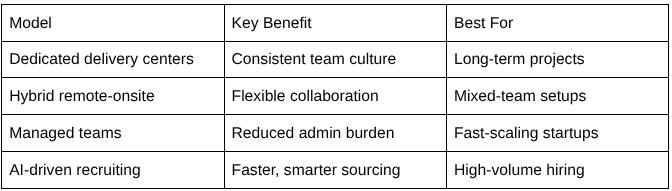
Leading nearshore staffing partners aren't just filling roles they're investing in upskilling, cross-functional development, and leadership pipeline construction. AI-powered screening tools, automated shortlisting, and predictive matching are compressing time-to-fill on even specialized roles. Hours saved per hire translate directly into faster delivery and revenue generation.
Real Results From Real Companies
A SaaS company cut its engineering hire timeline from 90 days to under 30 by partnering with a nearshore firm with deep tech talent networks. A fintech startup scaled its compliance team by 40% in a single quarter without exceeding budget. A healthcare technology provider improved developer retention by 35% after transitioning away from an offshore model entirely. These aren't flukes; they're the natural outcome of well-executed partnerships built on the right fundamentals.
Making the Partnership Work From Day One
Build Communication Infrastructure Before You Need It
Establish weekly syncs, define escalation paths, and standardize collaboration tools (Slack, Notion, or whatever fits your workflow) before the first hire lands. Getting this infrastructure right at the start dramatically shortens the runway to meaningful results.
Track the Metrics That Actually Tell You Something
Monitor time-to-fill, 90-day retention rates, candidate quality scores, and hiring manager satisfaction consistently. These benchmarks create shared accountability and surface problems early before they become expensive.
Think Partner, Not Vendor
The businesses achieving the strongest long-term outcomes treat their nearshore partners as genuine extensions of their internal team. That mindset shift produces better retention, stronger cultural integration, and deeper institutional knowledge that compounds over time.
Common Questions About Nearshore Recruiting
What roles work best?
Tech, finance, marketing, operations, and customer support, especially positions requiring English proficiency, time-zone alignment, and specialized skills.
Nearshore vs. offshore: what's the real difference?
Nearshore places teams in similar time zones (Latin America for U.S. companies). Offshore typically means significant time-zone gaps, which slow collaboration in ways that compound quickly.
How fast can you see results?
Most companies receive qualified candidates within one to two weeks. Full team integration generally happens within 30 to 60 days.
Can nearshore handle rapid scaling?
Yes, active talent pipelines mean high-volume hiring moves faster than domestic recruitment allows.
How is IP protection handled?
Reputable partners use NDAs, structured employment agreements, and compliance frameworks aligned with local labor laws and industry-specific security standards.
The Bottom Line on Nearshore Recruiting
The companies winning the talent war right now aren't waiting passively for the perfect domestic candidate to materialize. They're building agile, culturally aligned teams through trusted nearshore recruitment partners, and they're doing it faster and more affordably than their competitors thought possible.
If reducing hiring costs, accelerating timelines, and building teams that genuinely deliver are priorities for your business right now, the case for exploring nearshore recruitment services has never been stronger. The model works. The talent is there. The only real question is whether you're ready to take advantage of it.
