
Boswellia vs Glucosamine Shellfish Sourcing: A Label Guide
A boswellia vs glucosamine shellfish comparison starts with ingredient origin, not a ranking of supplement effects. Frankincense extract comes from Boswellia tree resin. Glucosamine can come from crustacean shells or a non-shellfish production process. This guide explains how to identify each source, what a label may leave unclear, and which questions matter when shellfish is a concern. HerbEra's editorial view is that a product's source and its finished-formula details should be checked separately.
The key distinction is simple: choosing a botanical extract is not the only way to avoid shellfish-derived glucosamine. Fermentation-derived glucosamine products also exist. At the same time, a plant-derived main ingredient does not establish that a finished product is suitable for someone with a shellfish allergy.
What are the three sourcing options?
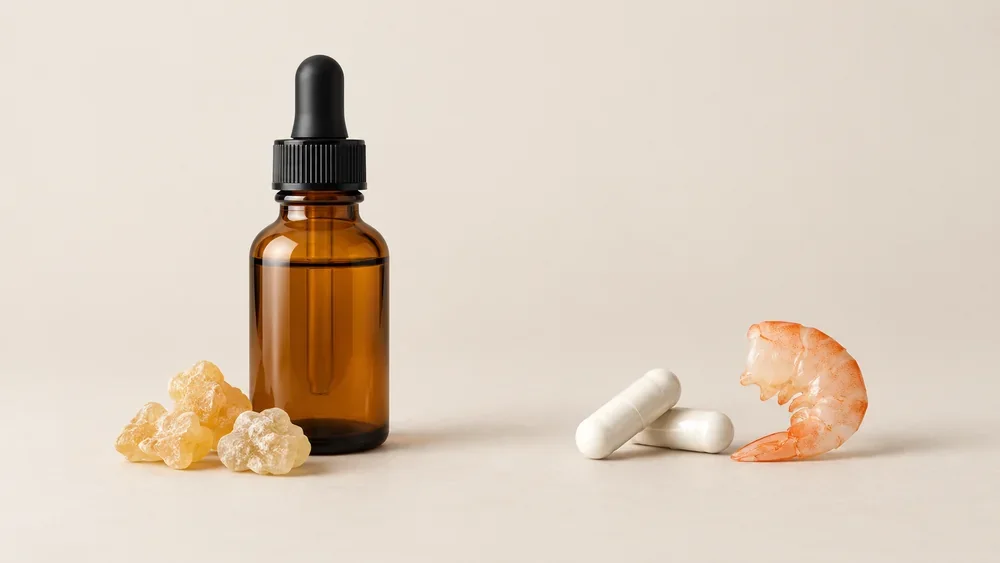
Shoppers may encounter shellfish-derived glucosamine, fermentation-derived glucosamine, and Boswellia extract. The first two supply forms of glucosamine but differ in origin. Boswellia is a different botanical ingredient, so it is not a shellfish-free version of glucosamine.
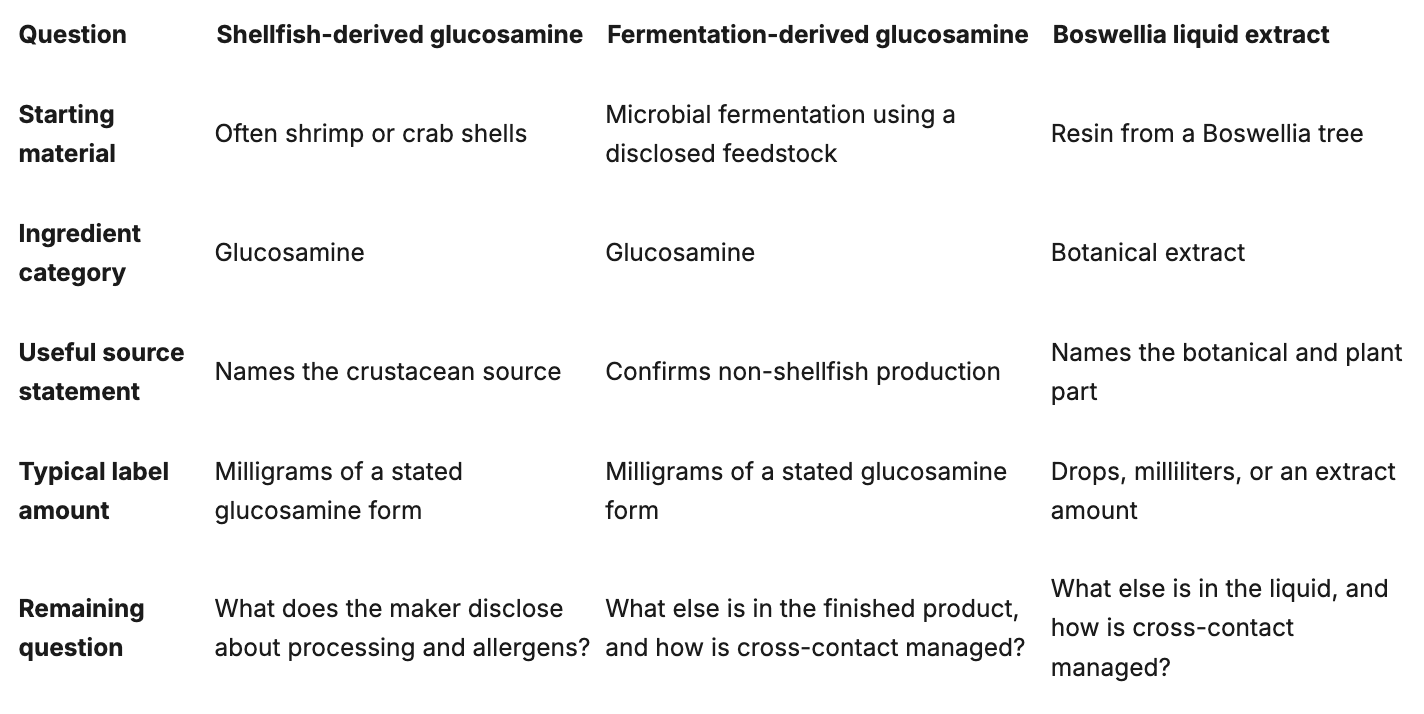
These categories answer different questions. A non-shellfish glucosamine may fit a sourcing restriction while keeping glucosamine as the chosen ingredient. A frankincense extract changes the ingredient itself. Neither route should be assumed suitable for a particular person without reviewing the finished product.
Does the word glucosamine reveal a shellfish source?
No. The word glucosamine identifies an ingredient, not how the manufacturer obtained it. Some commercial glucosamine starts with chitin from shrimp or crab shells. Other products use fermentation-based production without a shellfish starting material.
Terms such as glucosamine hydrochloride and glucosamine sulfate describe chemical forms. They do not, by themselves, identify animal or non-animal origin. A shopper cannot reliably infer the source from the letters HCl, the word sulfate, or a milligram amount. Look for a clear source statement on the finished-product label or request one from the maker.
Check combination formulas with the same care. A product may contain non-shellfish glucosamine alongside other ingredients whose sources differ. A claim about one component does not automatically cover the capsule shell, added ingredients, or the full manufacturing process.
Is fermentation-derived glucosamine a real non-shellfish option?
Yes. Manufacturers can produce glucosamine through fermentation rather than extracting it from crustacean shells. The process provides a different sourcing route, but buyers still need to verify the specific finished product.
Ask what the source statement covers. Does it refer only to the raw glucosamine ingredient, or to the complete supplement? Does the maker provide information about other ingredients and manufacturing cross-contact? A front-label phrase such as non-shellfish may answer the first question while leaving the others open.
Do not confuse source with formulation. Fermentation-derived glucosamine can appear in different chemical forms and product blends. Its non-shellfish origin does not show that it has the same amount, supporting ingredients, or evidence base as a different product. Compare the exact form and milligrams per serving when comparing two glucosamine labels.
Can a frankincense tincture resolve a shellfish sourcing concern?
A frankincense tincture avoids using glucosamine as its main botanical ingredient, but it cannot be declared allergy-safe from that fact alone. Frankincense resin comes from Boswellia trees. The liquid base, other ingredients, and manufacturing conditions belong to the finished product and need separate verification.
When evaluating a resin-based frankincense liquid, check the botanical species if disclosed, the resin amount or extract description, the solvent, and the full ingredient list. The word tincture does not tell you whether a particular bottle contains alcohol, glycerin, water, or another base. It also does not tell you whether the maker has assessed shellfish cross-contact.
HerbEra's editorial stance is to avoid turning plant origin into an allergy clearance. If shellfish exposure is a concern, ask the maker for a finished-product statement and relevant manufacturing information rather than relying only on the botanical name or product photograph.
Boswellia and glucosamine also use different serving measures. Drops of a resin extract cannot be converted into milligrams of glucosamine. They are separate product choices, not interchangeable presentations of one ingredient.
Does shellfish-derived glucosamine always pose the same allergy concern?
No single answer applies to every product or every person. Glucosamine made from shells is processed, and the amount of remaining shellfish protein can vary with the product and its manufacturing controls. A small controlled study found that participants with shrimp allergy tolerated the particular glucosamine products tested. That finding does not establish the status of every product on the market.
For someone with a diagnosed allergy, the sensible question is not whether a supplement category is generally fine. It is whether the exact product's source, residual-allergen controls, other ingredients, and cross-contact information meet the advice of their allergist. Do not use a general article or an at-home trial to settle a personal allergy question.
Labeling rules also differ across countries. In the United States, crustacean shellfish are a major food allergen category, but a missing precautionary cross-contact statement is not proof that cross-contact is impossible. Read the local label and ask the manufacturer when the information is incomplete.
What should a buyer ask before choosing either product?
Ask for facts about the exact bottle or package, especially when a sourcing restriction is the reason for shopping. A product name, a general statement about plants, or a broad testing claim does not answer every ingredient and cross-contact question.
For a glucosamine product
Ask whether the glucosamine comes from crustacean shells or a non-shellfish process. Confirm its chemical form, amount per serving, other active ingredients, capsule materials, and whether the maker's source statement applies to the current finished product.
For a frankincense liquid
Ask which Boswellia species and plant material the maker uses, what liquid carries the extract, and which other ingredients appear in the formula. If allergy exposure matters, request information about shared equipment and controls rather than assuming the resin's plant origin settles the issue.
For either category
Check the current label, lot information, and the scope of any available product documentation. A certificate that measures botanical identity or ingredient amount does not necessarily assess allergens. Ask specifically for the information relevant to your concern.
Shellfish sourcing checklist
Use this checklist to separate a sourcing preference from an allergy concern. Both require reading the complete product information, but an allergy question may need more specific confirmation from a qualified professional and the manufacturer.
Name the restriction
Decide whether you are avoiding animal-derived material, crustacean-sourced ingredients, or possible allergen exposure. These are related but not identical requirements.
Find the ingredient source
Look for a stated shellfish, fermentation, or botanical origin. If the source is not disclosed, do not guess from the ingredient name.
Read the full formula
Check supporting ingredients, flavors, carriers, and capsule materials. A claim about the main ingredient may not describe every component.
Check the serving details
Record the stated amount and unit. Do not compare botanical drops with glucosamine milligrams as though they measure the same substance.
Ask about cross-contact
If exposure matters, ask what the maker can confirm about shared equipment and manufacturing controls. An absent warning does not provide that answer on its own.
Bring the exact label
For an allergy or a complex supplement routine, show the current package to an allergist, pharmacist, or other qualified professional. Avoid making a personal safety decision from a product category alone.
FAQ
Is all glucosamine made from shellfish?
No. Some glucosamine comes from crustacean shells, while non-shellfish fermentation-derived options also exist.
Does glucosamine sulfate mean it came from shellfish?
No. Sulfate names a chemical form, not the raw material. Verify the source with the maker.
Is Boswellia a type of glucosamine?
No. Boswellia is a tree genus associated with frankincense resin. Glucosamine is a different ingredient.
Is frankincense tincture guaranteed to be shellfish-free?
No. Its main resin is plant-derived, but the complete formula and manufacturing cross-contact need separate confirmation.
Does a non-shellfish claim guarantee allergy suitability?
No. Check what the claim covers, review the full formula, and ask about cross-contact when relevant.
Can I compare frankincense drops with glucosamine milligrams?
Not as equivalent amounts. Drops measure a botanical liquid serving; glucosamine milligrams measure a different ingredient.
What if a product does not disclose its glucosamine source?
Ask the manufacturer for a current written source statement. Do not infer origin from the product name or chemical form.
Glossary
Boswellia
A genus of trees that can produce frankincense resin.
Frankincense resin
Material collected from certain Boswellia trees and used in some botanical extracts.
Glucosamine
An amino sugar sold in several supplement forms and made through different sourcing routes.
Crustacean-derived
Sourced from animals such as shrimp or crab.
Fermentation-derived
Produced through a controlled process involving microorganisms rather than extracted from shellfish shells.
Glucosamine form
The declared chemical presentation, such as hydrochloride or sulfate.
Cross-contact
Unintended transfer of an allergen during handling or manufacturing.
Finished-product statement
Information that applies to the complete product, not only one raw ingredient.
Conclusion
Shellfish-derived glucosamine, fermentation-derived glucosamine, and Boswellia extract represent three different sourcing choices. Confirm the exact formula and manufacturing information before deciding whether any finished product meets a shellfish restriction or a personal allergy requirement.
Sources Used
Frankincense resin and Boswellia species - kew.org/read-and-watch/frankincense
Non-shellfish glucosamine production petition - ams.usda.gov/sites/default/files/media/Glucosamine%20Hydrochloride%20Petition.pdf
Controlled study of shrimp-derived glucosamine in shrimp-allergic participants - pubmed.ncbi.nlm.nih.gov/17083356
Major food allergen labeling and cross-contact guidance - fda.gov/media/168000/download
Botanical extract and tincture background - ods.od.nih.gov/factsheets/BotanicalBackground-Consumer
Frankincense liquid product information - herb-era.com/products/frankincense-tincture
