
Collagen Supplements for Women: What Really Matters in a Well-Designed Formula
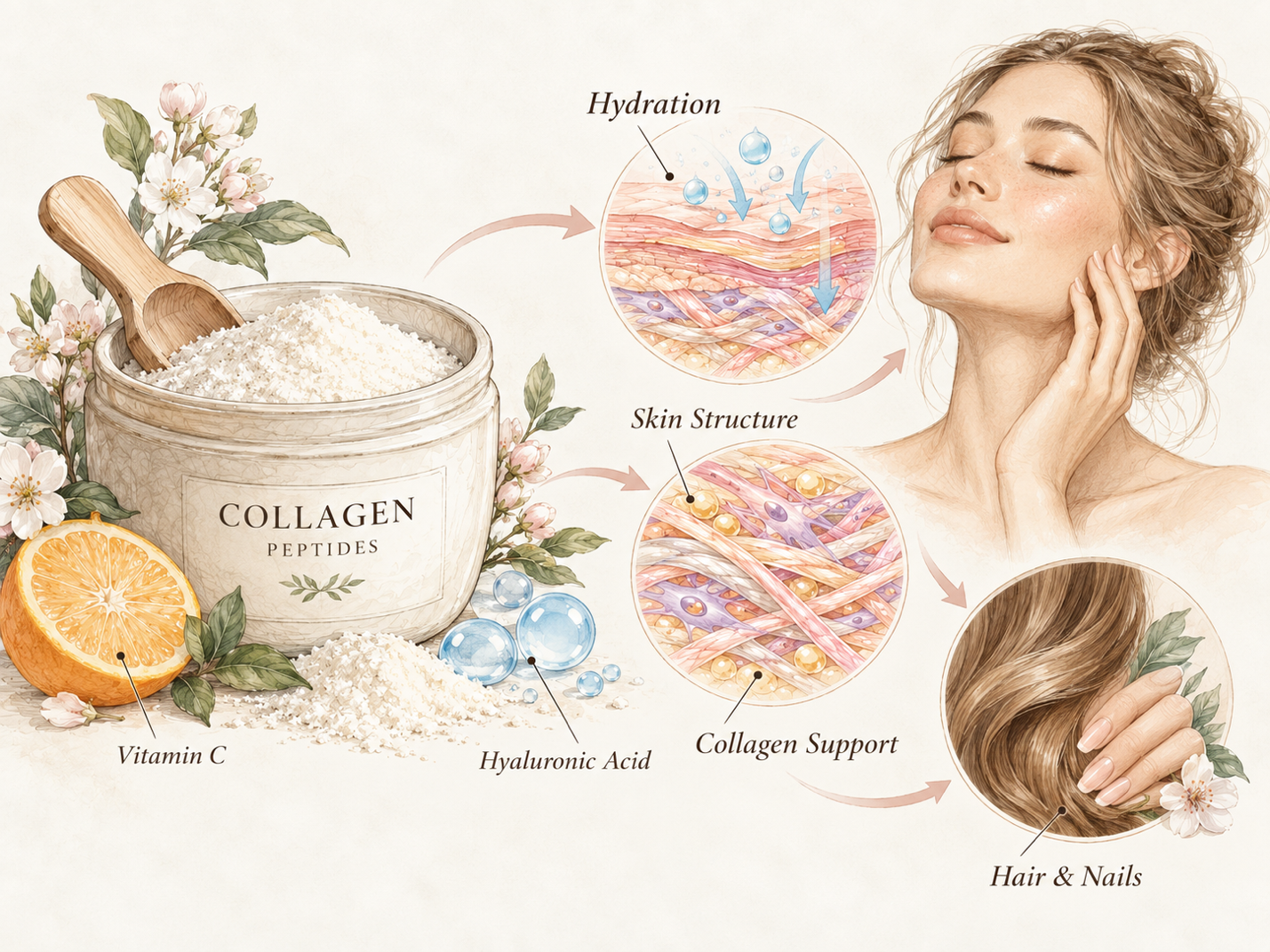
Collagen has become one of the most familiar ingredients in women’s wellness, yet choosing a supplement has become increasingly confusing. One product promotes five collagen types, another focuses on Types I and III, while others combine collagen with hyaluronic acid, vitamin C, biotin or long lists of beauty ingredients.
The problem is that more ingredients do not necessarily mean a better formula. A more useful way to evaluate collagen is to understand the biology of skin and ask whether the ingredients in a supplement actually serve a clear purpose.
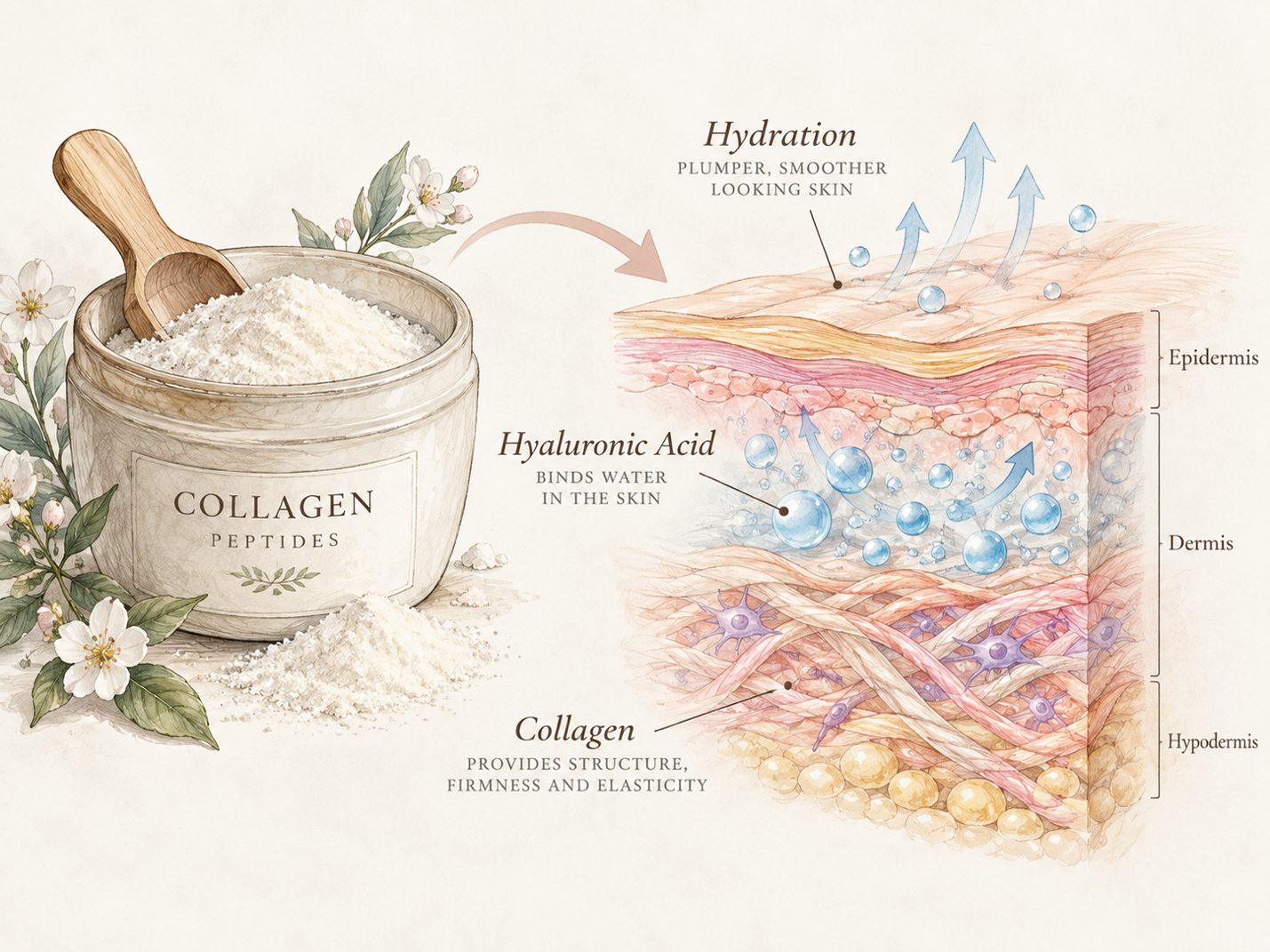
Skin is not supported by collagen alone. Beneath the surface lies a complex extracellular matrix made up of structural proteins, cells, water-binding molecules and nutrients that interact continuously. Collagen provides much of the structural framework, hyaluronic acid helps support the hydrated environment around that framework, and vitamin C participates in the body’s normal process of producing collagen.
Once those roles are understood, comparing formulas becomes much easier.
Why Collagen Matters to Skin
Collagen is the major structural protein of the dermis, the supportive layer beneath the skin’s surface. It helps give skin strength and structure, while elastin contributes flexibility and fibroblasts continually produce and remodel components of the surrounding extracellular matrix.
That system changes gradually with age. Collagen production becomes less efficient, existing fibers become increasingly fragmented, and the organization of the dermal matrix changes. Environmental factors, particularly ultraviolet exposure, can accelerate collagen breakdown. Hormonal changes during midlife can also influence skin thickness, hydration and collagen metabolism, which helps explain why changes in texture, dryness and elasticity often become more noticeable over time.
This is why collagen supplementation has attracted so much interest. But the important question is not simply whether a product contains collagen. It is what form of collagen it provides, what happens after digestion, and whether the rest of the formulation makes biological sense.
Why Supplements Use Hydrolyzed Collagen Peptides
Collagen in the skin is a large protein with a distinctive triple-helix structure. Dietary collagen does not remain intact as it moves through the digestive system, which is why most supplements use hydrolyzed collagen peptides.
Hydrolysis breaks collagen into smaller peptide fragments. Digestion then breaks these fragments down further into amino acids and smaller peptides that can be absorbed. Collagen is especially rich in glycine, proline and hydroxyproline, amino acids that are characteristic of collagen proteins.
Researchers have also detected hydroxyproline-containing peptides in the bloodstream after collagen ingestion, which has created interest in whether some of these fragments may have biological effects in addition to providing amino acids.
Clinical research has explored whether regular collagen supplementation affects measurable characteristics of the skin. A 2023 meta-analysis combining 26 randomized controlled trials and 1,721 participants reported improvements in skin hydration and elasticity among people receiving hydrolyzed collagen. More recent reviews have emphasized that study quality varies, so the results should be interpreted thoughtfully rather than turned into exaggerated promises.
Still, the science provides a useful foundation: hydrolyzed collagen supplies collagen-derived peptides and amino acids that become available to the body as part of normal protein metabolism.
Why Types I and III Matter Most for Skin
One of the most confusing trends in collagen marketing is the focus on how many collagen types appear on the label. A product with five collagen types may sound more complete than one containing Types I and III, but the number alone does not determine whether the formula is appropriate for a particular goal.
When the focus is skin, Types I and III are especially important because they make up the overwhelming majority of collagen in normal dermal tissue. Type I is the dominant collagen and contributes much of the skin’s tensile strength, while Type III is closely associated with Type I and helps support the organization of the dermal collagen network.
This gives bovine collagen rich in Types I and III a clear biological rationale in skin-focused formulas.
It is equally important to understand what happens after collagen is consumed. The body does not transport an intact Type I molecule from a scoop of powder directly into the skin. Dietary collagen is digested into amino acids and smaller peptides, which become part of the body’s broader pool of nutritional building blocks. Individual tissues then use those materials according to their own biological instructions, producing the proteins and collagen types they require.
For this reason, the quality, dose, source and peptide profile of the collagen matter more than simply accumulating as many named collagen types as possible on the label.
Women comparing formulas in greater detail may find this guide to the best collagen supplements for women useful for looking at collagen type, source, dose and supporting ingredients together.
Why Hydration Belongs in the Same Conversation
Collagen fibers do not exist in isolation. They are surrounded by a hydrated extracellular environment containing water-binding molecules that influence the physical properties of the skin.
Hyaluronic acid is one of the best-known components of this environment. It occurs naturally throughout connective tissues and has a strong relationship with water, helping support the hydrated matrix surrounding cells and structural proteins.
Its role is therefore different from collagen, which is exactly why combining the two can make sense. Collagen contributes structural support, while hyaluronic acid contributes to hydration.
Research into oral hyaluronic acid has also expanded. A randomized double-blind clinical trial involving 129 women reported improvements in skin hydration following supplementation, while other studies have explored changes in moisture, elasticity and wrinkle measurements.
The research base is smaller than the collagen literature, but it provides a scientific rationale for a collagen with hyaluronic acid formulation when both structure and hydration are priorities.
Where Vitamin C Fits
Vitamin C adds another distinct role.
Unlike collagen, it is not a structural protein, and unlike hyaluronic acid, its main role is not hydration. Vitamin C is required for normal collagen biosynthesis and acts as a cofactor for enzymes involved in forming and stabilizing collagen.
That makes its inclusion in collagen supplements easy to understand. Collagen peptides provide collagen-derived amino acids and peptides, hyaluronic acid contributes a hydration-focused component, and vitamin C supports the body’s own process of collagen formation.
The value of the formula comes from these ingredients complementing one another rather than simply adding more items to the label.
What Makes a Collagen Formula Well Designed?
Once the biology is understood, reading a collagen label becomes much simpler.
A good formula should clearly disclose how much hydrolyzed collagen it provides. The source should be identifiable, and the collagen types should make sense for the intended purpose. For skin-focused formulas, Types I and III have especially strong biological relevance.
Supporting ingredients should also have a clear reason for being included. Hyaluronic acid makes sense when hydration is part of the goal, while vitamin C has a direct physiological relationship with collagen synthesis.
Practical considerations matter as well. Collagen studies generally examine consistent supplementation over weeks or months rather than occasional use, so taste, texture and mixability influence whether someone will actually use a product regularly.
This is why the “best” collagen supplement is not necessarily the one with the longest ingredient list or the greatest number of collagen types. A well-designed formula is one in which the collagen source, dose and supporting ingredients work together logically and are easy for the consumer to understand.
A Smarter Way to Look at Collagen
The collagen category becomes much easier to navigate when the focus moves away from marketing numbers and back toward biology.
Types I and III provide a logical collagen foundation for skin-focused supplementation because they dominate normal dermal collagen. Once consumed, hydrolyzed collagen is digested into amino acids and smaller peptides that become available for the body’s own protein metabolism. Hyaluronic acid contributes to the hydrated environment surrounding the skin’s structural network, while vitamin C supports normal collagen synthesis.
Together, these roles create a coherent formulation strategy.
The most useful question is therefore not how many ingredients or collagen types a product contains, but whether each major component has a clear biological purpose and whether the formula provides those ingredients in meaningful amounts.
That is what separates a crowded label from a thoughtful one.
Scientific References
Pu SY, Huang YL, Pu CM, et al. Effects of Oral Collagen for Skin Anti-Aging: A Systematic Review and Meta-Analysis. Nutrients. 2023;15(9):2080.
Gao YR, Wang RP, Zhang L, et al. Oral Administration of Hyaluronic Acid to Improve Skin Conditions via a Randomized Double-Blind Clinical Test. Skin Research and Technology. 2023;29(11).
National Institutes of Health, Office of Dietary Supplements. Vitamin C: Fact Sheet for Health Professionals.
Al Hajj W, Salla M, Krayem M, et al. Hydrolyzed Collagen: Exploring Its Applications and Assessing Its Impact on Human Health—A Comprehensive Review. Heliyon. 2024.
