
Healthy Fats for Skin, Hair, Nails: The Inside-Out Approach
This is a contributed post.
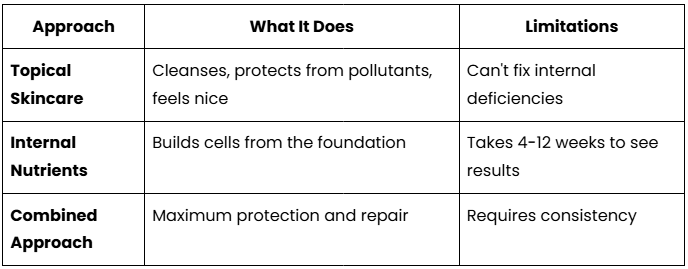
Walk into any skincare store, and you'll drown in options. Creams, serums, oils, masks, sprays, thousands of products promise to fix your skin, hair, and nails from the outside in. Some of them actually work. They protect you from environmental damage, they cleanse well, and they feel nice.
But here's what they can't do: they can't fix what's broken on the inside.
If your skin is dull, your hair is brittle, and your nails won't stop breaking, the problem isn't your skincare routine. The problem is that your cells aren't getting what they need to function. You can't slap enough serum on your face to fix that.
Real skin, hair, and nail health comes from one place: what you eat.
WHY YOUR CELLS ARE THE REAL FOUNDATION
Every cell in your body has a membrane. That membrane is made of phospholipids and essential fatty acids. Without them, your cells start breaking down. Eventually, this shows up as health problems, and yes, that includes terrible skin, hair, and nails.
This is cellular biology, not opinion. Your cell membranes need phospholipids to stay flexible and function properly. They need them to protect against UV damage and environmental toxins. They need them to absorb hydration and nutrients. Without phospholipids, nothing else works.
Essential fatty acids, omega-3s and omega-6s, are just as critical. Your body can't manufacture these on its own. You have to get them from food. That's literally why they're called "essential."
When you have enough phospholipids and essential fatty acids nourishing your cells, something shifts. Your skin glows. Your hair gets thick and shiny. Your nails stop breaking. Not because you bought a better serum. Because your cells are finally getting what they need actually to rebuild themselves.
PHOSPHOLIPIDS: THE BUILDING BLOCKS OF EVERY CELL
Phospholipids are the structural foundation of your cell membranes. If you think about your skin, hair, and nails as barriers protecting your body, because that's precisely what they are, then phospholipids are the bricks and mortar holding those barriers together.
Your skin is literally a barrier. Your hair is a barrier. Your nails are a barrier. All three depend on a strong cellular structure. All three depend on phospholipids.
The problem: phospholipid levels drop with aging, chronic stress, environmental toxins, and disease. Your body can't keep up with demand. So your cells start aging faster. Your skin loses elasticity. Your hair thins. Your nails weaken.
This is why phospholipid supplementation becomes valuable as you age. It's not vanity, it's cellular repair.
THE ESSENTIAL FATTY ACID STORY: YOU NEED BOTH OMEGA-3 AND OMEGA-6
There are two essential fatty acids you need to know about: omega-6 (linoleic acid) and omega-3 (alpha-linolenic acid).
Most people think omega-3s are the hero and omega-6s are the villain. This is entirely wrong.
Linoleic acid, an omega-6 fatty acid, is absolutely critical for healthy-looking skin and for maintaining your skin barrier. Without it, your skin becomes dry and sensitive. It can't hold onto moisture. It gets irritated easily.
But here's where people mess up: they avoid omega-6s because they've heard they're inflammatory. That's only true for the cheap, processed versions in grocery stores. Canola oil, cottonseed oil, soy oil, and sunflower oil have been heated, oxidized and processed to death. They create free radicals. They cause inflammation. Avoid them completely.
But cold-pressed, organic safflower oil and flaxseed oil? These are different. In their purest form, linoleic acid is essential for your skin's structural integrity and barrier function. Your skin actually needs it.
Alpha-linolenic acid, an omega-3 fatty acid, is equally important. It reduces inflammation. It protects your skin from sun damage. It prevents collagen breakdown. It helps prevent wrinkles. Without enough omega-3s, your skin ages faster, even if you're protecting yourself from the sun.
Here's the catch: omega-3s and omega-6s need to be balanced. The ideal ratio is 4:1 (omega-6 to omega-3). When this balance gets skewed, even a healthy nutrient like omega-3 becomes problematic. Your body is all about balance. Throw that off, and you create problems.
This is why "more omega-3" isn't always better. And this is why fish oil supplements, even good ones, don't always work.
WHY FISH OIL ISN'T THE MAGIC BULLET
Everyone talks about fish oil like it's the solution to everything. Better brain health. Less inflammation. Better skin. More hair growth.
But here's the reality: a 2019 meta-analysis found that fish oil supplements don't actually help with psoriasis, a chronic inflammatory skin condition. Not at all.
Why? A few reasons:
First, many commercial fish oils are oxidized and toxic. The processing heats the oil, which creates lipid peroxides. These damage your cells, not help them.
Second, even high-quality fish oil is highly concentrated in omega-3 fatty acids. Too much of a good thing becomes a bad thing. You need that 4:1 omega-6 balance. Most people taking fish oil supplements throw that ratio completely out of whack.
That said, if you're working with a knowledgeable healthcare provider and getting tested for your actual levels, fish oil can be beneficial at the correct dosage. But most people aren't doing that. They're just buying fish oil and hoping for the best.
A more straightforward approach: eat SMASH fish (wild-caught salmon, mackerel, anchovies, sardines, herring) regularly, along with omega-6 sources. This gives you the balance your body actually needs without guessing.
PRACTICAL WAYS TO BUILD SKIN, HAIR, AND NAIL HEALTH FROM THE INSIDE OUT
Step 1: Prioritize These Foods
Your diet is the foundation. Everything else is secondary.
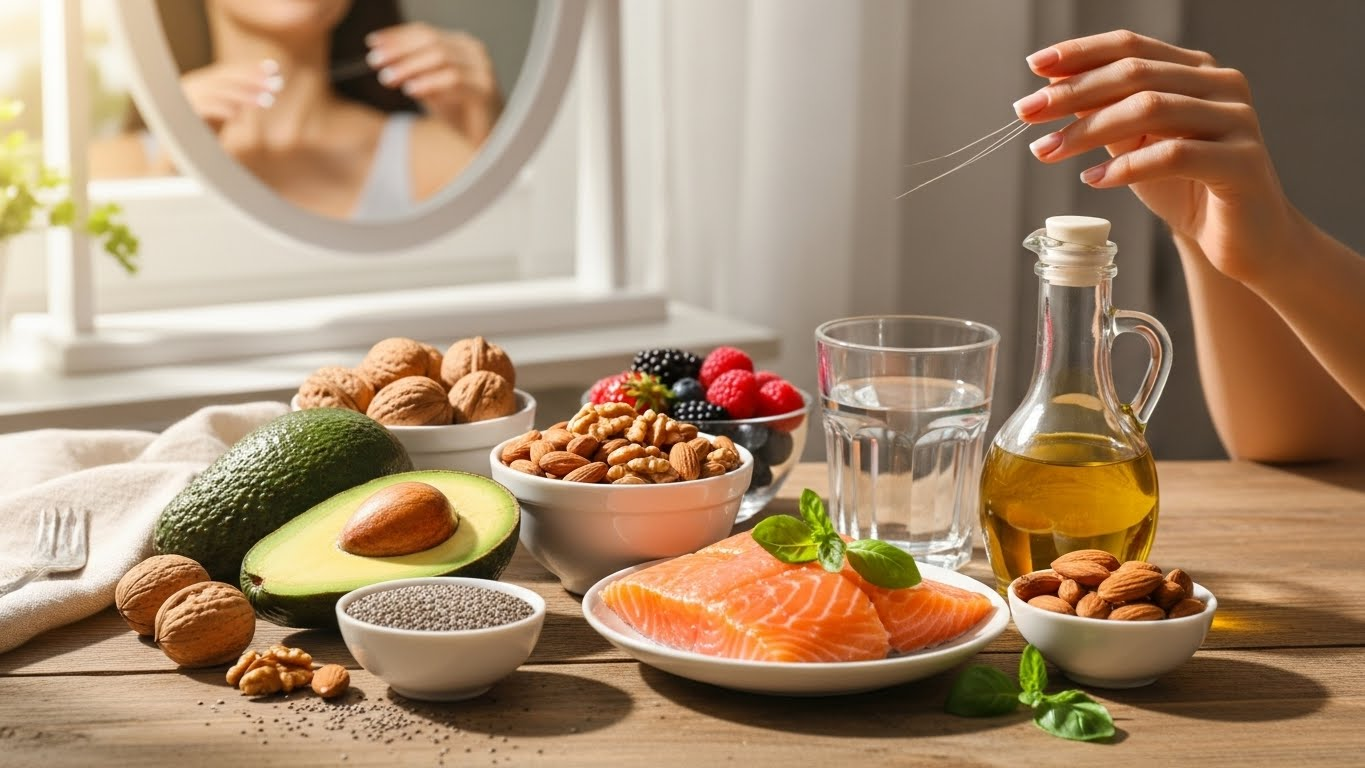
SMASH fish - Wild-caught salmon, mackerel, anchovies, sardines, and herring. Eat these regularly. They're packed with omega-3s and phospholipids.
Oysters - One of the most nutrient-dense foods on the planet. Full of minerals, zinc, and healthy fats.
Avocado - An easy way to get omega-6 and other healthy fats into your diet without thinking about it.
Organic seeds and nuts - Raw pumpkin seeds, flax seeds, sunflower seeds, hemp seeds, walnuts. These are your portable omega source.
Grass-fed meat and organ meats - The most bioavailable source of nutrients. Liver, especially, is a nutrient powerhouse.
Cold-pressed oils - A clean, cold-pressed oil made from organic safflower and flaxseed oils can fill gaps in your diet. Never heat it. Use it on salads, in smoothies, drizzled over cold dishes, or take a spoonful in the morning. The key is keeping it cold to prevent oxidation.
Step 2: Add Strategic Supplements
Once your diet is solid, targeted supplementation makes sense.
Vitamin C - Your skin naturally contains high levels of it, but vitamin C is water-soluble. Your body can't store it. You need it daily. While topical vitamin C serums exist, research shows that internal vitamin C levels actually matter more for real skin health.
Vitamin E - This fat-soluble vitamin works as a potent antioxidant and sun protector. It also supports your skin barrier. Many skincare products contain it, but again, internal levels are what actually drive results. Vitamin E may also help regulate hormonal fluctuations that contribute to acne.
Collagen peptides - Dozens of recent studies show collagen supports skin elasticity and fights skin aging. Collagen is a protein that your body breaks down into amino acids to build keratin, the protein in strong, healthy hair. When searching for vitamins for hair growth, you'll often see collagen listed because it's a foundational protein source many people are deficient in, especially women. Collagen also acts as an antioxidant, fighting free radical damage.
Phospholipids - A well-formulated phospholipid complex helps your cells retain their structure. This directly supports skin, hair, and nail integrity as you age.
THE BRAIN-GUT-SKIN CONNECTION
Here's something most people miss: your brain health affects your skin health. Chronic stress damages your gut, which in turn harms nutrient absorption, which in turn harms your skin.
When you're addressing skin, hair, and nail health through proper nutrition and supplementation, you're also supporting better stress management and vitamins for brain fog that naturally come from better nutrient absorption. It's all connected. A healthy gut absorbs nutrients better. Better nutrient absorption means better brain function, better skin, and better hair. They don't work separately, they work together.
TOPICAL VS. INTERNAL NUTRITION
FREQUENTLY ASKED QUESTIONS
Q: How long before I see results from eating more healthy fats?
A: Your skin cells turn over about every 28 days, so expect to see real changes in 4-8 weeks if you're consistent. Hair takes longer; hair growth cycles are 3-6 months. Nails show results in 3-4 months since they grow slowly. Patience matters here.
Q: Can I get enough omega-3s and omega-6s from food alone?
A: Yes, if you're eating SMASH fish, seeds, nuts, avocado, and grass-fed meat regularly. Most people don't, which is why supplementation becomes useful. A cold-pressed oil added to your diet makes a huge difference.
Q: Is vitamin E from supplements better than from food?
A: Food sources are ideal because they come with cofactors that help absorption. But if your diet is lacking nuts, seeds, and healthy oils, supplementation makes sense.
Q: Why does my hair still look bad if I'm taking supplements?
A: Hair is the last place your body sends nutrients. It's not essential for survival, so it gets deprioritized. You need consistency, months of good nutrition, before your hair really responds. Also, make sure you're getting enough total protein.
Related:
