
How long does it take to get flexible? A realistic timeline
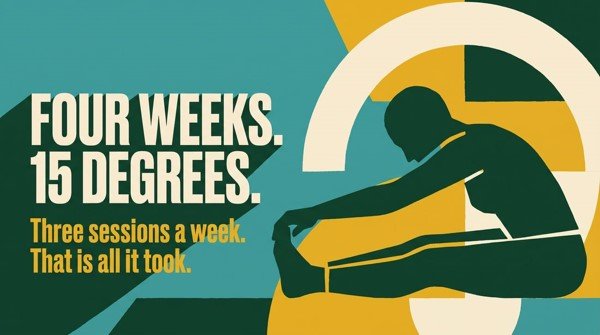
T L ; D R
● First measurable change lands at about four weeks, training three times a week.
● In a 2026 trial of 52 adults, contract and relax stretching added roughly 15 degrees of hamstring range and static stretching about 10.
● That is a gap of about 7 degrees between the two methods over the same four weeks.
● Federal activity guidelines set no flexibility target at all, while asking for strength work on two or more days a week.
Short version: four weeks buys a real, usable change. It also fades faster than it arrived, which is why the maintenance dose matters more than the program that got you there.
About four weeks before you notice, and about three sessions a week to get there. In a 2026 randomized trial, adults who stretched their hamstrings three times a week for four weeks gained roughly 10 to 15 degrees of knee extension range, depending on which technique they used. Not a split. Not touching your toes with your palms. Ten to fifteen degrees, which is enough to change how it feels to pick up a toddler off the floor.
The equipment question answers itself. It is the twelve minutes that are hard to find.
What you are actually training
Flexibility is how far a joint will go when something else moves it. Mobility is how far you can move it yourself, under control. They are related and they are not the same, which is why a guy can have hamstrings that pass a sit and reach test and still deadlift like a folding chair.
Most home stretching routines train the first and ignore the second. Programs sold as coaching, the Canary Wharf based Precision by Eser flexibility coaching among them, are mostly the second: contract and relax protocols aimed at two or three positions you specifically lack, with a retest date, rather than a printed list of eleven stretches. Whether you pay for that or build it yourself, the structure is what does the work.
What four weeks actually buys you
The trial worth knowing about is a 2026 randomized controlled trial in Scientific Reports. Fifty two participants, split into two groups, three sessions a week for four weeks. One group did active static stretching, the other did post isometric relaxation, which is the contract, relax and go further technique you may know as a version of PNF.
Both groups improved. The post isometric relaxation group gained about 15 degrees and the static stretching group about 10, a difference of roughly 7 degrees between them, and the authors reported the gap as statistically significant.
Worth keeping in perspective: 52 people, all of them healthy students, over four weeks. It tells you the shape of the curve, not your personal numbers. But the shape is the useful part.
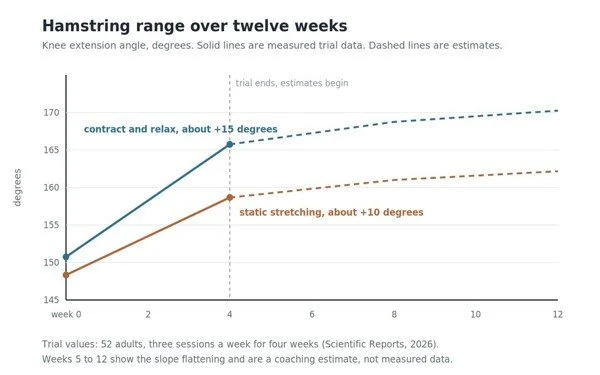
Weeks 0 to 4 are the measured trial values. Everything past week 4 is a coaching estimate, drawn to show the slope flattening, not a research finding.
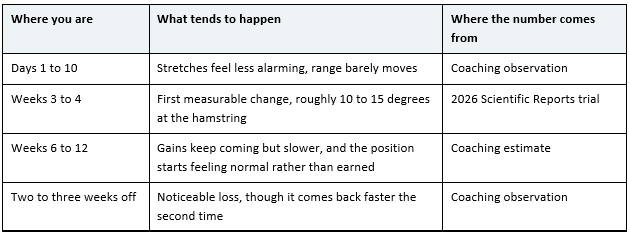
Why it disappears when you stop
Here is the part nobody selling a 30 day challenge mentions. A lot of what you gain in the first month is your nervous system agreeing to let you go further, rather than the muscle physically getting longer. It is real range, you can use it, and it also happens to be the kind of adaptation that fades quickly once you stop asking for it.
Practically, that means two things. Short and frequent beats long and occasional. And the maintenance dose is much smaller than the dose that got you there, so do not treat a missed week as a reason to start over from zero.
Where this sits next to everything else
Stretching is not on the list of things you must do for your health, and it is worth being honest about that. The federal Physical Activity Guidelines for Americans tell adults to do muscle strengthening work on two or more days a week alongside their aerobic activity. Flexibility gets a mention, an acknowledgment that stretching increases range of motion, and no target at all.
Which is a reasonable read of the evidence. If you have three hours a week and you spend all of it stretching, you have made a bad trade. MindBodyDad's Q&A on the best way to stretch makes a similar point about whether you even need to. Stretching earns its slot when a specific position is limiting a specific thing you want to do: getting into a deep squat, sitting on the floor for an hour without your back seizing up, throwing a kid onto your shoulders without a twinge.
The twelve minute version
Pick two positions. Not eight. The two that annoy you most, which for most fathers of small children means hips and the front of the shoulders.
Do four rounds in each, roughly 30 seconds of holding tension and 30 seconds of easing further in, three days a week. Do them where the interruptions already are, on the living room floor, at whatever hour actually exists in your house. Write the starting point down somewhere, because in four weeks you will have no memory of what you could not do.
Then measure again on the same day of the week, at the same time, cold. If it moved, keep going and add a third position. If it did not, the honest answer is usually that three sessions a week were actually one, and that is worth knowing before you buy anything.
