
Key Features to Consider in a Two-Person Mobility Scooter
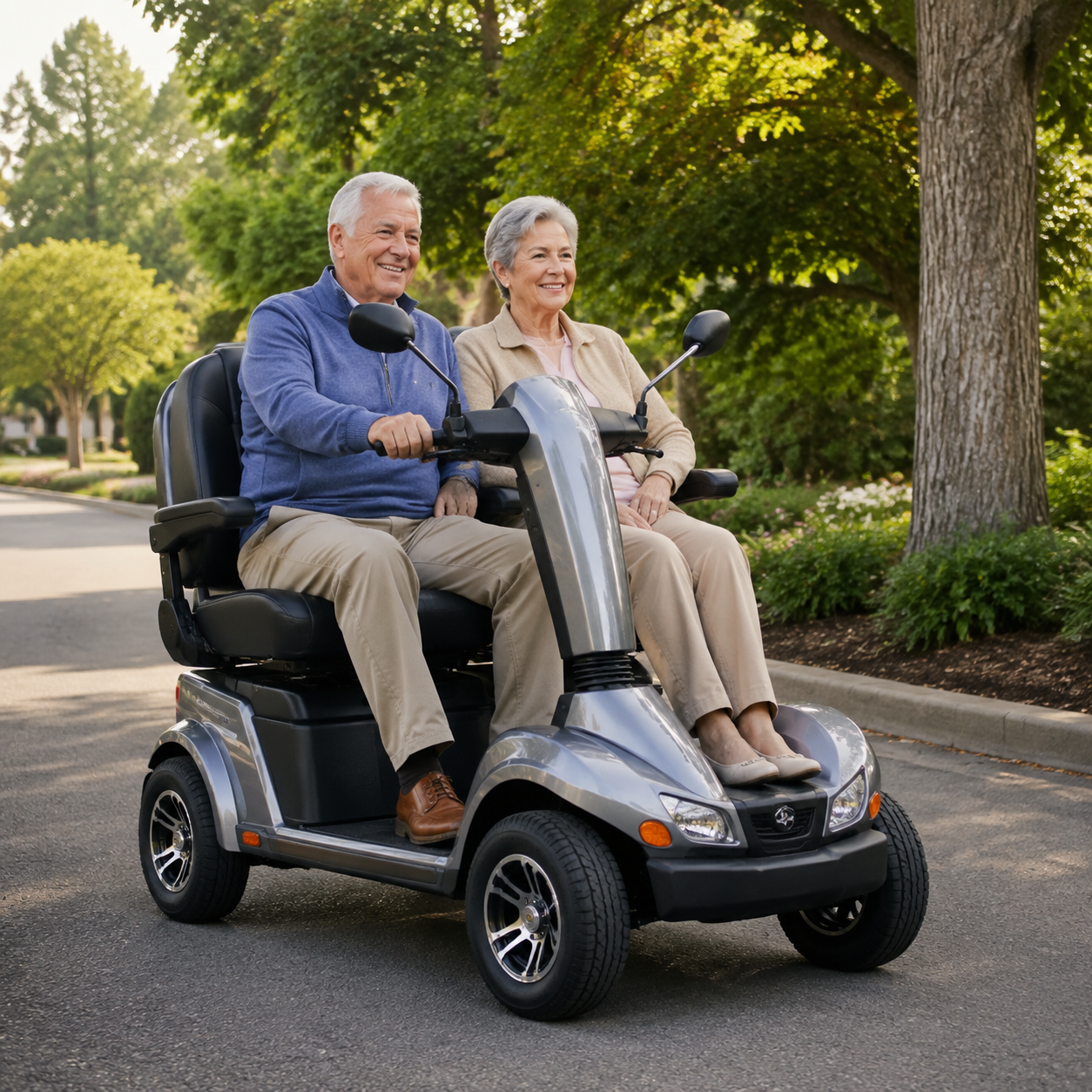
Shopping for a two-person mobility scooter starts with a question most product pages skip: who is riding, and why together?
Some buyers want a companion seat so a spouse can come along on the daily loop around the neighborhood. Others need a caregiver driving up front and a passenger who cannot safely steer on their own. Those are different machines.
A scooter that carries two people is not a single-seater with an extra cushion bolted on. Everything downstream of that second rider changes: frame, motor, brakes, batteries, footprint.
Here is what to look at, roughly in the order that decides whether the scooter works or sits unused.
Seating Layout Decides Almost Everything Else
Two-person scooters come in two basic layouts, and the choice shapes comfort, footprint, and handling all at once.
Side-by-side seating puts both riders on a bench or on paired seats. Conversation is easy, both riders get the same view, and boarding feels like sliding into a car. The tradeoff is width.
Tandem seating stacks one rider behind the other. The scooter stays narrower and turns tighter, which makes it far easier to live with indoors and in crowded spaces.
The cost of tandem is social. Talking over your shoulder gets old, and the rear passenger mostly looks at the driver's back.
If nearly every trip happens outdoors on wide paths, side-by-side usually wins on comfort. If the scooter has to clear doorways, shop aisles, or a garden gate, tandem is the safer bet.
Weight Capacity Is a Combined Number
Read the capacity spec closely, because manufacturers state it two different ways. Some publish a single combined limit covering both riders plus anything they carry, while others publish a per-seat limit.
Ratings in this category commonly run from around 400 pounds to 600 pounds or more. Several manufacturers also sell an upgraded suspension package that lifts the rated ceiling by roughly 50 to 100 pounds over the standard configuration.
Add both riders' real weights, then add groceries, a bag, a folded walker, and a dog if one comes along. Buy above that total, not level with it.
Riding at or over the limit is not only a warranty problem. It flattens the suspension, shortens range, strains the motor on climbs, and stretches stopping distance on exactly the descents where brakes matter most.
Purpose-Built Models Beat Adapted Ones
A common mistake is buying a heavy-duty single-seat scooter and adding a rear seat or a standing platform to it. The frame was never engineered for the extra load or the shifted center of gravity, and the result tends to feel unsettled on camber and in corners.
Models designed for two riders are built as a system. The wheelbase is longer, the rear axle is rated for the load, the motor is sized for two, and the seats mount to the frame instead of hanging off an accessory bracket.
Because those elements are engineered together, it is worth comparing mobility scooters built for two riders against each other rather than trying to stretch a single-seater into the role.
Ask the seller two direct questions: is the second seat factory equipment, and does the published capacity already account for it?
Range, Power, and the Ground You Actually Cover
Published range figures assume flat ground, mild weather, and a light load. Two riders and a few hills will cut that number, sometimes by a third or more.
Models in this class typically claim somewhere between 15 and 45 miles per charge. Work out your longest realistic trip, double it for the return, and be skeptical of anything that only just clears it.
Motor output matters more than top speed. A scooter with enough torque holds a steady pace up a driveway or a footbridge instead of crawling to a near-stop halfway, which is safer in traffic and easier on the batteries.
Tires and suspension decide whether the ride is pleasant or punishing. Larger pneumatic tires with genuine front and rear suspension absorb grass, gravel, and broken sidewalk, while small solid tires are fine on smooth pavement and rough everywhere else.
Battery Type Changes the Daily Routine
Most scooters ship with either sealed lead-acid batteries or a lithium pack, and the difference shows up in daily life more than on the spec sheet.
Lead-acid costs less up front and wants a long charge, often overnight. Lithium charges considerably faster, weighs far less for the same capacity, and holds voltage more steadily, so the scooter does not fade noticeably near the end of a trip.
Whichever you choose, check where the charge port sits and whether the pack can be removed. A removable pack means charging indoors rather than running an extension cord out to a cold garage.
Fit the Scooter to the Spaces You Actually Use
Measure before you buy, because a two-person scooter is a large object. Overall widths in this category run from roughly 28 inches at the narrow end to about 40 inches for wide side-by-side models.
Compare that against real doorways. The 2010 ADA Standards for Accessible Design set a 32-inch minimum clear width at accessible doorways and a 60-inch turning circle for a full turn, so a scooter approaching 30 inches wide will already be tight in older buildings and in homes that were never built to that standard.
Check turning radius and ramp capability too. Permanent ramps built to accessible guidance run no steeper than one inch of rise per foot of run, and a scooter that cannot manage something steeper will not climb a short portable ramp into a van either.
Then there is storage. Machines in this class commonly weigh several hundred pounds assembled, so lifting one into a car trunk is off the table.
Plan for a garage, a shed, a vehicle lift, or a trailer, and confirm how the scooter will be delivered and assembled before you order.For moving aids, you can also check our guides.
Safety Equipment Matters More With a Passenger
A second rider raises the stakes on every control. Look for braking that engages automatically when you release the throttle, plus a parking brake that reliably holds on a slope.
Lights, mirrors, turn signals, and a horn count for more here than on a small indoor scooter, because these models spend most of their life outdoors and near traffic. Some are sold as street legal in particular jurisdictions, which brings registration and insurance questions worth confirming locally before you buy.
For the passenger specifically, look at grab handles, a supportive backrest, footplates sized for adult feet, and a belt. A passenger with nothing solid to hold is a common comfort complaint on scooters like these.
Choose for the Trips You Actually Take
The right two-person scooter is usually the one that fits the tightest space you have to pass through, carries comfortably more than the weight you actually put on it, and covers your longest real trip with charge to spare.
Get those three right and everything else is preference. Get them wrong and the scooter stays parked, which is the most expensive outcome available.
If a test ride is possible, take it with the person who will ride with you, on the kind of ground you will actually cross.
