
TitanBody EMS Suit: Benefits, Drawbacks, and Is It Worth It?
TitanBody EMS Suit
I’m always interested in ways to make workouts more efficient (hence my MED series). I enjoy training, but I also have a job, kids, a website, I’m back in school, and about a million other things competing for my time. If I can legitimately get more out of a 20-minute workout, you have my attention.
That’s part of what drew me to electrical muscle stimulation (EMS). I’m also very familiar with it from my day job as an occupational therapist. I regularly use electrical stimulation with my neuro patients, including people recovering from strokes and spinal cord injuries, to get muscles firing that aren’t doing a great job of it on their own.
It works. I see it all the time.
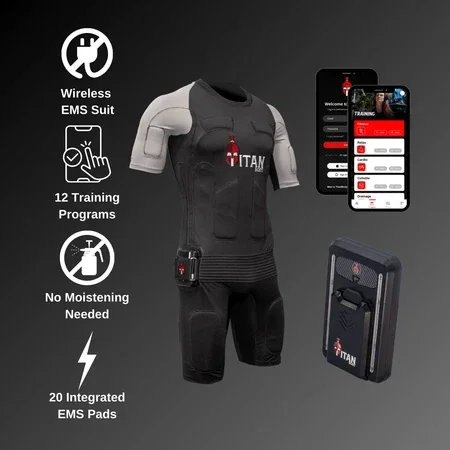
The TitanBody EMS Suit takes that same basic concept and spreads it across your body. Instead of putting a few electrodes over one specific muscle like I do in the clinic, TitanBody builds 20 electrodes into a wireless full-body suit.
What you do with that stimulation is where things get interesting.
You can throw it on while you're otherwise sedentary, including sitting at your desk, or use it while actually exercising. Squat, lunge, push, pull, or work through a circuit while the suit adds another layer of muscle stimulation.
So I don't really look at TitanBody as a replacement for exercise. It can fill some otherwise inactive time, but it can also facilitate and intensify the workout you're already doing.
That's a much more interesting proposition to me.
But is it actually worth the hefty price tag?
Here’s what you should know.
TitanBody EMS Suit
Technology: ⭐⭐⭐⭐⭐
Performance & Function: ⭐⭐⭐⭐☆
Price: ⭐⭐⭐☆☆
Value: ⭐⭐⭐⭐☆
Overall: 4/5 ⭐⭐⭐⭐☆
The Bottom Line
TitanBody packs a lot into 20 minutes. It's wireless, doesn't require wetting the electrodes, and lets you independently stimulate different muscle groups.
More importantly, you can use it in different ways. Throw it on when you'd otherwise be sitting at your desk, use one of the recovery-focused programs, or wear it during an actual workout to add another stimulus to the muscles you're already training.
The obvious downside is the big price tag, and I wouldn't ditch your weights, cardio, or other workouts for it.
But if you're short on time, have the money, and actually use it, TitanBody gives you another way to make your time count, whether that's adding muscle stimulation when you'd otherwise be sitting around or getting more out of an actual workout.
What Is EMS Training?
EMS stands for electrical muscle stimulation. Your nervous system uses electrical signals to make your muscles contract. EMS uses an external electrical current to create a muscle contraction.
I've used this technology clinically for years. For example, after a stroke, someone may have difficulty voluntarily activating a muscle. Electrical stimulation can be applied over that muscle to help produce a contraction while we're working on movement.
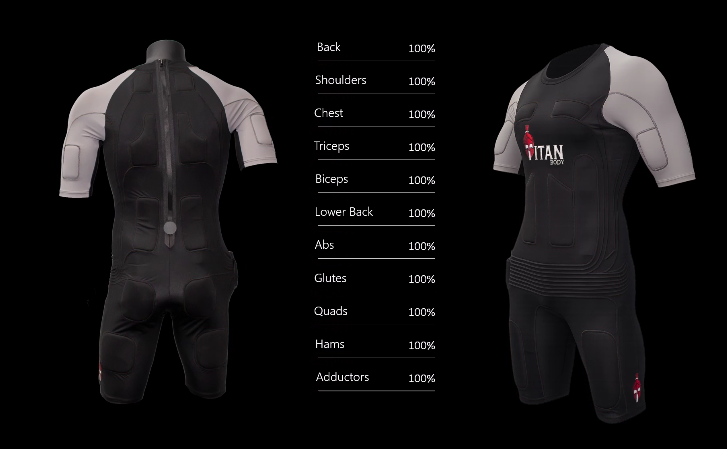
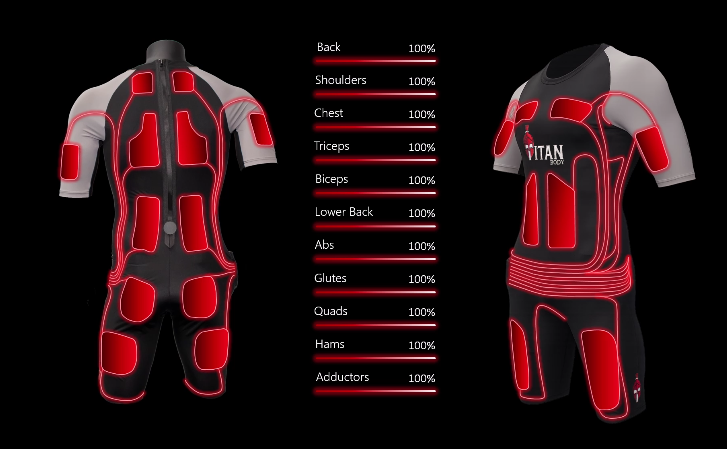
TitanBody obviously has a very different purpose, but the underlying concept of electrically stimulating muscle is familiar to me. The original suit has 20 integrated electrodes controlled through 10 independent channels. They cover major muscle groups including the pecs, biceps, triceps, abs, traps, lats, obliques, quads, and hamstrings.
You can use that stimulation by itself or while exercising.
I prefer the idea of combining the two. If I'm doing squats, for example, my quads and glutes are contracting voluntarily while the suit is also providing electrical stimulation.
That's a more practical way for me to think about the potential benefit of TitanBody.
How TitanBody Works
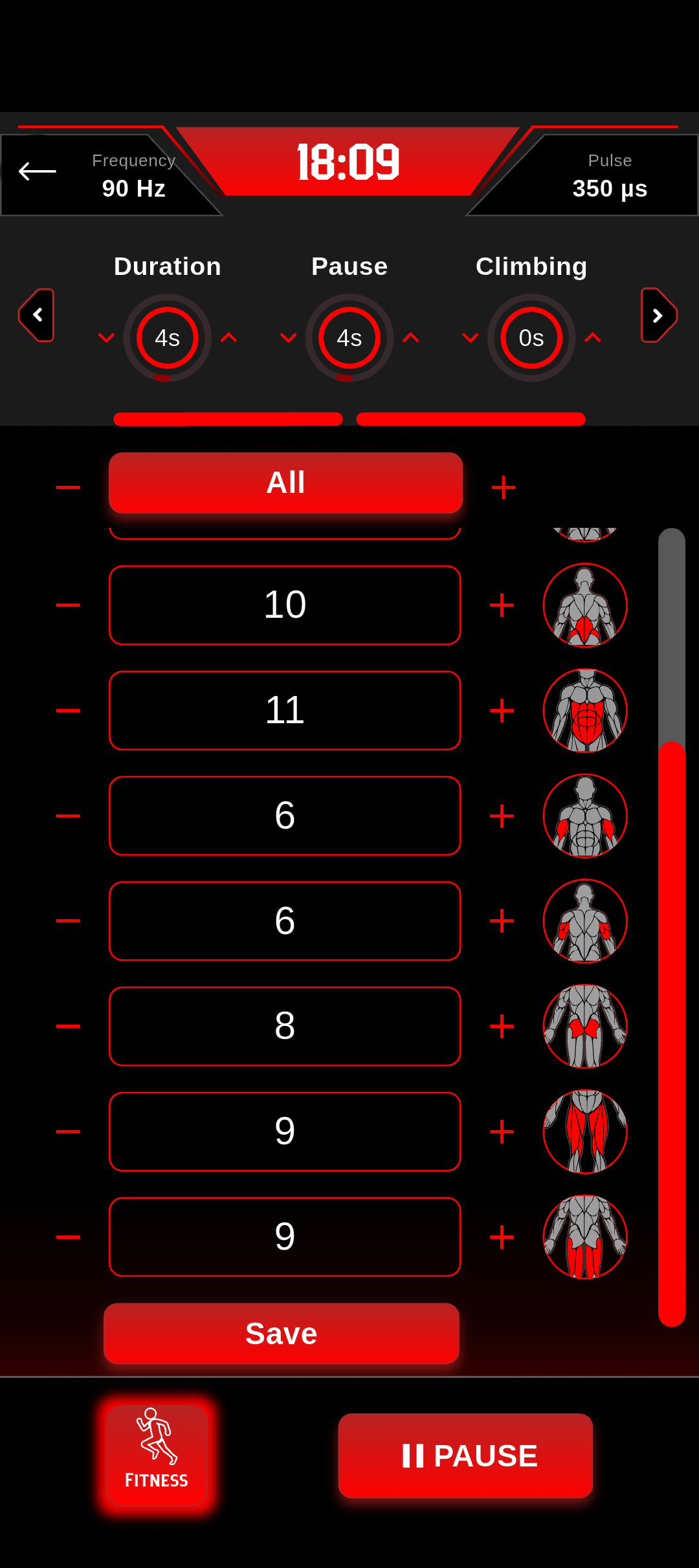
The setup is simple: Put on the suit, attach the rechargeable Power Box, open the TitanBody app, choose your program, and adjust the stimulation intensity for the different muscle groups.
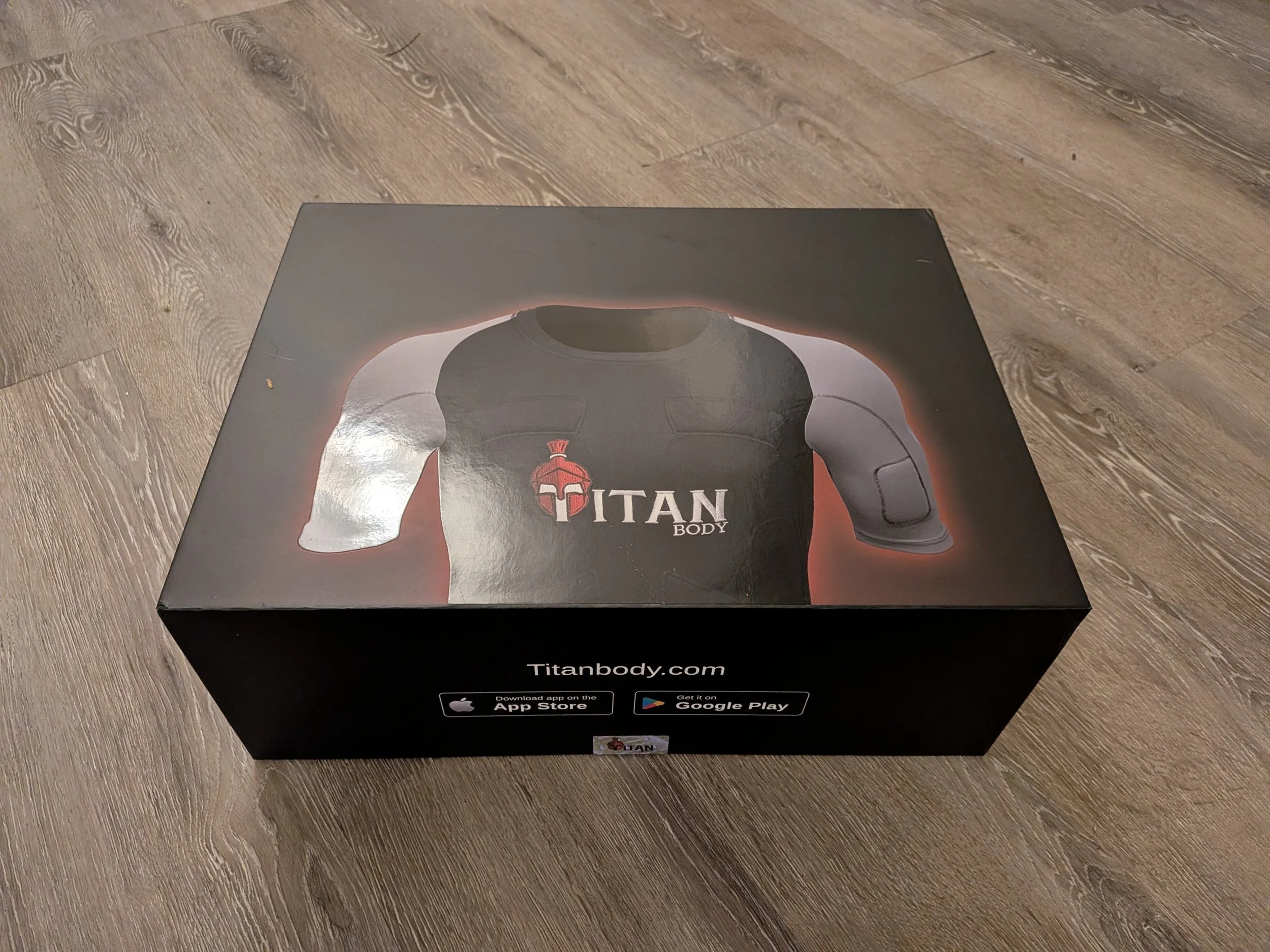
The suit is wireless, so you can move around normally while wearing it. It also uses dry electrodes, which means you don't have to wet them before every session.
I like both of these features because they make it much easier to use the suit during a normal workout. I could put it on and do a bodyweight circuit, kettlebell workout, or other exercises without being connected to a separate machine.
The app comes with 12 preset programs, and you can create your own programs as well. There are no monthly subscription fees or limits on training minutes.
The 12 TitanBody Modes
I initially thought of TitanBody primarily as a workout tool, but the app has quite a few other options.
There are 12 preset programs: Fitness, Warm Up, Cardio, Slim, Cellulite, Drainage, Relax, Load, Metabolic, Capillary, Dermal, and Tightness.
Fitness is the general workout mode.
Warm Up uses lower intensity stimulation before exercise.
Cardio is geared more toward endurance and circulation.
Load uses higher frequency stimulation and is intended more for strength and power.
Relax uses gentler stimulation and is designed for recovery and muscle soreness.
Tightness is another lower intensity option aimed at stiffness and muscle tension.
Then you get into some of the more specialized programs.
Drainage is designed to stimulate the lymphatic system and is marketed for post workout recovery. Capillary is aimed at circulation and blood flow. Metabolic uses repeated contractions intended to increase metabolic activity.
There are also Slim, Cellulite, and Dermal modes.
I'd keep my expectations more conservative with these. I know EMS can make muscles contract because I use it regularly. Claims involving things like cellulite reduction, fat loss, lymphatic drainage, or skin changes are different questions and would require evidence for those specific outcomes.
Still, I like having the options. I'd probably spend most of my time with Fitness, Load, Warm Up, Relax, and Tightness and experiment with the others.
Selling Points
It can be used during exercise. This is probably my favorite feature. I'd be more likely to use TitanBody during a 20 minute strength or conditioning workout than as a replacement for one.
It can also be used while you're sitting. I spend plenty of time at a computer working on this website and doing schoolwork. If I'm going to be sitting there anyway, the ability to get some muscle stimulation at the same time is appealing.
20 muscle zones. The original suit has 20 electrodes with 10 independently controlled channels.
Independent intensity controls. Different muscles tolerate different amounts of stimulation, so being able to adjust each area makes sense.
It's wireless. You can squat, lunge, walk around, or do a circuit without wires getting in the way.
Dry electrodes. You don't have to wet the electrodes before every session.
There are 12 programs. I like having options for actual workouts along with warmup and recovery sessions.
No subscription. The app is included and TitanBody says there are no monthly fees or limits on training minutes.
Battery life is good. TitanBody says the Power Box lasts up to 20 sessions per charge.
It's machine washable. This is pretty important for something you're going to sweat in. TitanBody also includes a wash bag.
Everything comes with it. The package includes the suit, Power Box, charger, battery, manual, wash bag, and storage bag.
There's a 30 day trial. That's particularly important at this price.
Drawbacks
The price. At $1,895, TitanBody costs more than a lot of home gym setups.
It takes some experimenting. You have 10 independently controlled channels, so you'll need to figure out what intensity works for different parts of your body.
Fit matters. The electrodes need good contact with your body, so sizing is important.
The warranties are different. The suit itself has a one year warranty, while the Power Box has a three year warranty.
Some of the claims are stronger than I'd like.
TitanBody says a 20 minute session can provide results equivalent to an intense three to four hour traditional workout.
I wouldn't look at it that way.
I use electrical stimulation regularly as an OT, so I don't need convincing that it can produce a muscle contraction. That doesn't mean 20 minutes of EMS provides all of the same adaptations as several hours of traditional exercise.
Strength training puts external load through your muscles, bones, and connective tissue. Running and other cardio challenge your cardiovascular system. Exercise also involves coordination, balance, power, and skill.
For me, the more useful question is whether EMS can add something to the workout I'm already doing.
That's how I'd primarily use TitanBody.
Who I Think TitanBody Makes Sense For
TitanBody makes the most sense to me for people who are short on time but still want to train consistently.
Busy parents and professionals are obvious examples.
I also think it makes a lot of sense for people who already exercise. If you have 20 or 30 minutes for a workout, you can wear the suit while doing the exercises you'd normally do.
People who spend a lot of time sitting may find another use for it. I wouldn't call sitting at a desk in an EMS suit a workout, but it does give you the opportunity to stimulate muscle during time when you'd otherwise be sedentary.
The recovery modes may also appeal to people who train frequently. Relax, Tightness, Drainage, and Capillary give you some options on days when you don't want another hard session.
And, of course, this is the type of thing that appeals to fitness nerds like me who enjoy experimenting with different training tools.
Tips
Start low. Give yourself time to get used to the sensation and figure out the appropriate intensity for each muscle group.
Try it with exercises you already do. Squats, lunges, pushups, carries, and circuits would be some of my first choices.
Experiment with when you use it. A Fitness session during a workout is very different from using Relax after training or running an EMS session while you're working at your desk.
Don't overdo it. TitanBody recommends three to four sessions per week with adequate recovery and advises against training when you're already experiencing significant soreness or signs of muscle strain.
Track your settings. Once you figure out what works for each muscle group, write it down.
Track results. Strength, measurements, workout performance, and other objective changes are much more useful than simply judging a session by how intense it felt.
TitanBody Specifications
Price: $1,895
Electrodes: 20
Independent channels: 10
Typical session: 20 minutes
Programs: 12 presets plus custom programs
Modes: Fitness, Warm Up, Cardio, Slim, Cellulite, Drainage, Relax, Load, Metabolic, Capillary, Dermal, Tightness
Electrodes: Dry contact
Design: Wireless
Battery: Up to 20 sessions per charge
App: iPhone and Android
Subscription: None
Cleaning: Machine washable
Trial: 30 days
Suit warranty: 1 year
Power Box warranty: 3 years
Resizing: Free during the first year with qualifying before and after photos and testimonial
Included: Suit, Power Box, charger, battery, manual, wash bag, and storage bag
HSA/FSA: TitanBody accepts HSA/FSA payments through Flex.
TitanBody vs. TitanBody 2.0
The original TitanBody costs $1,895 and gives you 10 independent channels, 20 electrodes, standard muscle coverage, and up to 50V output.
The TitanBody 2.0 costs $2,995 and increases that to 14 channels, 28 electrodes, expanded muscle coverage, and up to 70V.
That's an extra $1,100.
For someone new to EMS, I think the original TitanBody is the more reasonable starting point. You're still getting the core features that make the system interesting.
If money isn't much of a consideration and you want greater coverage, more control, and the newest technology, the 2.0 is the obvious upgrade.
My Experience
My perspective on TitanBody is probably a little different because I've used electrical stimulation clinically for years.
I see it work regularly. I've watched muscles that someone was struggling to activate voluntarily start contracting when electrical stimulation was applied. I've used it with patients recovering from strokes, spinal cord injuries, and other neurological conditions. So the basic technology doesn't seem gimmicky to me.
What interests me about TitanBody is figuring out how useful that stimulation becomes when it's available across multiple muscle groups at the same time.
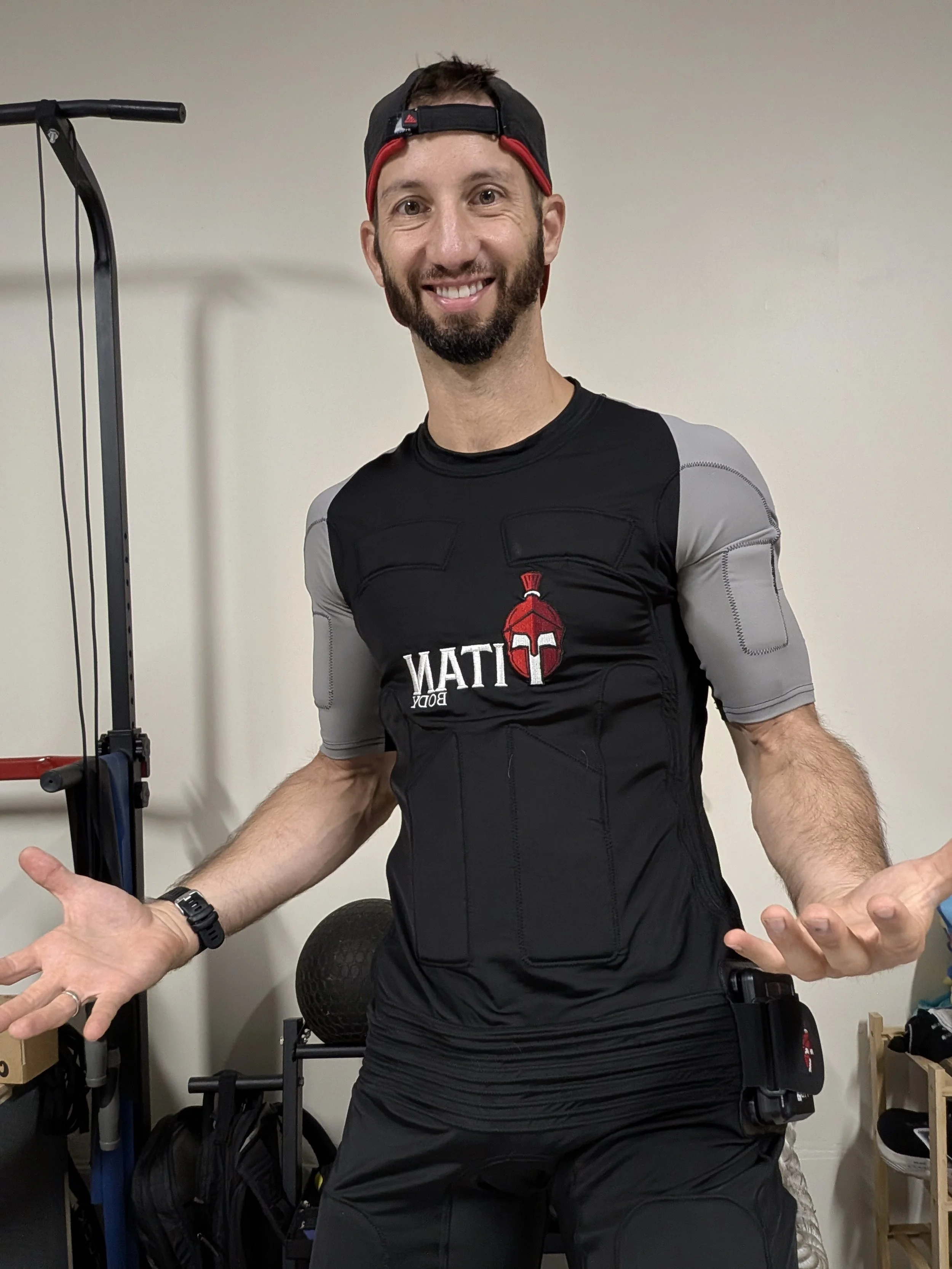
So here is how I´ve tried it so far:
Working at my desk: Wearing it while sitting at my computer doing website work or schoolwork.
During short strength sessions: Using it during 20-minute workouts to see how it affects movements like squats, lunges, push-ups, and circuits.
Post-workout recovery: Running lower-intensity recovery programs after harder training sessions while Iḿ hnaging around the house with my family.
The convenience is my second favorite part (next to effectiveness). I don't have to wet electrodes or connect myself to a separate machine, and there's no monthly app subscription.
The biggest hurdle is still the price. If you use it a few times and lose interest, it's an expensive mistake. If it becomes something you regularly use during workouts, while sitting at your desk, and for recovery sessions, it's easier to make a case for it.
The Final Verdict: Is TitanBody Worth It?
For the right person, I think so.
I wouldnt buy TitanBody because of the claim that 20 minutes can replace three or four hours in the gym. That is not how I view EMS. I see it as a tool that can supplement movement and training when time, mobility, or circumstances make conventional exercise difficult.
For me, the value comes from its flexibility. I can wear it during a workout to add stimulation to muscles I am already training, use it during recovery, or turn it on during periods when I would otherwise be sitting. That last use could be especially helpful for someone who literrally cannot get away from a desk for long stretches, although EMS should not become a reason to remain seated. Walking and regular movement breaks still provide benefits that electrical stimulation cannot replace.
Even when used while sitting, EMS produces repeated muscle contractions. Those contractions increase local energy demand, support glucose uptake and insulin sensitivity, activate cellular pathways involved in mitochondrial adaptation, and create a muscle-pump effect that supports circulation. This could make the suit useful for more than maximizing workouts. Busy parents, heavy travelers, older adults trying to maintain muscle activation, people returning to activity after an injury, and those with pain or physical limitations may also find practical value in it.
The muscle-pump effect may be particularly relevant for someone who experiences mild dependent edema from prolonged sitting or limited movement. Unexplained, significant, or one-sided swelling can indicate a blood clot or problems involving the heart, kidneys, veins, or lymphatic system, so it should be medically evaluated before using EMS. (Disclaimer: talk to your doctor about this.)
If you are short on time, have the money, and will consistently use it, TitanBody provides some practical ways to incorporate EMS into your routine, including during exercise, recovery, travel, rehabilitation, or deskbound portions of the day.
That is a more realistic reason for me to use it than expecting it to replace exercise altogether.
FAQ
How much does TitanBody cost?
The original TitanBody EMS Suit costs $1,895. TitanBody 2.0 costs $2,995.
How long is a TitanBody workout?
TitanBody sessions are designed around approximately 20 minute workouts.
Do you need to wet the TitanBody suit?
No. TitanBody uses dry electrodes, so you don't need to pre-moisten them before exercising.
Does TitanBody require a subscription?
No. TitanBody currently advertises its app without an ongoing subscription.
What's the difference between TitanBody and TitanBody 2.0?
The original has 10 channels and 20 electrodes with up to 50V output. The 2.0 increases that to 14 channels, 28 electrodes, expanded coverage, and up to 70V.
Can TitanBody replace regular exercise?
I wouldn't use it that way. Think of EMS as an additional training stimulus rather than a substitute for strength training, cardiovascular exercise, and regular movement.
What warranty does TitanBody offer?
TitanBody currently advertises a three year warranty and a 30 day free trial.
Related:
