
Building Confidence Through Early Academic Experiences
What a child believes about themselves as a learner at age eight can quietly determine who they become at eighteen. That's not an exaggeration; it's one of the most underappreciated truths in education. Building confidence in students doesn't happen by accident.
It emerges from intentional, well-structured experiences that meet young learners where they are and gently push them further. Research confirms that early education shapes far more than test scores; it shapes lifelong confidence in learning and the trajectory of future success.
Consider this: while 60% of middle schoolers feel capable of reaching their aspirations, nearly two in five lack that conviction entirely. That gap doesn't close on its own. It closes through deliberate action.
So let's dig into the research, the milestones, and the strategies that reveal just how profoundly those earliest learning experiences shape a student's sense of self.
The Lasting Impact of Early Academic Experiences on Student Confidence
Early education does something remarkable. It sets the emotional and intellectual tone for everything that follows. When students encounter genuine encouragement alongside genuine challenge, confidence stops being a personality trait and starts becoming a skill, something built, not born.
For families weighing structured options during these formative years, a thoughtfully designed pre-high school summer program can genuinely become a turning point one where young learners encounter real challenges, meet diverse peers, and stumble onto something they didn't know they loved, all within an environment built specifically to support them.
Building Confidence in Students: Why Early Education Matters
The benefits of early education reach far beyond reading fluency and arithmetic. Cognitively, early learners develop the problem-solving frameworks they'll rely on for decades.
Emotionally, they learn to manage frustration without shutting down. Socially, they practice collaboration and communication competencies that don't just matter in elementary school but in every professional environment that follows.
Studies consistently link positive early academic experiences to durable student self-esteem. Students who feel capable early take bigger intellectual risks.
They ask more questions. They persist through difficulty rather than retreat from it. Even shy or hesitant learners can genuinely thrive when the environment values effort over perfection.
Key Milestones That Shape Student Self-Esteem
Understanding the broad benefits is useful, but the real power lives in specific, memorable moments.
Reading independently for the first time. Cracking a math problem without any help. Walking into a new classroom and actually making a friend by lunch. None of these are small moments. Each one quietly tells a child something important: You belong here. You can do this.
Resilience, too, is forged in the setbacks. When students stumble, and the adults around them respond with patience rather than alarm, children absorb a crucial message: mistakes are part of learning, not evidence of failure.
Innovative Strategies to Foster Confidence in Learning Before High School
Understanding why early experiences matter is the first step. The more pressing question for most parents and educators is: what do you actually do to create those moments consistently?
Creating Supportive Academic Environments
Classroom culture shapes everything. When teachers celebrate effort, participation, and incremental progress, not merely correct answers, students gradually stop fearing failure and start pursuing challenge. An inclusive, mistake-friendly classroom sends every child the same message: your voice matters here.
Safe spaces are not soft spaces. They are environments where students take genuine intellectual risks precisely because they trust the room won't punish them for trying.
Role of Pre-High School Summer Programs in Building Academic Confidence
Few experiences accelerate academic confidence as effectively as placing a student in a completely new environment built for growth. A well-designed pre-high school summer program provides exactly that, especially when a strong classroom foundation has already been laid. Programs like EXPLO 360° offer more than 40 customizable workshops spanning medicine, engineering, law, and the arts. Students choose their own direction, collaborate with peers from around the world, and work alongside professional instructors who bring genuine real-world authority to every session.
The outcome is consistent: students leave with fundamentally expanded beliefs about what they're capable of achieving. They enter high school not just hoping they'll manage; they're ready.
Project-Based Learning and Real-World Connections
Summer programs create powerful immersive experiences, but the same confidence-building energy can carry into everyday school life through project-based learning year-round.
When students design a product, run a simulation, or construct something tangible with their own hands, abstract academic concepts suddenly connect to the actual world. That connection builds intrinsic motivation the durable kind that doesn't require external rewards to sustain itself.
Encouraging Growth Mindset and Self-Reflection in Young Learners
Hands-on projects spark curiosity beautifully. But sustaining that momentum requires something more foundational: teaching students to genuinely believe in their own capacity to grow.
Daily journaling, structured goal setting, and intentional reflection routines quietly compound into lasting student self-esteem. When students track their own progress over time, they begin to see themselves improving, and that visibility alone can be transformative.
Benefits of Early Education That Go Beyond Academics
These strategies don't just sharpen academic performance. The most significant benefits of early education frequently unfold well outside any textbook.
Social and Emotional Growth as a Foundation for Academic Success
Peer collaboration teaches children how to listen actively, disagree respectfully, and contribute meaningfully. These aren't merely social competencies; they're academic ones. Students who feel genuinely connected to their peers show up more engaged, more willing to attempt difficult things, and more resilient when circumstances become hard.
Even small leadership opportunities, such as guiding a group project or presenting findings to classmates, give students an early taste of what capability feels like from the inside out.
Building Resilience Through Safe Academic Risk-Taking
Empathy and collaboration help students connect. But real, lasting confidence is forged in those brave moments when a young learner steps forward and discovers they can handle what comes next.
Research supports this directly: students who believe they can succeed and who learn alongside instructors who share that belief are significantly more likely to persevere through challenging coursework and academic setbacks. The environment surrounding a student shapes their inner narrative more than most people realize.
Nurturing Individual Strengths and Talents
Resilience grows even stronger when students get to pursue the specific strengths and passions that make them genuinely come alive.
Tailoring early academic experiences to individual interests, whether engineering, culinary arts, or creative writing, sends students a clear message: your particular kind of brilliant has a place here. That message matters enormously, and it sticks.
Actionable Tips for Parents and Educators to Build Confidence in Learning
Knowing the research is inspiring. Translating it into daily habits is where parents and educators hold their greatest influence.
Modeling Confidence and a Positive Attitude Toward Learning
Adults set the tone. When parents and teachers openly embrace challenges, admit mistakes without embarrassment, and express genuine curiosity, students absorb those behaviors organically. Modeling "I don't know yet, but I'll figure it out" teaches more than almost any structured lesson could.
Celebrating Progress and Effort, Not Just Achievement
Specific feedback lands far more powerfully than generic praise. Telling a student, "I noticed how you didn't give up on that problem" reinforces persistence in a way that "great job" simply cannot. It tells them exactly what behavior is worth repeating and why.
Fostering Independence and a Sense of Ownership
Recognition builds motivation. And that motivation reaches its full height when students feel genuine ownership over their own learning journey.
Choice boards, student-led projects, and self-directed reading time all signal one thing clearly: I trust you. Students who feel trusted tend to rise to meet that trust more often than not.
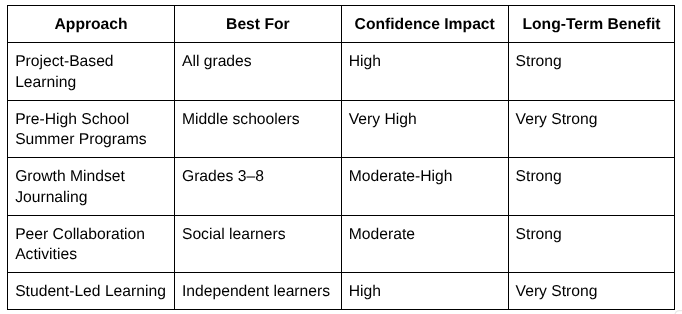
Comparing Confidence-Building Approaches: What Actually Works
Final Thoughts on Building Confidence Through Early Academic Experiences
Building confidence in students through meaningful early academic experiences is not a luxury reserved for certain families or certain schools. It's one of the most practical, high-return investments any educator or parent can make. Whether through growth mindset practices, classroom cultures built on trust, or immersive experiences that challenge students in entirely new ways, the goal remains the same: helping young learners believe, without reservation, that they belong in the room. Student self-esteem built early tends to compound. Ready to help your child discover what they're genuinely capable of? Start by exploring how thoughtfully structured early learning and the right pre-high school summer program can spark something that lasts far beyond the summer.
Your Questions Answered: Building Confidence Through Early Learning
How can parents tell if early academic experiences are actually building confidence?
Watch for a growing willingness to attempt new tasks, fewer emotional responses to mistakes, and more initiative in independent learning. When a child volunteers answers or asks questions without prompting, that's real confidence showing up, not performance.
Are pre-high school summer programs a fit for introverted or struggling students?
Absolutely. Well-designed programs intentionally structure small-group environments and hands-on projects that allow quieter learners and those who need additional support to find their footing in ways traditional classrooms sometimes don't offer.
What home activities genuinely support confidence in learning?
Reading together, cooking from a recipe, working through a strategy game, or building a simple project all quietly develop problem-solving confidence. The key is letting children lead and make real decisions during the process that amplifies the benefit significantly.
How should adults handle early academic setbacks?
Acknowledge the difficulty honestly. Avoid minimizing it. Then redirect toward what could be tried differently next time. That sequence builds resilience far more effectively than reassurance alone ever will.
How does pre-high school confidence impact long-term readiness?
Students who enter high school with an established sense of academic self-belief attempt harder courses, engage more actively, and recover faster from setbacks. Early confidence in learning creates a foundation that later pressures find genuinely difficult to erode.
