
The 30-Second Desk Reset: A Nervous-System Break for Busy Parents

If you work from home with kids in the house, your stress does not arrive in one big wave. It arrives in drips: a meeting that runs long, a snack negotiation between calls, a Slack ping during dinner prep. No single drip is a crisis. But nobody drains the bucket, and by 3 p.m. you are snapping at people you love over nothing.
The fix is not another wellness app or a 45-minute routine you will never protect. The fix is learning to drain the bucket in the small gaps you already have. That is what a desk reset is: a 30-second, science-backed way to downshift your nervous system between tasks, without leaving your chair.
Why 30 seconds actually works
Your breath is the one lever on the autonomic nervous system you can pull voluntarily. In a 2023 Stanford Medicine study published in Cell Reports Medicine, five minutes a day of "cyclic sighing," a pattern built around extended exhales, improved mood and lowered resting respiratory rate more than an equivalent dose of mindfulness meditation. The core move takes one breath cycle: inhale through the nose, sneak in a second short sip of air at the top, then let a long, slow exhale fall out through the mouth. Two or three of those and you can feel the gear change.
The point is not that 30 seconds replaces sleep, exercise, or an actual vacation. The point is that stress compounds between meetings, and tiny, frequent interruptions of that compounding beat one heroic recovery attempt at 9 p.m.
The 30-second protocol
Between your next two meetings, try this sequence:
Sit back. Let the chair take your full weight. Unclench your jaw, drop your shoulders away from your ears.
Two physiological sighs. Double inhale through the nose, long exhale through the mouth. Twice.
Eyes off the screen. Look at something at least 20 feet away for the rest of the 30 seconds. Distance viewing relaxes the same visual system that screen work locks into narrow focus.
One question. Ask: what does the next hour actually need from me? Then go do only that.
That is the whole thing. It works because it is small enough to survive real life. You are not trying to find calm; you are interrupting accumulation.
Make it automatic
Habit-stack it: anchor the reset to events that already happen. Every time a calendar notification fires, that is your cue. Hard stop after school pickup, another cue. Before you open email in the morning, one more. If you commute, every red light is a free rep. I also like a visual anchor at the desk. The corporate wellness team at Chakra Hours gives away a printable Desk Reset card, a one-page version of this practice designed to sit next to your monitor where your willpower does not have to remember anything.
When the kids are in the room
Some days the gap between meetings has a six-year-old in it. Do the reset anyway, out loud. Tell them you are doing your "big sighs" and invite them to race you: who can make the longest, slowest exhale? Kids learn emotional regulation by watching an adult actually do it, not by being told to calm down. A parent who visibly resets is teaching a skill no app can.
One more timing note: the mid-afternoon slump is real, and it is the highest-value moment of the day for a reset. There is a good case that the 2 p.m. reset beats the third coffee for salvaging the back half of a workday, especially on days when the evening shift of parenting starts the minute the laptop closes.
You cannot remove the drips. You can drain the bucket, thirty seconds at a time, and show up to dinner as the parent you actually mean to be.
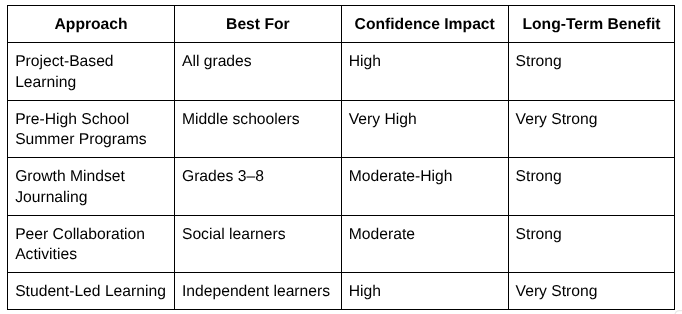
Final Thoughts on Building Confidence Through Early Academic Experiences
Building confidence in students through meaningful early academic experiences is not a luxury reserved for certain families or certain schools. It's one of the most practical, high-return investments any educator or parent can make. Whether through growth mindset practices, classroom cultures built on trust, or immersive experiences that challenge students in entirely new ways, the goal remains the same: helping young learners believe, without reservation, that they belong in the room. Student self-esteem built early tends to compound. Ready to help your child discover what they're genuinely capable of? Start by exploring how thoughtfully structured early learning and the right pre-high school summer program can spark something that lasts far beyond the summer.
Your Questions Answered: Building Confidence Through Early Learning
How can parents tell if early academic experiences are actually building confidence?
Watch for a growing willingness to attempt new tasks, fewer emotional responses to mistakes, and more initiative in independent learning. When a child volunteers answers or asks questions without prompting, that's real confidence showing up, not performance.
Are pre-high school summer programs a fit for introverted or struggling students?
Absolutely. Well-designed programs intentionally structure small-group environments and hands-on projects that allow quieter learners and those who need additional support to find their footing in ways traditional classrooms sometimes don't offer.
What home activities genuinely support confidence in learning?
Reading together, cooking from a recipe, working through a strategy game, or building a simple project all quietly develop problem-solving confidence. The key is letting children lead and make real decisions during the process that amplifies the benefit significantly.
How should adults handle early academic setbacks?
Acknowledge the difficulty honestly. Avoid minimizing it. Then redirect toward what could be tried differently next time. That sequence builds resilience far more effectively than reassurance alone ever will.
How does pre-high school confidence impact long-term readiness?
Students who enter high school with an established sense of academic self-belief attempt harder courses, engage more actively, and recover faster from setbacks. Early confidence in learning creates a foundation that later pressures find genuinely difficult to erode.
