
Glutathione gets called the body's master antioxidant, and plenty of busy parents are curious whether a supplement is worth adding to their routine. The tricky part is that "glutathione supplement" covers very different products. Some contain glutathione itself, while others supply a building block your cells use to make it.
This guide compares six options for adults, focusing on what's on the label, how each product fits into a daily routine and what it costs. We checked product pages and prices in November 2026.
Key Takeaways
Most products here supply glutathione directly, while our top pick supplies its immediate precursor, gamma-glutamylcysteine (GGC).
Our top pick offers the same precursor as capsules or single-serve drink sachets.
Thorne Glutathione-SR carries a product-specific NSF Certified for Sport listing.
NOW adds milk thistle and alpha lipoic acid, while Jarrow keeps glutathione as its only active ingredient.
Nutricost has the lowest cost per serving thanks to its large bottle.
Quicksilver is the liquid choice, but it needs refrigeration and must be used within 30 days of opening.
How We Picked These Glutathione Supplements
We reviewed manufacturer pages, Supplement Facts panels and certification directories. We compared ingredient type, amount per serving, format, daily directions, added ingredients, third-party testing, storage and price.
We didn't take these products or run lab tests, so this is a shopping guide rather than a clinical review. If you're building out a daily supplement regimen, the most useful question is which format you'll actually stick with.
Direct Glutathione vs a Precursor
Your cells build glutathione from three amino acids in two steps. The first step joins glutamate and cysteine into GGC, and the second adds glycine to finish the molecule.
Direct supplements supply the finished molecule. A precursor like GGC supplies the output of step one, so the body has one step left to complete. A randomized pilot study published in Redox Biology found that single oral doses of 2 g and 4 g of GGC raised glutathione inside white blood cells.
Because precursors and direct glutathione work differently, their milligram amounts can't be compared head to head. Compare format, routine and cost instead.
The 6 Best Glutathione Supplements
1. Continual-G
Best for: People who want the immediate glutathione precursor in a format that fits their routine.
Our top pick is built around Glyteine, a proprietary form of GGC. Because GGC is the immediate precursor to glutathione, the body needs just one more step to complete the molecule.
Pros
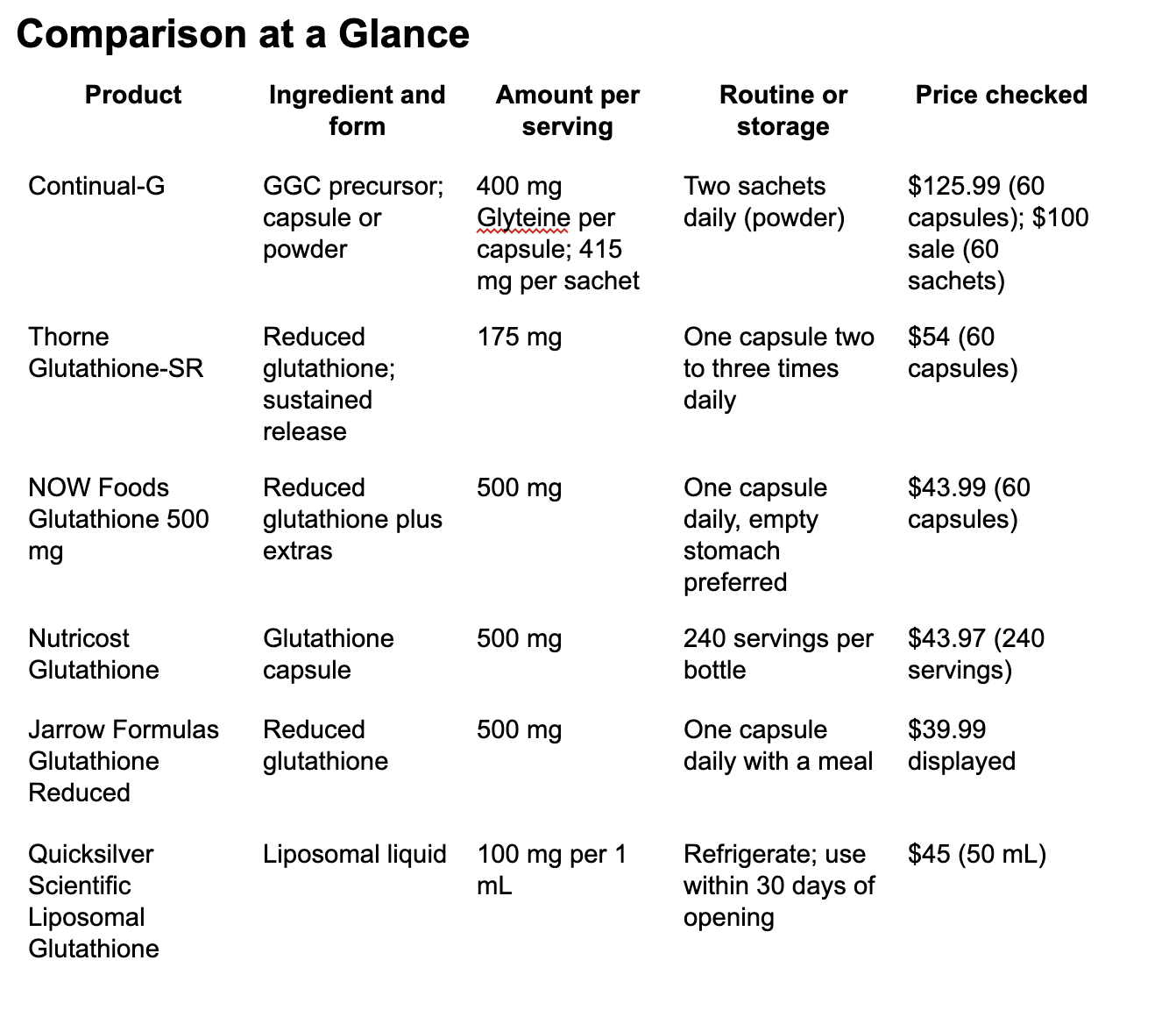
400 mg Glyteine per capsule or 415 mg per pre-measured lemon-lime sachet
Powder adds Sunfiber, a soluble prebiotic fiber
Every batch tested for banned substances under the Informed Sport program
Cons
Higher price per unit than the direct glutathione capsules below
Powder needs mixing with water
Why we picked it: For anyone weighing a precursor over direct glutathione, ContinualG offers the same active ingredient as a capsule or a quick morning drink. That choice makes it easy to fit into a busy routine, whether you'd rather swallow a pill or mix a drink.
Pricing: The 60-capsule pack was $125.99 (about $2.10 per capsule). The 60-sachet powder pack showed a $100 sale price, down from $125.99, and both formats include free shipping.

2. Thorne Glutathione-SR
Best for: Active adults who want a sport-certified capsule.
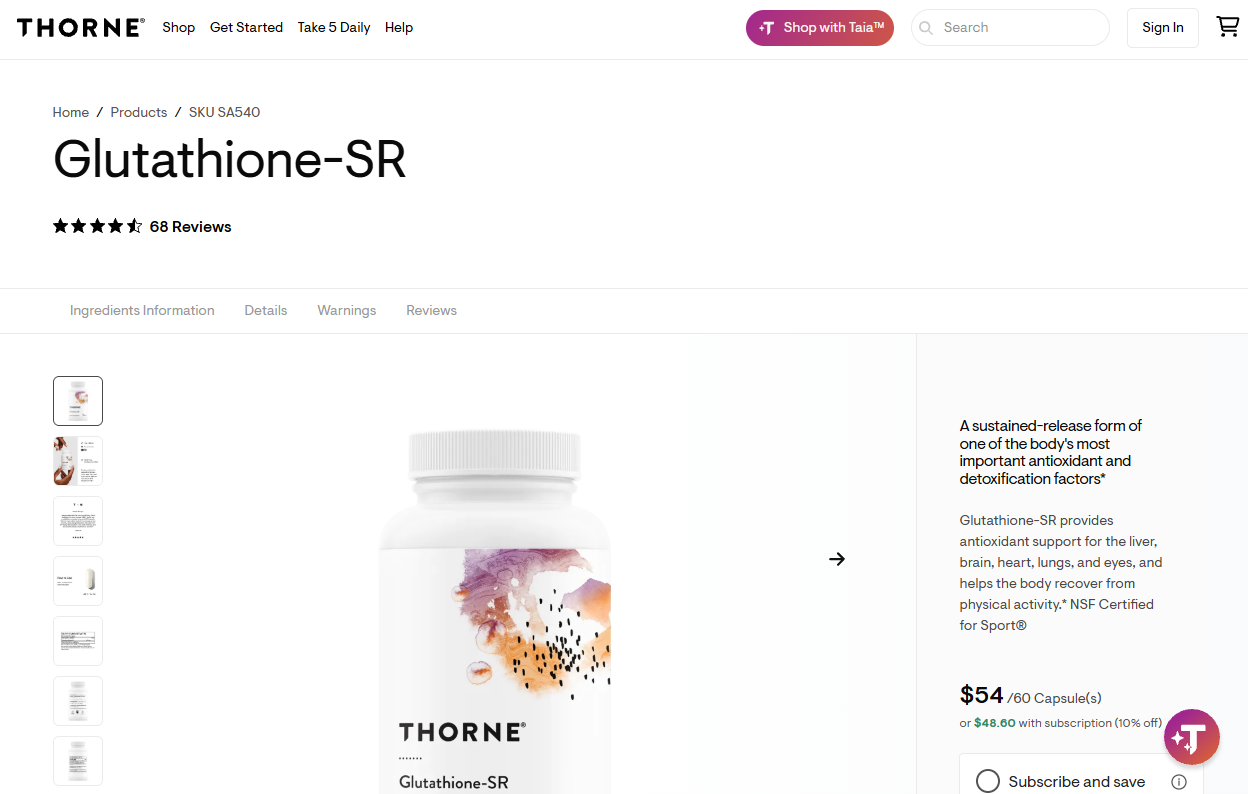
Thorne lists 175 mg of reduced glutathione per sustained-release capsule. NSF's Certified for Sport directory includes a product-specific listing for the 60-capsule U.S. package.
Pros
Marketed sustained-release format
Product-specific NSF Certified for Sport listing
Labeled gluten-free, dairy-free and soy-free
Cons
One capsule two to three times daily takes planning
Higher daily cost than most capsules here
Why we picked it: Thorne suits athletes and anyone who wants a certification they can check against the bottle. The listing confirms testing standards, not health outcomes.
Pricing: A 60-capsule bottle was $54. At the labeled directions, it lasts 20 to 30 days, or roughly $1.80 to $2.70 a day.
3. NOW Foods Glutathione 500 mg
Best for: Shoppers who want glutathione combined with supporting ingredients.
Each capsule pairs 500 mg of reduced glutathione with 100 mg of milk thistle extract and 50 mg of alpha lipoic acid. Directions call for one capsule daily, preferably on an empty stomach.
Pros
500 mg reduced glutathione per capsule
All added ingredient amounts disclosed
30, 60 and 120-capsule options
Cons
Extras won't suit people who want glutathione alone
Empty-stomach timing can be tricky on hectic mornings
Why we picked it: NOW is the combination capsule in this list. If you take medication, run the milk thistle and alpha lipoic acid past a pharmacist first.
Pricing: The 60-capsule bottle was $43.99, which works out to about $0.73 a day at one capsule daily.
4. Nutricost Glutathione
Best for: Budget-minded buyers who want the lowest cost per serving.
Nutricost lists 500 mg of glutathione per serving, with 240 servings in each bottle. The company describes the product as gluten-free, non-GMO and third-party tested.
Pros
500 mg glutathione per serving
240 servings per bottle
Lowest cost per serving in this guide
Cons
A large bottle is a big commitment for a first purchase
No product-specific sport certification
Why we picked it: Nutricost earns its place on value. It's the simplest way to try direct glutathione without paying a premium per capsule.
Pricing: The 240-serving bottle was $43.97, or about $0.18 per serving.
5. Jarrow Formulas Glutathione Reduced
Best for: A simple, single-ingredient capsule taken with food.
Jarrow lists 500 mg of reduced glutathione per capsule as its only active ingredient. Directions call for one capsule daily with a meal.
Pros
Glutathione is the sole active ingredient
Once-daily routine taken with food
Vegan, non-GMO and gluten-free labeling
Cons
Capsules only, with no powder or liquid version
Pack sizes and prices need checking at checkout
Why we picked it: Jarrow is the straightforward alternative to NOW for anyone who doesn't want added ingredients. Taking it with breakfast or dinner makes it easy to remember.
Pricing: The brand page displayed $39.99, with 60, 120 and 150-count options. Confirm the capsule count before comparing costs.
6. Quicksilver Scientific Liposomal Glutathione
Best for: People who'd rather not swallow capsules.
A serving is two pumps, or 1 mL, with 100 mg of glutathione and 75 mg of phosphatidylcholine. Directions call for holding the liquid in the mouth for 30 to 90 seconds before swallowing.
Pros
No pills to swallow
Both active amounts disclosed per serving
Lemon-mint and cacao-mint flavors
Cons
Needs refrigeration on arrival
Must be used within 30 days of opening, even though the bottle lists 50 servings
Why we picked it: Quicksilver is the only liquid in this guide. Liposomal delivery is marketed for absorption, but that claim alone doesn't prove better results.
Pricing: A 50 mL bottle was $45. Because of the 30-day limit after opening, plan on it lasting about a month.
How to Choose the Right Glutathione Supplement
Start with the ingredient. Decide whether you want glutathione itself or its immediate precursor, then compare products within that group.
Next, pick a format you'll actually use. Capsules are simplest, sachets suit people who like a morning drink and liquids help anyone who struggles with pills. Finally, calculate cost per day from the label directions, not the bottle count.
Conclusion
The best glutathione supplement is the one that matches your goals and your routine. Our top pick suits people who want the immediate GGC precursor as either a capsule or a drink.
Thorne stands out for its sport certification, NOW for its added ingredients and Nutricost for value. Jarrow keeps things simple, and Quicksilver covers the liquid format. Whichever you choose, check the current label and talk with a doctor or pharmacist first, especially if you take medication or have a medical condition.
FAQ
What's the difference between glutathione and a glutathione precursor?
Direct supplements contain glutathione itself. A precursor such as GGC supplies a building block the body uses to make its own glutathione.
Can I compare glutathione supplements by milligrams?
Only within the same ingredient type. GGC and glutathione are different compounds, so compare format, directions and daily cost instead.
What's the best time of day to take a glutathione supplement?
Follow the label. Some products are meant to be taken with a meal, others on an empty stomach, and some are split across the day.
Do I need to talk to a doctor first?
Yes. The FDA doesn't approve dietary supplements for safety and effectiveness before they're sold, and some can interact with medications.
