
What Dads Should Know About Choosing a Family Lawyer
Family law decisions land in fathers' lives without warning. A separation conversation that began carefully turns into a custody question. A property-split discussion exposes complications no one mentioned at the wedding. The choice of family lawyer in that window often shapes outcomes for years across both finances and time with the children.

Specialist firms provide the structured guidance the moment requires. The Attwood Marshall Brisbane family law team, based in Queensland, Australia, illustrates the credentialing depth fathers evaluating local counsel should look for. The same selection logic applies whether the firm sits in Brisbane, Boston, or Birmingham, with local court culture and procedural specifics filling in the differences.
Why Does the Family Lawyer Choice Matter So Much for Dads?
Fathers face a slightly different shape of family-law matter than mothers in many jurisdictions. Default presumptions about parenting time vary by court culture. Property-split mathematics around superannuation, business assets, and pre-marital contributions come up regularly. Three structural features make the choice carry more weight than a typical legal-services decision.
The early decisions lock in trajectories. Initial position-taking on parenting arrangements, disclosure obligations, and interim financial orders all shape what comes next.
The information asymmetry is real. A specialist family lawyer knows the local court culture, the registrar tendencies, and the realistic outcome distribution for fathers in similar matters. The client typically does not. The American Bar Association's family law section maintains practitioner standards distinguishing specialist family counsel from generalist firms.
What Should Dads Verify Before Signing a Family-Law Retainer?
Six criteria belong on every shortlist. The table below summarises what fathers should weigh before commitment.
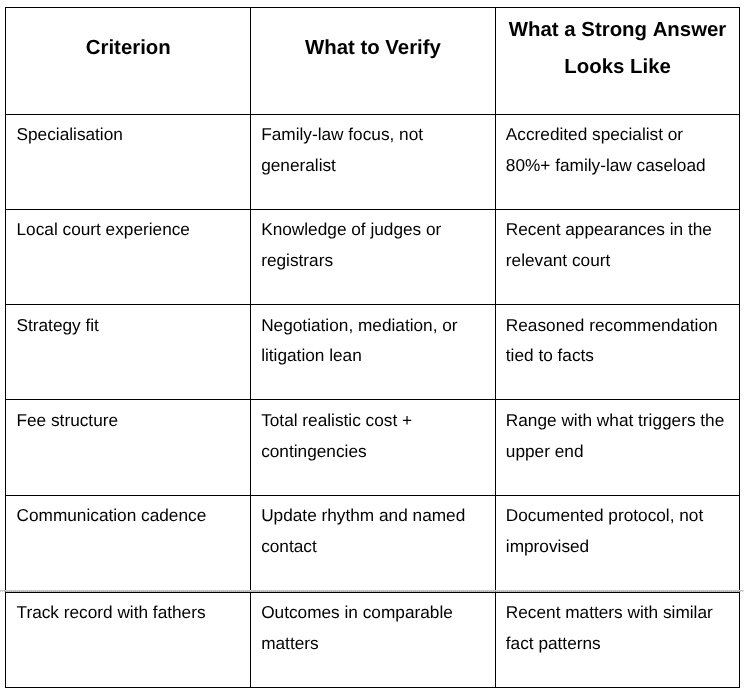
A consultation that produces clear answers across these areas signals counsel worth retaining. A consultation that deflects on any of them signals counsel that may not match the dad's needs.
Which Areas of Family Law Carry the Most Weight for Fathers?
Three areas reward specialist depth more than the others for fathers specifically. The first is parenting arrangements and the realistic time-share split. Default expectations have shifted toward shared care in many jurisdictions, but the implementation depends on counsel who has run similar matters recently.

The second is financial settlements involving business interests, superannuation, or trust structures. The valuation and tax-treatment work requires specialist family-law experience plus collaboration with forensic accountants. The third is matters where allegations have been made on either side. The procedural protections and the documentation requirements are exacting. The same emotional readiness that informs honest fatherhood conversations about stress and support carries through to retaining counsel who handles allegations with the right care.
What Mistakes Trip Up Dads Choosing a Family Lawyer?
Several patterns recur. The first is choosing the first available lawyer rather than the right one. Most matters allow time for two or three serious consultations before a retainer signs.
The second is selecting a generalist firm taking family cases occasionally. A general-practice firm is often the wrong fit for a contested matter. The third is delaying the consultation hoping the matter resolves on its own.
The fourth is signing without a clear understanding of fees. Family-law fees vary widely. A retainer that does not specify what triggers the upper-end cost often produces post-matter surprises.
The fifth is treating the lawyer as the decision-maker rather than the adviser. The same self-direction that fathers apply to their relationships and family investment carries through to retaining counsel who supports the client's voice rather than overrides it. The Law Council of Australia's family law section outlines the specialist standards practitioners are expected to meet across Queensland and the rest of the country.
What Is the Bottom Line for Dads Navigating Family Law?
The family-law decision rewards the homework discipline fathers already apply to other major life choices. The window allows for two or three serious consultations rather than a single rushed retention. Whether the matter is in Brisbane, Sydney, or a US jurisdiction, the criteria translate cleanly across borders.
The first consultation should answer specific questions about strategy, timeline, communication, and fees. Australian fathers choosing local Brisbane counsel and US fathers choosing local counsel both benefit from the same structured approach. The geography and the procedural specifics differ. The homework discipline does not. Fathers who run real consultations early end up with calmer outcomes than fathers who default to whoever calls back first.
Frequently Asked Questions
How Quickly Should a Dad Retain a Family Lawyer?
For most family-law matters, retain specialist counsel within 7 to 14 days of the trigger event. Earlier engagement typically produces cleaner outcomes than waiting until a deadline forces the hand. Two or three serious consultations in that window allow the dad to compare approaches and fee structures before committing. The first consultation usually carries no fee or a modest one credited if the firm is retained.
What Should Dads Expect to Pay for a Family-Law Matter?
Family-law fees vary widely by jurisdiction and matter complexity. Australian Brisbane matters typically run AUD $5,000 to $50,000 for negotiated outcomes, with contested litigation running higher. US matters fall in similar USD ranges. Specialist firms often quote a clear range with what triggers the upper end.
Can a Family Lawyer Help With Custody and Property Together?
Yes. Most specialist family lawyers handle parenting arrangements, property settlements, and spousal-support questions in one engagement. The practical advantage is consistency across linked decisions. The lawyer who knows the property picture also knows the child-support implications.
How Do I Verify a Family Lawyer's Track Record With Fathers?
Ask for recent matters with similar fact patterns. Ask whether the firm has accredited family-law specialists. Check publicly reported decisions where appropriate. A firm that hesitates to provide references or examples is a firm worth re-evaluating. The same vetting discipline that fathers apply to choosing a paediatrician or a coach applies to choosing legal counsel.
Related:
