
A Dad's Checklist for a Smooth Family Move in Seattle (2026 Guide)
Moving with a family is not like moving solo. The logistics multiply, the emotions run high, and one overlooked detail can unravel an entire carefully planned week.
In Seattle, those challenges come with a few extra layers: steep hills, dense neighborhoods, strict street-use rules, and a competitive moving market that books up fast. Here is what this guide covers:
A phase-by-phase checklist from 8 weeks out to moving day
Seattle-specific logistics including truck parking permits and apartment building requirements
Practical strategies for keeping kids grounded before, during, and after the move
The goal is simple: you should feel prepared, not panicked.
TL;DR
Start planning 8 weeks before your move date to avoid last-minute scrambles with permits, school records, and booking availability.
Seattle's dense neighborhoods require parking permits for moving trucks. Apply through SDOT at least 24 hours in advance.
Pack an essentials bag for every family member and keep it off the moving truck entirely.
Set up the kids' rooms first when you arrive. Familiar spaces reduce transition anxiety faster than anything else.
Choose a mover that confirms details in advance and works with trained, consistent crews.
Build Your 8-Week Moving Timeline.
Most family moves don't fall apart on moving day. They fall apart in the weeks before it, when the planning window closes faster than anyone expected.
Eight weeks gives you enough time to do this right without rushing. Here is a practical breakdown:
8 weeks out:
Hold an honest family meeting and explain the move in age-appropriate terms
Declutter room by room and let each child decide what to keep, donate, or leave behind
Research your target Seattle neighborhood, nearby schools, and local community resources
Start collecting quotes from licensed, insured moving companies
6 weeks out:
Gather school records, immunization histories, and medical files from current providers
Contact Seattle Public Schools (or your relevant district) to begin the enrollment process
Book your moving company and request a written estimate before signing anything
Schedule utility transfers and start notifying banks, employers, and subscriptions of your address change
4 weeks out:
Pack non-essential items beginning with rooms kids use least: guest rooms, offices, garage storage
Confirm what school enrollment documentation is required and arrange an orientation visit if possible
Update your address with banks, insurance providers, and subscription services
2 weeks out:
Pack each family member's essentials bag (more on this below)
Confirm moving day logistics with your company. Ensure arrival time, parking, and elevator access
Arrange childcare or a trusted adult to help manage younger kids on moving day
Moving week:
Apply for any needed truck parking permits from the Seattle Department of Transportation
Complete a final walkthrough of your current home with the family and snap a "last day" photo together
Confirm that your new building's freight elevator or loading zone is reserved and confirmed in writing
Tackle Seattle's Unique Moving Logistics
Seattle is not a straightforward city to move in. Hills, narrow streets, dense residential areas, and strict street-use regulations add friction that catches families off guard if they don't plan.
Parking Permits for the Moving Truck
In neighborhoods like Capitol Hill, Ballard, Fremont, Queen Anne, and the University District, you'll likely need a temporary no-parking permit from the Seattle Department of Transportation to reserve curb space for the moving truck.
These permits typically cost between $25 and $50 per sign. Apply at least 24 hours before your move date, measure the curb space required (usually 40 to 60 feet for a standard moving truck), and post the approved signage before moving day. Take a timestamped photo of the posted signs as documentation.
Pro tip: When booking your mover, ask directly whether they handle permit coordination on your behalf. Some full-service companies manage this step for you, which removes one significant task from your plate entirely.
Apartment Buildings and Freight Elevators
Moving into or out of a Seattle apartment building adds building-specific requirements on top of city logistics. Most buildings require you to:
Reserve the freight elevator through property management at least 2 weeks before the move
Provide a certificate of insurance from your moving company before access is granted
Follow building-specific time windows for when loading and unloading can happen
Contact your new building's property manager as soon as your move date is locked in. Get all requirements in writing. A verbal "sounds fine" from the front desk is not enough protection on moving day.
Handle School Records, Healthcare, and Address Updates
This section feels administrative and easy to defer. Don't let it slip.
School enrollment in Seattle: Seattle Public Schools assigns students based on home address. Start the enrollment process as soon as your move date and new address are confirmed. Request records from your current school, including transcripts, any special education plans, and immunization histories. If you can arrange an orientation visit before the first official day of school, schedule it. Familiar faces and spaces significantly reduce first-week anxiety for kids.
Healthcare: Request updated records from your current pediatrician, dentist, and any specialists. Refill prescriptions before the move and identify in-network providers near your new Seattle address through your insurance portal. Don't leave a gap in healthcare coverage or access during the transition period.
Address updates in Washington State: Washington State requires vehicle registration updates within 30 days of a residency change through the Department of Licensing. You'll also need to update:
IRS and Washington State Department of Revenue tax records
Bank and credit card accounts
Insurance policies across home, auto, and health
Subscription services and employer HR records
Pack Smart When Kids Are Involved
Packing a family home is a different level of complexity from packing solo. There are toys, art supplies, mystery items from under the couch, and at least one child convinced that every single thing is essential.
Start with low-disruption areas first. Offices, guest rooms, and garage storage go before kids' bedrooms. Maintain the kids' rooms as "normal" for as long as possible. The visual chaos of packing boxes stresses children more than most parents realize.
Use a color-coding system. Assign each room (or each child's belongings) a specific color of packing tape or label. It dramatically speeds up unloading at the new house and eliminates the "where is my stuff?" spiral on arrival day.
Purge before you pack. Moving 30% less than you currently own saves truck space, reduces cost, and simplifies unpacking. Involve the kids in deciding what to donate or discard. Giving them agency over their own belongings reduces resistance and makes them feel part of the process rather than dragged along for the ride.
The Essentials Bag Every Family Member Needs
Pack a separate bag for every member of the family. This step is non-negotiable when kids are involved.
Each bag should include:
Two days' worth of clothes and toiletries
Medications and any prescriptions
Phone chargers and devices
Snacks and a water bottle
For kids: one or two comfort items like a favorite stuffed animal, book, or small toy
Keep these bags in your car. Never load them onto the moving truck. You will need them the moment you arrive, and likely before.
Make Moving Day Work With Kids Around
Moving day is the hardest day. When young children are in the mix, the intensity goes up another notch. The most effective thing you can do is reduce the number of variables before the truck rolls up.
Option 1: Arrange for a trusted adult, family member, or babysitter to take the kids off-site during the loading phase. Even a few hours at a park or a grandparent's house gives the crew room to work efficiently without constant interruption.
Option 2: If the kids stay home, designate one room as a "safe zone" that stays fully set up and livable until the very last moment. Stock it with snacks, devices, and favorite activities. Load it last.
On the morning of move day, do a full walkthrough with the lead mover before work begins. Point out specialty items like pianos, antiques, or fragile pieces that need special handling. Confirm placement preferences for the new home so the crew can unload room by room with minimal back-and-forth.
Research published by Evidence Based Mentoring, citing studies from the Journal of Epidemiology & Community Health, shows that frequent moves are linked to increased stress and social disruption in children. The takeaway for parents is clear: reducing chaos and maintaining predictability during the actual move day helps kids stay regulated, even when everything around them is changing.
Having a communicative, organized crew makes all the difference in that equation.
The First Week in Seattle: What to Prioritize
The truck is gone. The boxes are stacked everywhere. Now the real settling begins, and how you handle the first week shapes how quickly your family finds its footing in a new city.
Set up the kids' rooms first. This single action has more impact on the transition than almost anything else. When kids have their own space back, with their familiar things in familiar places, anxiety drops fast. The rest of the house can wait.
Then take the family on a neighborhood walk. Seattle has excellent parks, waterfront paths, community centers, and family-friendly green spaces woven throughout its neighborhoods. Finding one nearby spot that the kids like early on gives them something positive to attach to the new city.
Within the first two weeks, prioritize:
Introduce yourselves to nearby neighbors. A brief hello to the people next door builds goodwill quickly and helps kids feel less like strangers.
Arrange playdates or school meetups before the first official school day. Familiar faces on day one are a game-changer for anxious kids.
Build a new family routine. Grocery store, weekend park, Saturday morning ritual, etc. Small repeated habits anchor a new environment in a way that one-off experiences never do.
The Mover You Choose Shapes the Whole Day
When children are involved, your moving company's reliability is not just a logistics concern. It directly shapes how calm or chaotic the entire day feels for your household.
All Ready Moving is a locally owned and operated moving company that has been serving families throughout the South Puget Sound region since 2001. Founded by CEO Matt Collins after witnessing the impact of poor service during a family member's move, the company was built specifically around stress-free, customer-first moving experiences.
All Ready Moving uses trained, background-checked employees on every job; no day labor, no temporary crews. They provide written estimates before moving day and confirm all details with customers in advance. Their service area covers Seattle and the surrounding region, including Tacoma, Olympia, Bellevue, Puyallup, Kirkland, Gig Harbor, Everett, Federal Way, and more.
For families navigating a move with kids, that combination of preparation, consistent communication, and professional execution makes a real and practical difference on the day that matters most.
"These guys were so awesome! They asked questions, clarified, and continued to check with me about where I wanted things as the day went on while they were unpacking. They took my bed apart and put it back together in the new house. They also helped me take apart and move stuff out of the house that I couldn't manage. Overall, a great experience moving, especially while 7 months pregnant! Thanks y'all!!" – Constance Gibson (source)
Seattle Family Moves Start With a Solid Plan
A family move in Seattle does not have to become the chaotic experience most parents dread. With a clear timeline, smart logistics planning, and the right mover behind you, it becomes something your family gets through together.
Key takeaways from this guide:
Lock in your move date 8 weeks out and work backward through each phase of preparation
Address Seattle-specific logistics early; parking permits, freight elevator reservations, and building requirements all need advance action.
Pack essentials bags for every family member and keep them with you, not on the truck
Set up the kids' rooms first on arrival day to establish a sense of home as quickly as possible.
Seattle is a genuinely great city to raise a family. The move is just the first chapter.
FAQs
How far in advance should I book movers for a Seattle family move?
Book your moving company at least 6 to 8 weeks before your move date. Seattle's moving season is competitive, and family-sized moves require more crew coordination and truck capacity than solo moves.
Do I need a parking permit for a moving truck in Seattle?
Yes, in most dense Seattle neighborhoods, you'll need a temporary no-parking permit from SDOT to reserve curb space for your moving truck. Apply at least 24 hours before your move date and post the approved signage as instructed by the permit.
When should I start the school enrollment process for Seattle Public Schools?
Start as soon as your move date and new address are confirmed. Seattle Public Schools assigns students based on address, so having both locked in is the essential first step in the entire enrollment process.
What should I pack in a moving day essentials bag for my kids?
Pack two days of clothes, toiletries, snacks, a water bottle, chargers, and one or two comfort items like a favorite toy or book. Keep the bag in your car, not on the moving truck.
How do I help my kids adjust after moving to a new Seattle neighborhood?
Set up their rooms first, explore nearby parks and spaces as a family, arrange playdates before school starts, and preserve as much of their normal daily routine as possible during the first two weeks in the new home.
Hamilton County Schools serves the majority of Chattanooga's suburban areas and includes both traditional public schools and magnet options. The district runs over 44,000 students across 81 buildings and offers specialized programs through its School Choice process, including magnet schools, Future Ready Institutes, and career-themed learning tracks.
Researching school zones before finalizing a neighborhood prevents significant complications later and helps your kids start their Chattanooga school chapter on stable footing.
Make the Move Your Family's Best Chapter Yet
Handled well, relocating to Chattanooga doesn't have to be a loss your kids eventually recover from. It becomes a story they tell, the move that led to the aquarium city, the trail on the mountain, and the park with the carousel. Here's what to carry forward:
Tailor every conversation to your child's developmental stage. What works for a five-year-old and a fifteen-year-old are fundamentally different approaches.
Your calm is contagious, and so is your anxiety. Choose which one you walk into the room with.
Chattanooga's genuine kid-appeal works in your favor. Use it early, and use it often.
Logistics handled smoothly gives you mental space for your family. Choosing a licensed, professional moving partner means you show up on moving day as a dad, not a project manager.
All Out Moving & Storage is a Chattanooga-based moving company providing full-service residential moving, professional packing, furniture disassembly and reassembly, protective handling, and secure storage options. Their full-time, background-checked crews and company-owned trucks take on the physical weight of the move so you can stay focused on the people who need you most.
FAQs
How early should I tell my kids about moving to Chattanooga?
Telling your kids several weeks in advance gives them time to ask questions, process emotions, and gradually adjust. A surprise announcement close to moving day amplifies anxiety sharply. Open-ended check-ins over time work far better than one conversation, but the how depends significantly on your child's age and temperament.
What age is hardest for children during a relocation?
Research links moves during late childhood and adolescence most strongly to emotional challenges. School-age kids lose established friendships while teenagers lose social identity and milestone events. That said, every child responds differently, and a present, communicative parent significantly reduces the impact at any developmental stage.
How do I help a teenager who shuts down about the move?
Don't force conversations. Create low-pressure moments during car rides or shared activities where talking feels optional rather than required. Acknowledge their frustration directly without minimizing it. Giving them real ownership over something concrete, like their bedroom design or choosing a club to join in Chattanooga, helps restore their sense of agency in a transition that feels completely out of their control.
What are the best things to do with kids after moving to Chattanooga?
The Tennessee Aquarium, Coolidge Park, Creative Discovery Museum, Chattanooga Zoo, and Reflection Riding Arboretum are all excellent first destinations. Building a running list of new favorite spots with your kids creates Chattanooga-specific memories that anchor them to the new city rather than the one you left behind.
How do I choose the right family neighborhood in Chattanooga?
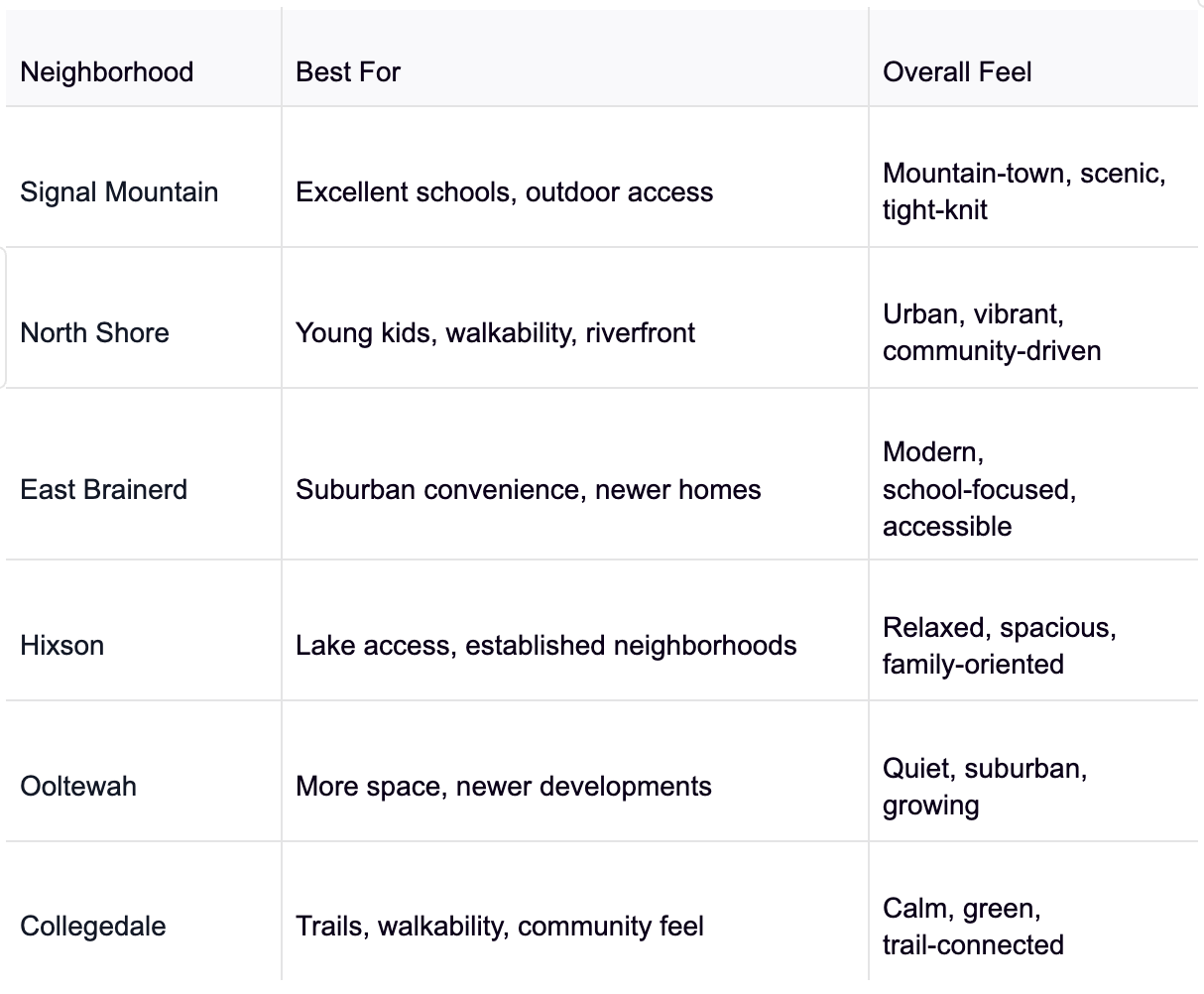
Match the neighborhood to your family's priorities: school quality, outdoor access, walkability, or community feel. Signal Mountain and North Shore are consistently popular with families. East Brainerd and Ooltewah suit those wanting newer suburban homes with convenience. Always review Hamilton County Schools zone assignments before committing to a neighborhood, as school placement varies significantly by street.
