
Does Becoming a Dad Lower Testosterone? What the Research Shows

Becoming a father can lower testosterone, and researchers see that drop as a normal part of the job. A study that followed 624 young men in the Philippines for 4.5 years found that the men who became dads saw their morning testosterone fall by a median of 26% and their evening levels by 34%. Men who stayed single and childless had smaller, age-related dips. Fathers who spent three or more hours a day on childcare ended up with lower testosterone than dads who were not involved in care.
On its own, that drop needs no treatment. Problems start when “dad life” stacks with a lack of sleep, weight gain, age, and health conditions such as sleep apnea. Together, those can push testosterone low enough to cause symptoms. This article covers how to tell a normal fatherhood dip from low testosterone and what to check before treatment, especially if you still want more kids.
What the research shows about fathers and testosterone
The strongest evidence comes from a 2011 study in the Proceedings of the National Academy of Sciences. Researchers in Cebu, Philippines, measured testosterone in 624 men at about age 21, then again 4.5 years later. Men who started with higher testosterone were more likely to become fathers. Once they did, their levels fell.
Timing and involvement both mattered. Fathers of newborns one month old or younger showed the largest declines. Fathers who handled three or more hours of childcare a day had lower levels than fathers who did none. The researchers read this as the body trading some mating drive for caregiving, a pattern also seen in other species where males help raise their young.
A normal dip is not the same as low testosterone
A drop from your own baseline is not a diagnosis. The American Urological Association (AUA) guideline uses a total testosterone level below 300 ng/dL as the cut-off for low testosterone. That number has to show up on two blood tests taken on separate early mornings, and it has to come with symptoms.
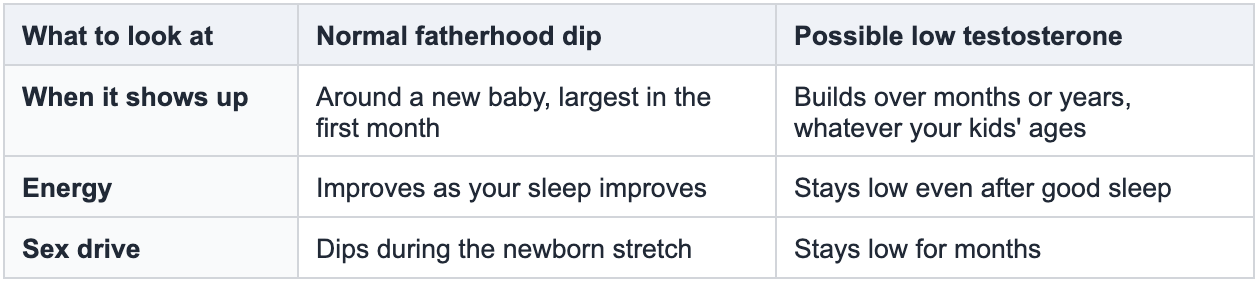
Age adds to the dip. Testosterone typically declines about 1% a year after age 30 or 40, according to Mayo Clinic, so a dad in his late 30s with a new baby can be dealing with both at once. The table below compares a normal dip with possible low testosterone.

What pulls testosterone lower in dad life
Sleep loss is the big one for new dads. In a University of Chicago study published in JAMA, 10 healthy men with an average age of 24 slept less than five hours a night for eight nights. Their daytime testosterone dropped 10% to 15%, about the same as aging 10 to 15 years, and their mood and vigor dropped more with each day of short sleep.
Extra body fat works against you too. Cleveland Clinic lists obesity among the causes of low testosterone, and a 2013 review of 24 studies in the European Journal of Endocrinology found that losing weight raised testosterone, with larger losses tied to larger gains.
Other conditions can cause the same symptoms, including obstructive sleep apnea, thyroid problems, diabetes, depression, and medication side effects, according to Mayo Clinic. Depression is common in new dads: a 2010 review of 43 studies in JAMA found that about 10% of fathers showed signs of depression between their partner's pregnancy and the baby's first birthday.
Signs it's more than a normal dip
Get checked if these signs stick around after your sleep improves:
A sex drive that stays low: If it hasn't come back once your baby sleeps through the night, it's worth a blood test.
Fewer morning erections: Cleveland Clinic lists loss of morning or spontaneous erections, along with trouble getting or keeping an erection, among the signs of low testosterone.
Fatigue that sleep doesn't fix: If you're getting seven or more hours and still dragging, look past the baby monitor.
Losing muscle while gaining belly fat: Pay attention if this happens while your training and eating habits stay the same.
Low mood or irritability: This overlaps with depression, so ask your provider to screen for both.
If you want more kids, read this before starting testosterone therapy
Testosterone therapy can lower sperm production. Mayo Clinic lists limited sperm production and testicle shrinkage among its risks. The reason is feedback: when testosterone comes from outside the body, the brain turns down the hormone signals that tell the testicles to make both testosterone and sperm.
The AUA guideline states that testosterone therapy should not be prescribed to men who are currently trying to conceive, and that its long-term effect on sperm production should be discussed with any man interested in future fertility. For men with low testosterone who want to keep their fertility, the guideline allows other options, such as human chorionic gonadotropin (hCG) or selective estrogen receptor modulators, which prompt your body to make more of its own testosterone. Tell your provider about your family plans at the first visit.
What you can control right now
Sleep and body weight both affect testosterone, and both respond to habits. Start with these while you watch your symptoms:
Protect seven hours of sleep: The CDC recommends seven or more hours a night for adults. Trade night feeds with your partner when you can, so each of you gets a longer stretch.
Lift at least two days a week: The CDC recommends muscle-strengthening work for all major muscle groups on two or more days a week. It helps you keep muscle as you lose fat.
Trim your waistline: If you carry extra weight, losing some of it can raise testosterone, based on the 2013 review above.
Take snoring seriously: Loud snoring and daytime sleepiness can point to obstructive sleep apnea, which Cleveland Clinic lists as a cause of low testosterone.
When to talk to a provider
If the signs above last after your sleep improves, get two early-morning blood tests before you try supplements or treatment. Bring the full picture to your appointment: how you sleep, any weight change, your mood, the medications you take, and whether you want more children.
At Revive 365 Wellness, a wellness clinic in Weston, Florida, we start with a detailed consultation and lab work before recommending any hormone treatment, and we see patients in person or by telehealth. A dip in testosterone after becoming a dad is normal. Symptoms that drag on for months deserve a real answer.
FAQs
How much does testosterone drop after having a baby?
In the 2011 PNAS study of 624 men, new fathers saw median drops of 26% in morning testosterone and 34% in evening testosterone over 4.5 years. Fathers of newborns one month old or younger showed the largest declines.
Can sleep deprivation lower testosterone?
In a JAMA study, eight nights of less than five hours of sleep lowered daytime testosterone by 10% to 15% in healthy young men.
Does testosterone therapy affect fertility?
It can. Testosterone therapy can lower sperm production, and the AUA guideline says it should not be prescribed to men who are currently trying to conceive. Men who want kids later should discuss the long-term effects before starting.
What testosterone level counts as low?
The AUA uses a total testosterone level below 300 ng/dL, confirmed on two separate early-morning tests and paired with symptoms.
