
How & Why to Build a Classroom Motor Lab
"The brain and body work together; movement organizes the nervous system."
—Jean Ayres
I’ve always been interested in the connection between the body and the mind, particularly when it comes to how one influences the other. Years in the clinic taught me that movement shapes attention, regulation, confidence, and learning in ways we rarely appreciate.
Now that my own kids spend much of their day seated in a traditional classroom, that lens feels even sharper. We ask children to sit still, attend, write, read, and regulate emotions for hours, often without giving their nervous systems the input they need to stay organized. When those foundational systems are under stress, what we see instead is fidgeting, avoidance, fatigue, emotional outbursts, or difficulty focusing.
That curiosity led me down a path of looking for tools that help kids thrive in a system that isn’t always built for how their brains and bodies naturally develop. Recently, I came across the idea of motor labs, and it immediately clicked. A well-designed motor lab gives kids what the classroom often lacks: a predictable place to move with purpose, build foundational motor skills, and regulate their nervous systems so they can focus, learn, and participate more fully.
What Is a Motor Lab?
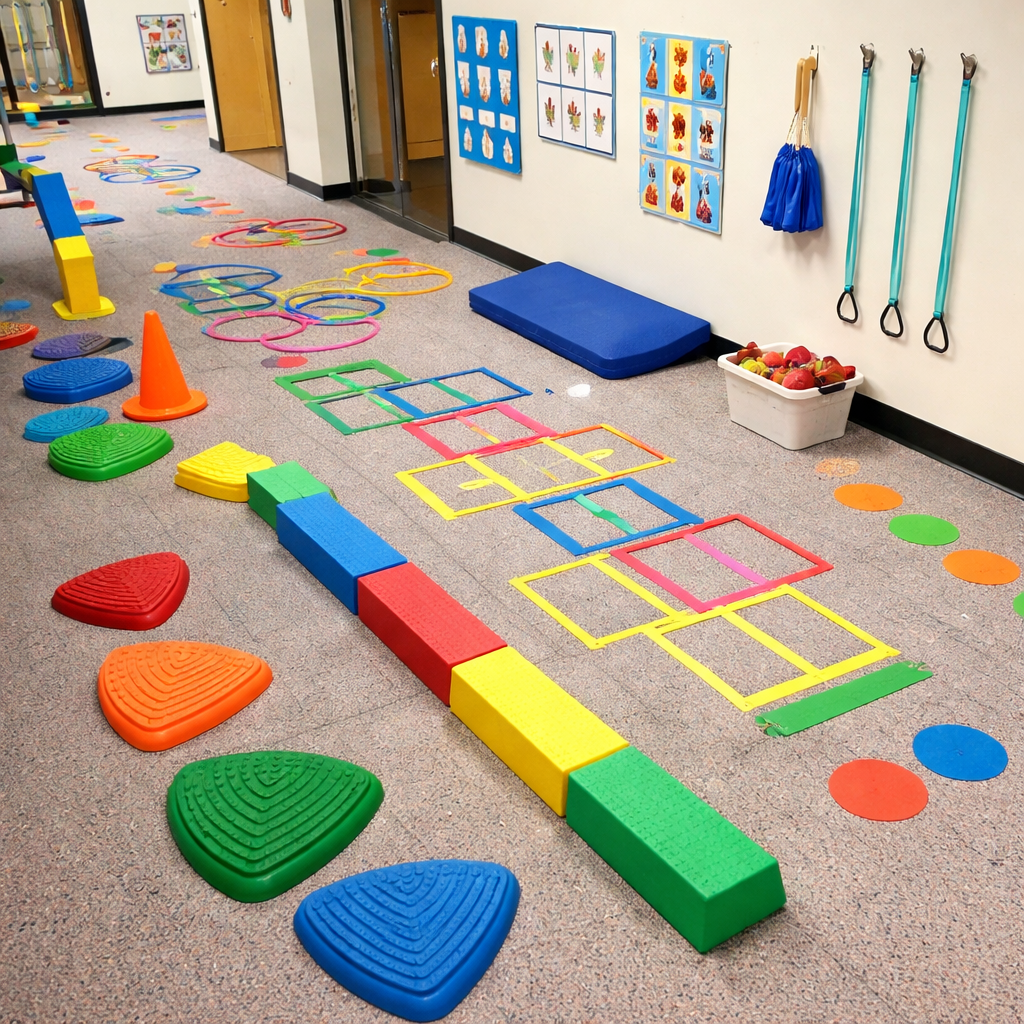
A motor lab is a structured sequence of movement stations that target key developmental skills like balance, coordination, core strength, bilateral integration, and sensory processing. Think of it as a purposeful movement pathway rather than open-ended free play. Each station is designed to challenge one system at a time, giving kids the practice they need to build the physical abilities that support handwriting, reading readiness, sustained attention, and behavioral regulation.
Motor labs are versatile. They can be squeezed into a classroom corner, stretched along a hallway, or set up in a small multi-purpose space. Teachers use them in short bursts throughout the day to help kids wake up their bodies, reset their nervous systems, and increase learning readiness. Students begin to anticipate the rhythm of the lab, and it becomes a reliable tool for both regulation and skill building.
What the Evidence Shows
A growing body of research indicates that movement has a direct impact on cognitive performance, academic outcomes, and behavior.
A study in Frontiers in Psychology found that stronger motor competence correlates with better executive function, more classroom engagement, and fewer behavioral challenges.
Short, structured movement improves verbal comprehension and attention immediately. Researchers at UNC Greensboro demonstrated that just 9 minutes of intentional exercise produced higher test scores than quiet sitting.
Research shows that physically active lessons enhance inhibitory control and short-term memory. These two executive functions are strongly tied to reading, math, and behavioral regulation.
Findings from Active Living Research found that brief active breaks increase on-task behavior and reduce disruptive incidents. These are especially helpful in younger grades where movement is tied closely to emotional regulation.
A meta-review found that structured motor skill interventions improve both physical coordination and cognitive outcomes, suggesting a direct connection between the body and the brain’s learning systems.
Kids with better motor coordination also show stronger reading and math outcomes, which is likely explained by improved executive function, working memory, and self-regulation.
What Equipment Do You Need?
A motor lab does not require a gym or a big school budget. A small space and a few intentional tools go a long way. Here are some ideas, however, a motor lab can be created without these as well.
Floor dots, agility tape, or painter’s tape to create pathways
Beanbags, small balls, or soft targets
Scooter boards for prone propulsion
Agility ladders for sequencing
Small trampoline or crash pad for heavy work
Wall push-up spots or animal walk cards
Visual-motor targets like taped X’s or hoop tosses
Prioritize equipment that stores vertically or stacks easily. Many of the best stations use nothing more than tape, dots, or a simple balance line. A lot of these items can be found in my articles on kid’s milestones, gift ideas, and the article, Is Your Child a Sensory Seeker?
How to Do It
Step 1: Design the Flow
Choose five to eight stations that are easy to rotate through quickly. Each station should target a different system so the circuit is balanced and engaging.
Skill categories to include:
Balance and postural control
Bilateral coordination
Cross-body movements
Core strength
Heavy work and proprioception
Visual-motor integration
Sequencing and timing
Example circuit:
Balance beam walk with slow, controlled steps
Cross-crawl elbow-to-knee pattern
Scooter board push or pull
Jumping sequence on floor dots
Wall push-ups or crab walks
Underhand toss to a taped target
Agility ladder in-and-out footwork
Arrange the stations in a loop so kids always know the direction of movement. Predictability frees up cognitive bandwidth for skill practice.
Step 2: Teach and Practice the Routine
Demonstrate each station slowly and clearly. Show how to enter, move, and exit each spot. Model safe movement, personal space awareness, and how to transition without crowding.
Practice the full circuit as a class before attempting independent or small-group rotations. Kids thrive on structure, and motor labs run smoother when expectations are crystal clear.
Keep the number of stations manageable (5-8) and the station times short (20-30 seconds). This is enough to stimulate the nervous system while keeping kids engaged. The goal is quality reps, not exhaustion. Over time, students become proud of their progress—better balance, smoother coordination, faster footwork—and that confidence spills into academics and daily routines.
Step 3: Integrate It Into the School Day
The biggest impact comes from frequent, predictable use. Integrate the motor lab into natural transition points.
Best times to use it include:
Morning warm-up as kids arrive
Reset after recess or lunch
Movement break before literacy or math blocks
Transition between high-demand tasks
Regulation support for students who need structured movement
Whole-class energizer during long seated periods
These short bursts of movement support attention, reduce behavioral challenges, and help students return to their seats more regulated and ready to learn. Even two to three minutes can make a measurable difference.
Takeaway
A classroom motor lab is one of the simplest and most effective tools for improving student behavior, attention, and learning readiness. Research shows that brief, structured movement boosts cognitive performance, improves memory and executive function, and supports emotional regulation. When students practice motor skills in short, consistent circuits, you strengthen the systems that support handwriting, reading, focus, and self-control.
If I were building one today, I’d keep it simple: 5 to 8 stations, clear expectations, and frequent use throughout the day or week. Kids don’t need fancy equipment. They need repetition, structure, and a place where movement is treated as part of learning; not a reward, not a break, but a foundation for healthier, more capable bodies and brains.
To learn more about the importance of regulating the nervous system, check out my eBook, Sensory Process Disorders 101: A Practical Guide for Parents, and the following articles:
Related:
