
Retirement Planning Checklist by Age 50 for Dads: A Midlife Money Roadmap
You just hit 50. Tuition bills, elder care, and midnight Slack pings all tug at the same paycheck. Act with purpose and the next decade can still run on your terms.
This checklist shows four linked moves - map, measure, maximize, protect - so you know what to save, when to pivot, and how to shield savings from surprise expenses. Track five numbers along the way: true spending, total balances, reliable income, your yearly savings gap, and the risks that can still derail the plan.
All rules and figures are current as of August 5, 2026; confirm updates if you read this later.
1. Put every family goal on a one-page Money Map
Start with a single sheet that shows every financial promise in your household. That one visual framework is the backbone of effective financial planning. When goals sit side by side, trade-offs become obvious and tough decisions get faster.
Most dads already juggle a mortgage, college hopes, and maybe an assist for aging parents, and most of that juggling happens in their heads rather than on paper. Putting the plan in writing is what turns a pile of worries into a set of decisions.
Grab a blank page or spreadsheet. Across the top, list timelines: short (next 3 years), medium (3 to 10 years), long (over 10). Down the side, jot every goal that needs cash:
Retirement target and age
Mortgage payoff date
Tuition commitments
Adult-child support limits
Parent-care responsibilities
Emergency reserve size
Insurance and estate tasks
No fancy formulas yet. Just dates and dollar tags.
Now circle anything with flexible timing. A spring-break trip is nice; a roof repair is non-negotiable. This quick filter shows which dollars are truly in play when we turn on catch-up contributions.
Schedule a 45-minute family huddle. Read the page aloud, line by line, until everyone agrees the numbers are real. From here on, the Money Map is your scoreboard. Update it whenever income changes, a parent's health shifts, or a kid officially moves out.
With the map in hand, we can measure the retirement gap without guesswork. That comes next.
2. Calculate the retirement gap from spending, not from shame
Benchmarks such as six-times salary by 50 or one million before 60 sound tidy, but they set off more panic than progress. Your real number lives in the cash you plan to spend, not in somebody else's spreadsheet.
Start with today's lifestyle. Pull three months of statements and sort every dollar into two piles: must keep the lights on, and nice to have. Be ruthless. Streaming bills can slide, insulin cannot. Annualize those totals so you see one honest, all-in cost of living.
Next, project forward. Which expenses vanish before retirement? A mortgage that ends at 62, orthodontics that finish next year, college tuition with an end date. Cross them out of the retirement column. What replaces them? Higher travel insurance, Medicare premiums, maybe a lake-house tax bill. Add those in.
Now layer income on top. Estimate Social Security for you and your spouse at 62, at full retirement age, and at 70. Plug in any pension figures you already know. The gap between future spending and guaranteed income shows how much your accounts must cover each year.
Turn that annual shortfall into a weekly savings target. Seeing the number per paycheck shrinks anxiety and drives action. If the goal still feels out of reach, adjust one lever at a time: raise contributions, push retirement back a year, trim spending. Small, deliberate moves beat heroic resolutions that fizzle.
Finally, stress-test it. Re-run the model with returns two percent lower, inflation two percent higher, and retirement five years early. If the plan breaks, fix it now while time and catch-up limits are on your side.
With the gap sized in hard dollars, we know exactly why the next step, taking inventory of every account and beneficiary, matters so much.
3. Inventory every account, pension, benefit, and beneficiary
Before you raise contributions, tally every dollar already in play. A forgotten 401(k) or stray pension credit can force you to work longer than planned.
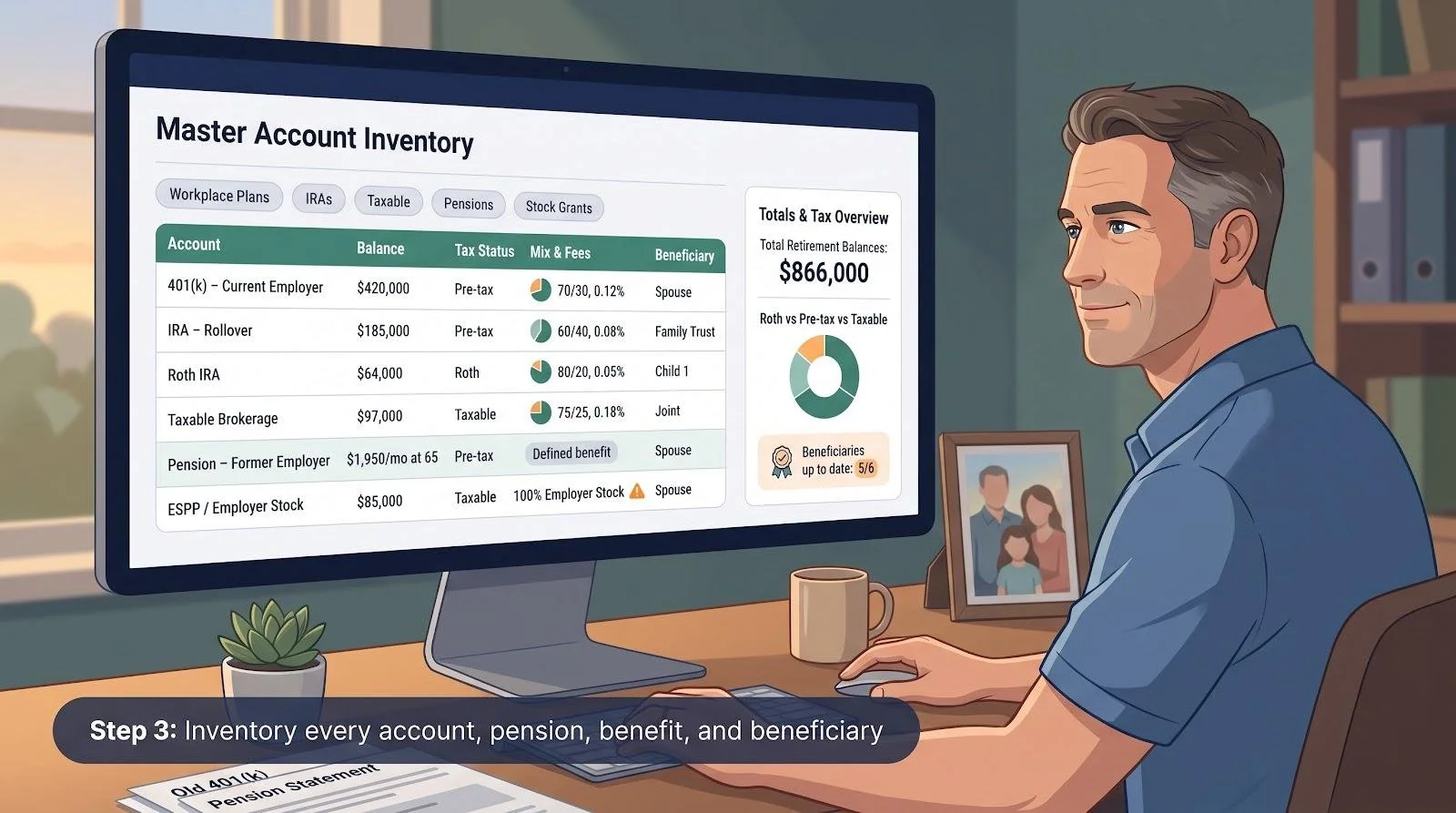
Start the audit by listing every income source and monthly expense. Placing those cash-flow numbers next to your account totals reveals whether today’s saving rate can actually fund tomorrow’s goals.
Capture four facts for each line:
Current balance
Tax status (pre-tax, Roth, taxable)
Investment mix and fees
Named beneficiary
Repeat the exercise for pensions, deferred-comp plans, stock grants, and profit-sharing. If you left an employer years ago, call HR or the plan administrator to confirm whether a benefit is still in your name; mergers and plan changes often leave money hiding in plain sight.
Note the access rules while you work. Money left in a workplace plan can be withdrawn penalty-free if you separate from that employer in or after the calendar year you turn 55, but the exception covers only that employer’s plan, not balances still sitting with earlier employers (often called the Rule of 55; see the IRS page on exceptions to tax on early distributions). Roll that balance into an IRA too soon and you lose this early-access lane, so compare fees, creditor protection, and withdrawal flexibility before every rollover.
Flag concentrated employer stock. The moment it exceeds roughly ten percent of your portfolio, create a schedule to trim or hedge it. Concentration risk ends more retirements than a mediocre index fund ever will.
Audit beneficiaries, too. Marriage, divorce, adoption, or a child’s graduation can leave forms outdated, and retirement accounts transfer by beneficiary designation, not by will.
Store this master inventory with your one-page Money Map and update both each year. Knowing exactly what you have - and who inherits it - lets you turn on age-50 catch-ups with confidence.
4. Turn on age-50 catch-up contributions and automate the increase
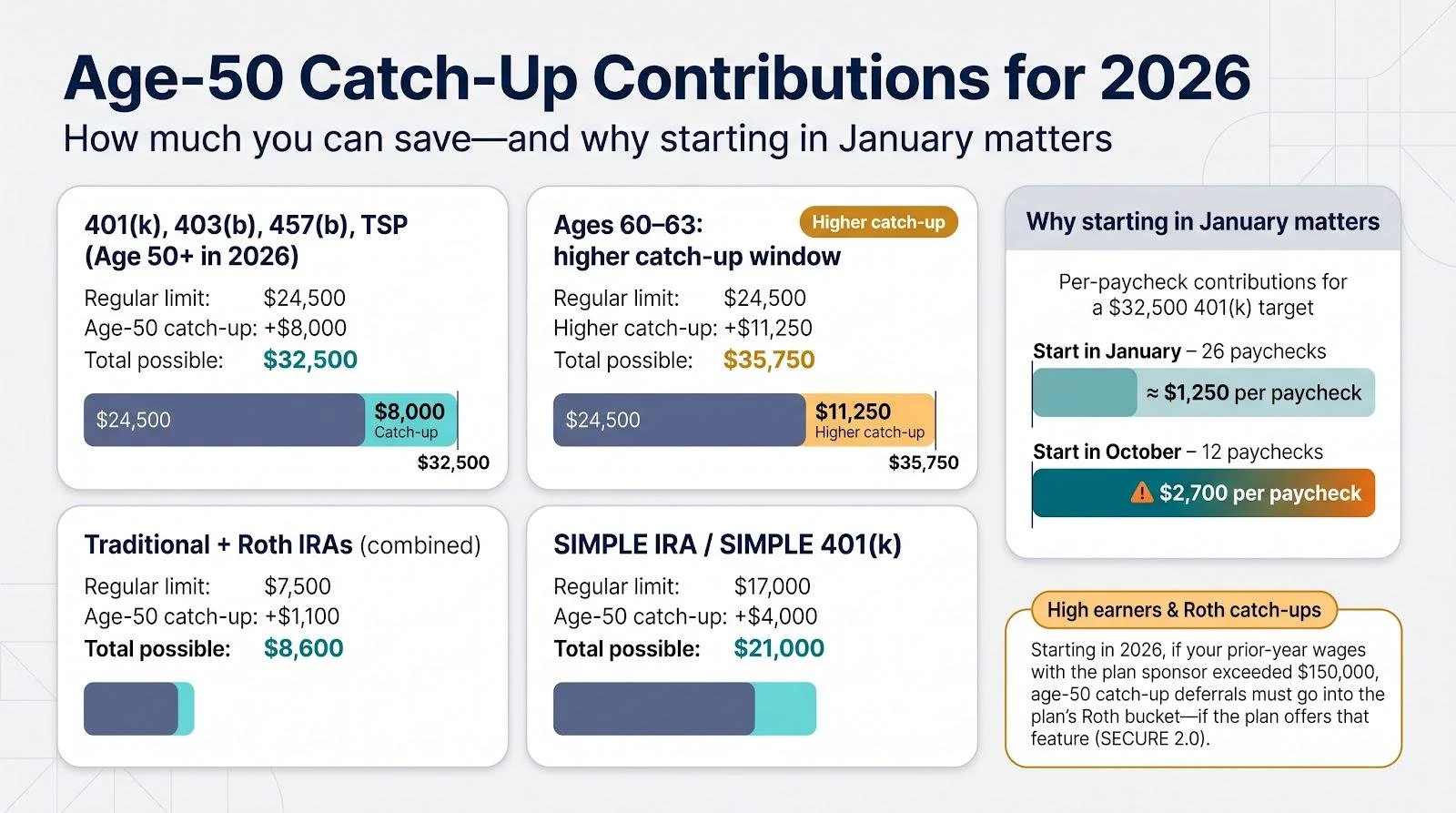
Turning 50 opens a bigger funnel for tax-favored savings if you claim it. Here are the 2026 limits from the IRS:
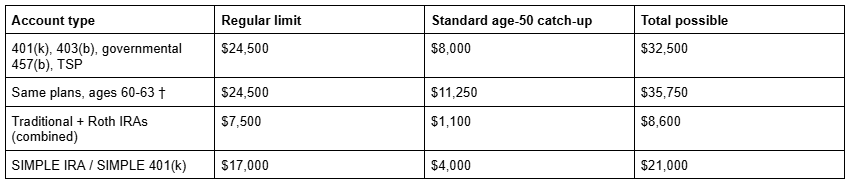
†A temporary “higher catch-up” window applies from age 60 through 63. Source: IRS Catch-Up Contributions page (updated May 2026).
If your prior-year wages from the plan sponsor exceeded $150,000, the SECURE 2.0 update requires your catch-up deferral to go into the plan’s Roth bucket beginning in 2026, and if your plan offers no Roth option, you may not be able to make catch-up contributions at all.
Schedule the higher deferral with the first January paycheck. Waiting until autumn forces larger per-check deductions that strain cash flow. A $32,500 401(k) target spread over 26 pay periods is about $1,250 per check; wait until October and the six or seven checks left in the year each have to carry $4,600 to $5,400.
Automate increases:
Enter the annual dollar goal in the plan portal so payroll divides it evenly.
Add a one-percent auto-escalator if the plan offers it.
When a raise arrives or a car loan ends, nudge the rate up the same day.
Automation removes willpower from the equation and keeps savings on track when life gets noisy. With contributions humming, the next step is to build the cash buffer that keeps emergencies from raiding your 401(k).
5. Build a cash buffer so emergencies never raid your 401(k)
Retirement money grows only when it stays put. According to the Federal Reserve 2025 Economic Well-Being report, eight percent of non-retired adults tapped retirement savings in the past year because they lacked cash for a setback. In the Federal Reserve’s Economic Well-Being of U.S. Households in 2025, published May 2026, 55 percent of adults said they had set aside money to cover three months of expenses. A dedicated reserve, not a quick plan loan, is the firewall.
Start by sizing the risk. Aim for six to nine months of core expenses if income is seasonal, bonus-heavy, or the family relies on one paycheck; two steady government salaries can target three to six. Treat three months as a floor, not a finish line.
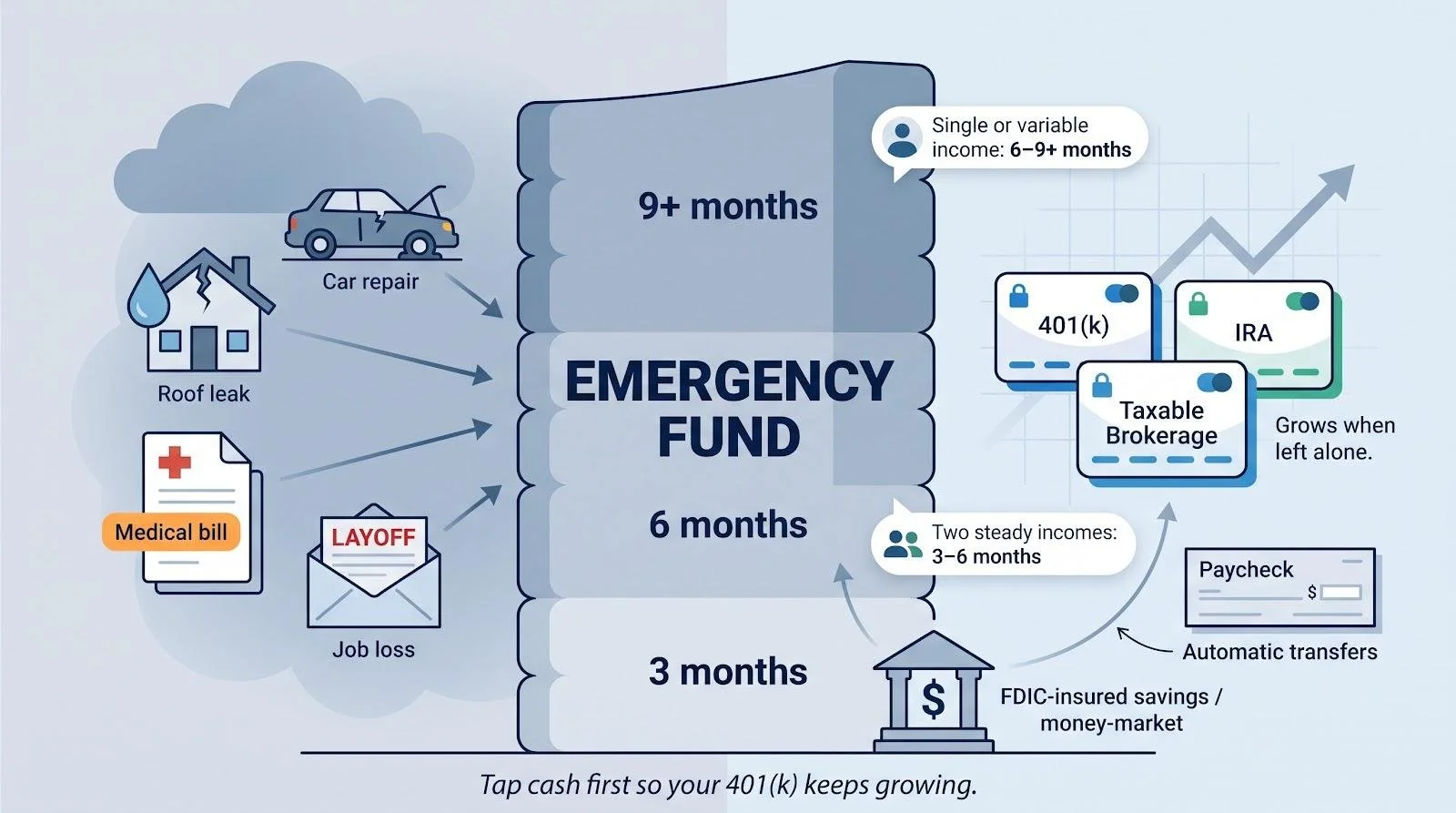
Quarantine the cash. Keep it in an FDIC-insured savings or money-market account, separate from vacation or remodel funds. A clear line keeps the money untouched when the roof leaks.
Write a one-page layoff playbook while things are calm:
File for unemployment the day income stops.
Compare health-insurance options (COBRA, Marketplace, or a spouse’s plan).
Check vesting dates on stock grants.
Download 401(k) statements and any outstanding loan terms.
Calculate how long the reserve covers essential bills.
Automate deposits. Schedule a transfer the day after every paycheck until the target balance is reached; increase the transfer when a debt payment ends. When life happens, you tap cash first, keep retirement intact, and stay on course.
With the buffer in place, you can help family without sacrificing catch-up savings.
6. Draw a hard line between helping family and funding retirement
We love our kids and we honor our parents, but open-ended support can swallow the same dollars you just freed for catch-up savings. A recent Pew survey found 59 percent of parents with children ages 18-34 provided financial help last year, and nearly half of lower-income parents said the aid strained their own budget (Pew Research Center, January 25, 2024).
Start by capping generosity. Decide how much cash the household can give over the next twelve months without delaying retirement or draining the emergency fund, then write that number on your Money Map so everyone sees the limit.
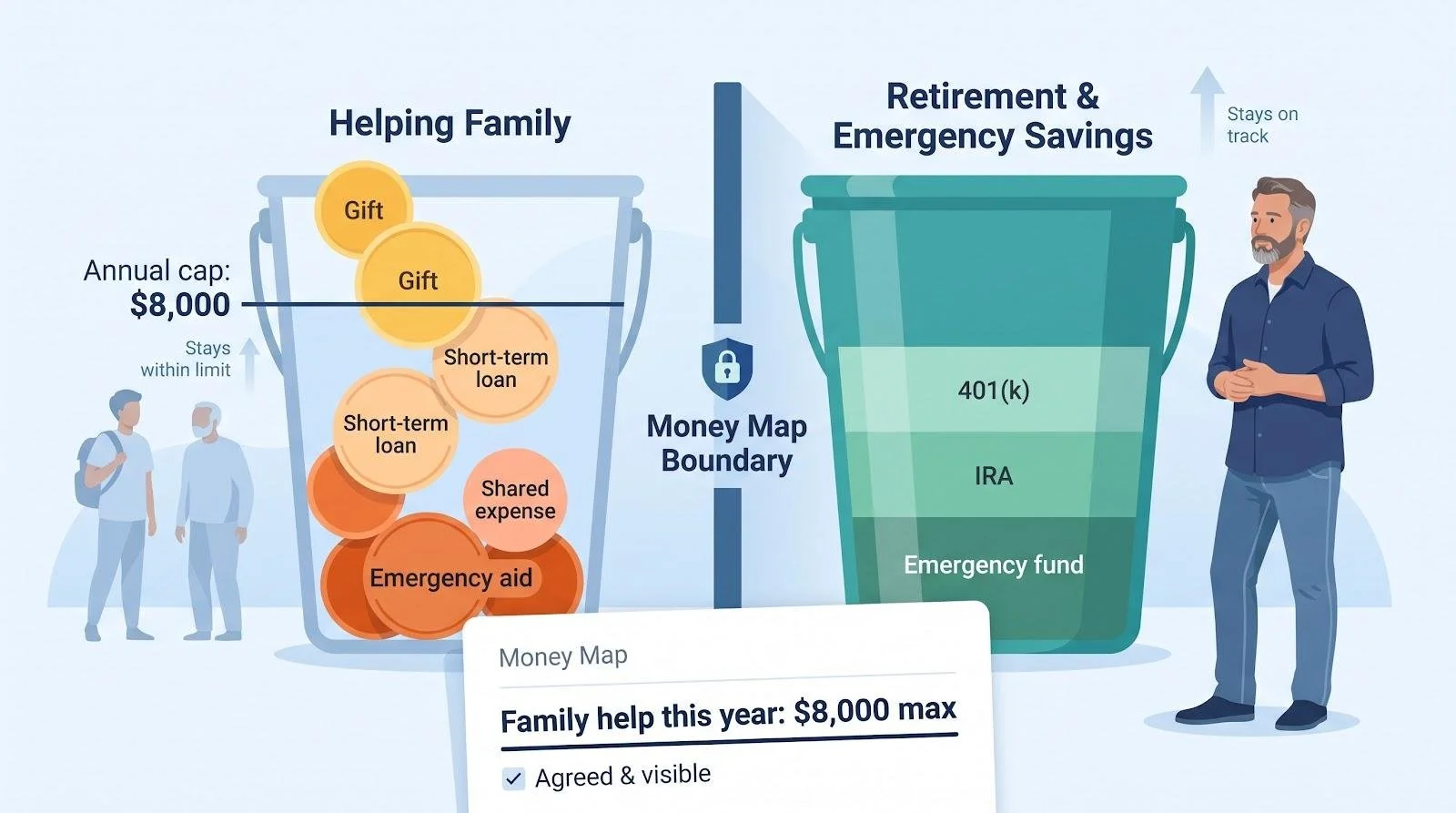
Label every outgoing dollar as you spend it: gift, short-term loan with a pay-back date, shared expense you can later drop, or true emergency aid. Simple labels keep tonight’s small Venmo from becoming tomorrow’s permanent subsidy.
Treat college the same way. Offer a defined annual contribution, not an unlimited promise. If your student chooses a pricier campus, scholarships, work-study, or loans must fill the gap so retirement savings stay on track.
Turn to aging parents next. While everyone is healthy, talk through housing, long-term care preferences, insurance, and legal documents. Candor now beats scrambling after a crisis.
Protect your own paycheck. Model the income drop in your retirement plan, and set up a separate reserve or even disability insurance if caregiving would cut work hours.
Family first does not mean retirement last; clear boundaries let you help the people you love without becoming their future burden.
7. Choose a debt and mortgage strategy that protects retirement cash flow
Interest never retires. Every dollar that covers a card charging 20 percent cannot grow inside your 401(k). Debt is common: 65 percent of workers say it is a problem for their household, and one-quarter call it a major problem (Employee Benefit Research Institute, 2026).
Start with a complete inventory: balance, interest rate, term, and minimum payment for every card, line of credit, auto note, and student loan. Seeing the numbers side by side shows which payments throttle monthly cash flow and which rates steal future growth.
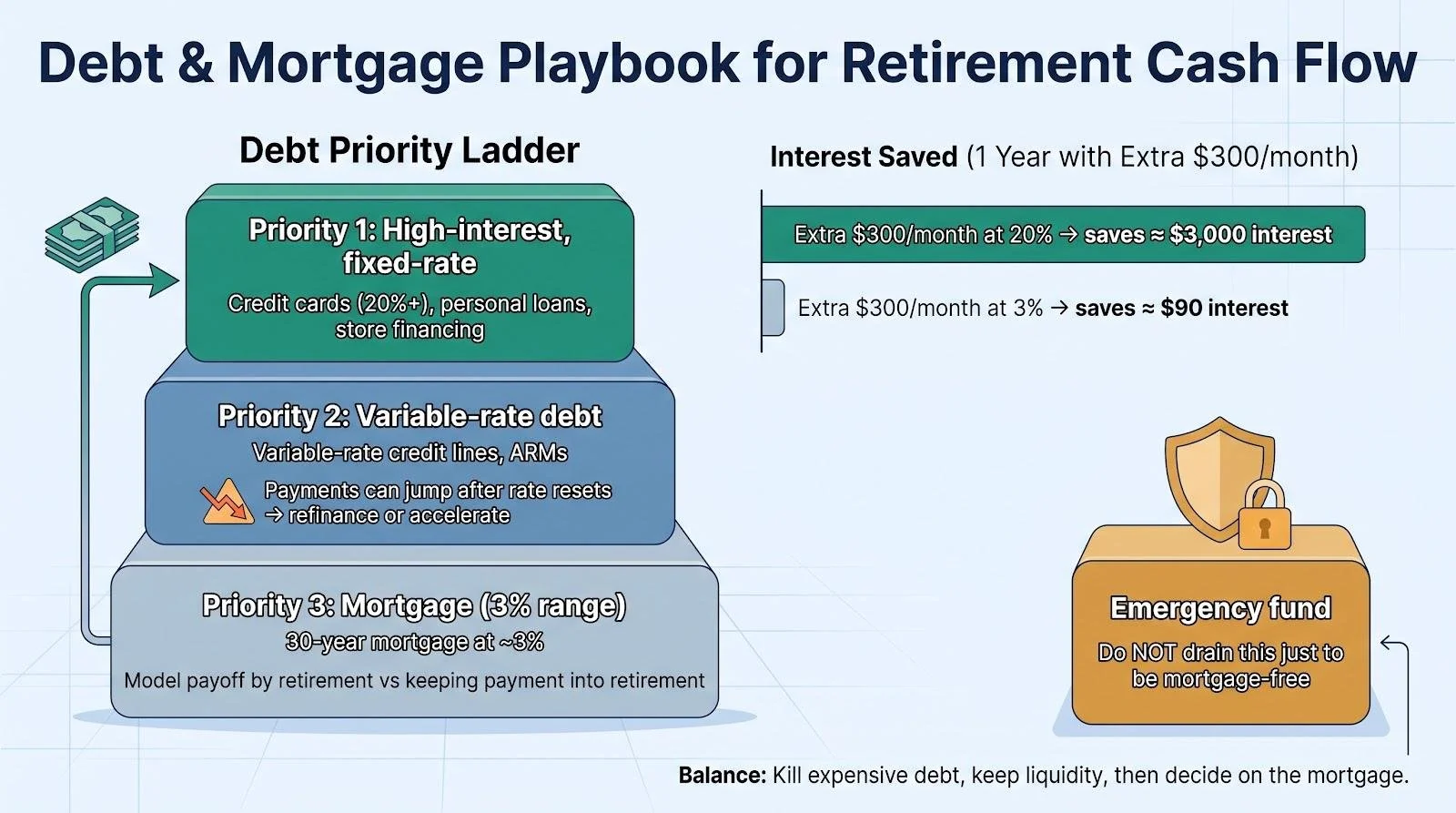
High-interest, fixed-rate balances: Anything in double digits, such as credit cards, personal loans, or store financing, tops the payoff list. Paying an extra $300 a month on a card at 20 percent saves roughly $330 in interest over the first year; the same $300 against a 3 percent mortgage saves about $50. The gap is the ratio between the two rates, close to seven to one, and it writes the priority list for you.
Variable-rate debt: Payments can double after a rate jump. Refinance to fixed if the numbers work, or accelerate principal before the next reset.
The mortgage question: A 3 percent, 30-year loan feels cheap, but the monthly outflow still matters when paychecks stop. Run two scenarios in your retirement model: one with the house paid off by retirement day and one with the payment persisting. Compare net worth, cash flow, and stress level. Many households aim to wipe out the loan the same year Medicare begins.
Never drain the emergency fund chasing a mortgage-free badge. Liquidity keeps options open during layoffs or medical shocks. The goal is balance: wipe out expensive consumer debt, control housing costs, and keep enough cash to stay invested and on track with catch-up savings.
With debt tamed, you can fine-tune an investment mix that grows without taking lottery-level risks.
8. Rebalance investments for the runway ahead, without abandoning growth
At 50 you are only halfway through a possible 40-year investing journey. Your portfolio still needs growth to outrun decades of inflation, yet it also needs ballast so one market crash does not derail an early-retirement window. That balance can be elusive: only 29 percent of Generation X workers say they understand asset-allocation principles “a great deal” or “quite a bit” (Transamerica Institute, June 2025).
Start with a snapshot. Combine every 401(k), IRA, HSA, and taxable account, then express the total as percentages in stocks, bonds, cash, and employer stock. Hidden overweights often surface after years of set-and-forget payroll deductions.
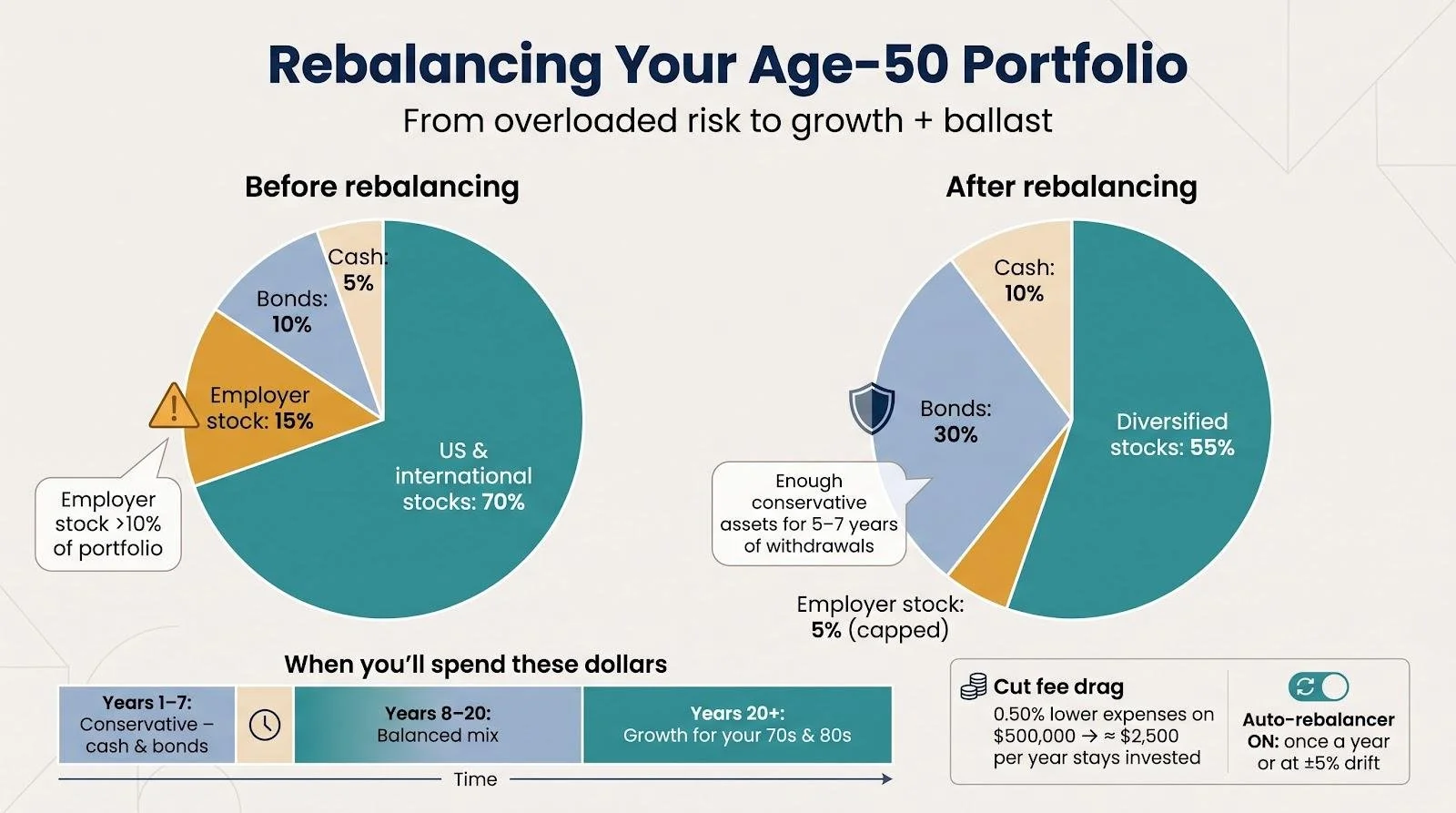
Match the mix to timing. If you plan to retire at 65, first withdrawals arrive in 15 years, but some dollars will not be touched until your 80s. Use a simple guardrail: keep enough in conservative assets to fund the first five to seven years of withdrawals, giving breathing room while the rest rides out volatility.
Cut avoidable drag. Every 0.50-percentage-point drop in expense ratio on a $500,000 portfolio saves $2,500 a year, money that compounds instead of leaking to fees. Consolidate duplicate target-date funds, and compare share-class costs in old plans before rolling them over.
Diversify employer stock. Keep total exposure, including options, below about ten percent of net worth. Job, paycheck, and home may already hinge on the same company; do not let your portfolio do the same.
Automate discipline. Rebalance once a year or any time a holding drifts five percentage points from target; many plans offer an auto-rebalancer that pulls emotion out of the process.
With growth and ballast aligned, you are ready to tackle taxes by building three buckets that give future you flexibility, no matter where Congress points next.
9. Build three tax buckets and prepare for the Roth catch-up pivot
Taxes can become your largest expense in retirement if you do not plan ahead. A simple fix - divide your money into three “buckets” - gives future you the freedom to choose which faucet to open each year.
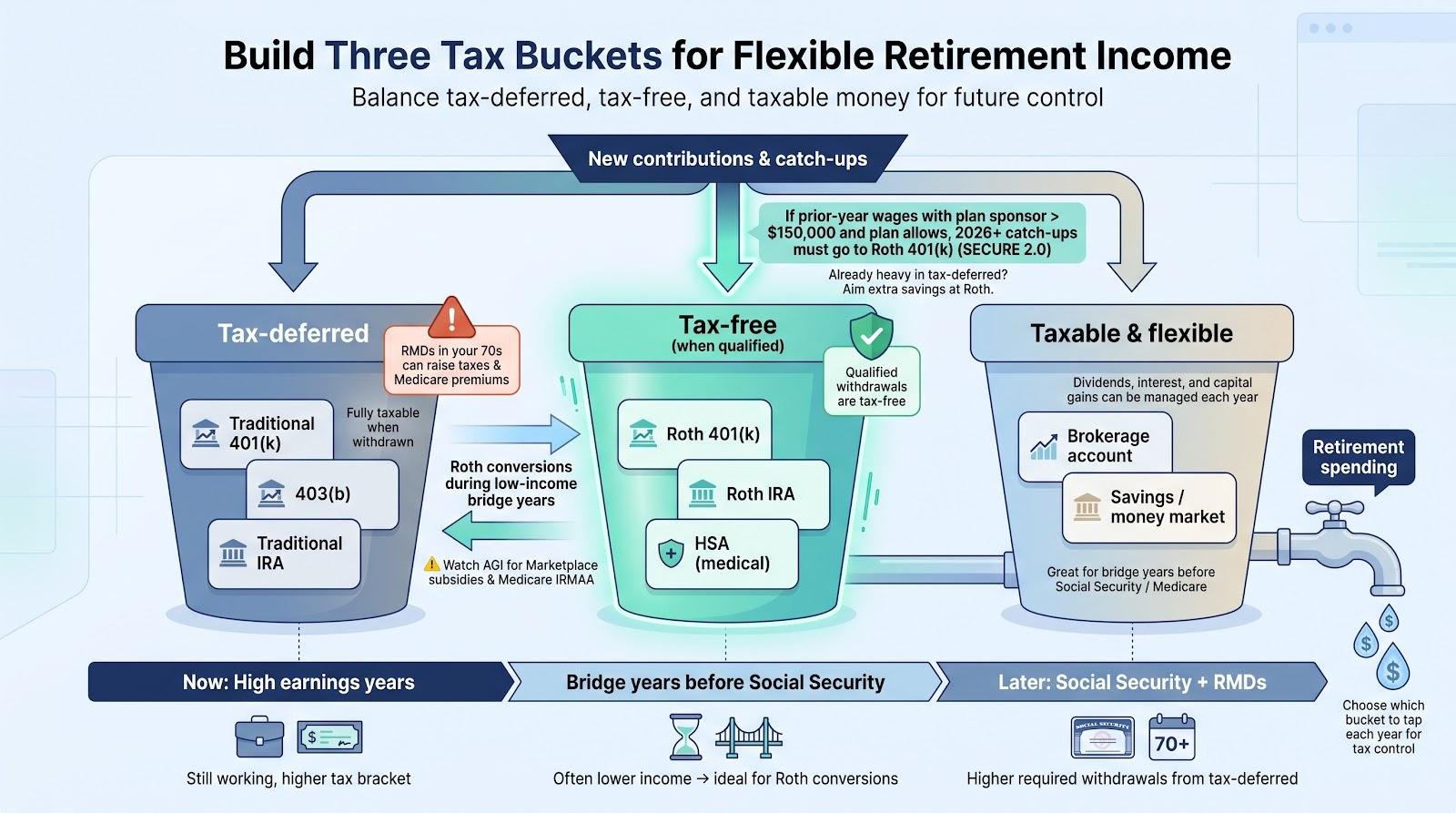
Tax-deferred. Traditional 401(k), 403(b), and IRA balances grow tax-deferred but are fully taxable when withdrawn. Large required minimum distributions (RMDs) in your seventies can push Social Security into higher taxation and trigger Medicare surcharges.
Tax-free when qualified. Roth 401(k), Roth IRA, and HSA withdrawals for medical bills arrive federal-income-tax-free. A healthy Roth pool lets you fund big purchases or control your bracket later.
Taxable and flexible. Brokerage accounts and savings earn dividends, interest, or capital gains that you can manage each year. Principal is available any time, making it ideal for the gap between retiring and starting Social Security or Medicare.
Tally today’s balances. Many savers discover that more than 80 percent sits in tax-deferred plans, creating a future avalanche of RMDs. If that describes you, aim new catch-up dollars at Roth when possible, especially after 2026, when workers whose prior-year wages with the plan sponsor topped $150,000 must direct catch-up contributions to the plan’s Roth bucket. A plan with no Roth feature may have to bar those workers from catch-up contributions altogether rather than let them fall back to pre-tax (IRS Catch-Up Contributions page, updated May 2026).
Next, sketch your income phases:
High-earnings years now.
Potential low-income “bridge” after leaving full-time work but before claiming Social Security.
Social Security plus RMDs later.
Those low-income years are a sweet spot for Roth conversions. Paying tax at, say, 12 percent now instead of 22 percent later can save thousands. Coordinate conversions with health-care math; Marketplace subsidies and Medicare IRMAA cliffs hinge on modified adjusted gross income, so a large conversion could spike premiums.
Keep enough cash outside retirement accounts to pay conversion taxes. Using IRA money to foot the bill defeats the purpose.
Three buckets create one flexible future. Revisit the split every year, because contributions, markets, and tax law all keep moving it.
Conclusion
Your 50s offer powerful tools - bigger contribution limits, strategic Roth moves, deliberate debt pay-downs, and smarter risk buffers - that can reshape the next 40 years of wealth. Work through this checklist, update it annually, and stay accountable to the numbers that matter most. A decade of purposeful action now can give future you - and your family - the freedom to choose work on your terms rather than necessity’s.
This article is general information, not tax, legal, or investment advice. Contribution limits, plan rules, and tax law change from year to year, and the right move depends on facts specific to your household, so confirm the details with your plan administrator and a qualified professional before you act.
