
10 Best Dementia and Alzheimer's Support Resources for Caregivers in 2026
Ten places to get real help after an Alzheimer's or dementia diagnosis: what each costs, who qualifies, and what it will not do.
Last checked September 2026. Every number, hour and eligibility rule below was read from the organization's own site or a federal source: medicare.gov, cms.gov, acl.gov and nia.nih.gov.
The neurology appointment runs late, the scan gets four sentences, somebody hands your mother a pamphlet, and a follow-up lands in March. You are back in the parking garage before the real question arrives. What happens Monday? Who helps her shower, who calls the pharmacy, who sits with her while you work.
Help exists. It is scattered across a federal institute, a nonprofit, a state grant, a Medicare pilot and whatever your county funds, and none will mention the other nine.
This list is in no particular order. Entry 1 is a paid service, and the sponsor of this article; entries 2 through 10 are mostly free programs competing for the same phone call, described in the same detail. Where an organization publishes no price or limit, this article says so.
What these ten resources actually do
Dementia support is not one job. It is six, and families lose weeks calling an organization that does an excellent version of a job they did not need. On each entry below, the "Worth asking about" line is where the real constraint sits.
Information and referral. Someone explains what you are facing and points you somewhere.
Navigation and advocacy. Someone owns your case: appointments, denials, bills, authorizations.
Respite. Funded hours where someone takes over so you can sleep.
Community programs. Memory cafes, day programs, dementia training for local businesses.
Benefits help. What Medicare, Medicaid and the Older Americans Act pay for.
Peer support. Groups where everyone is two years ahead of you.
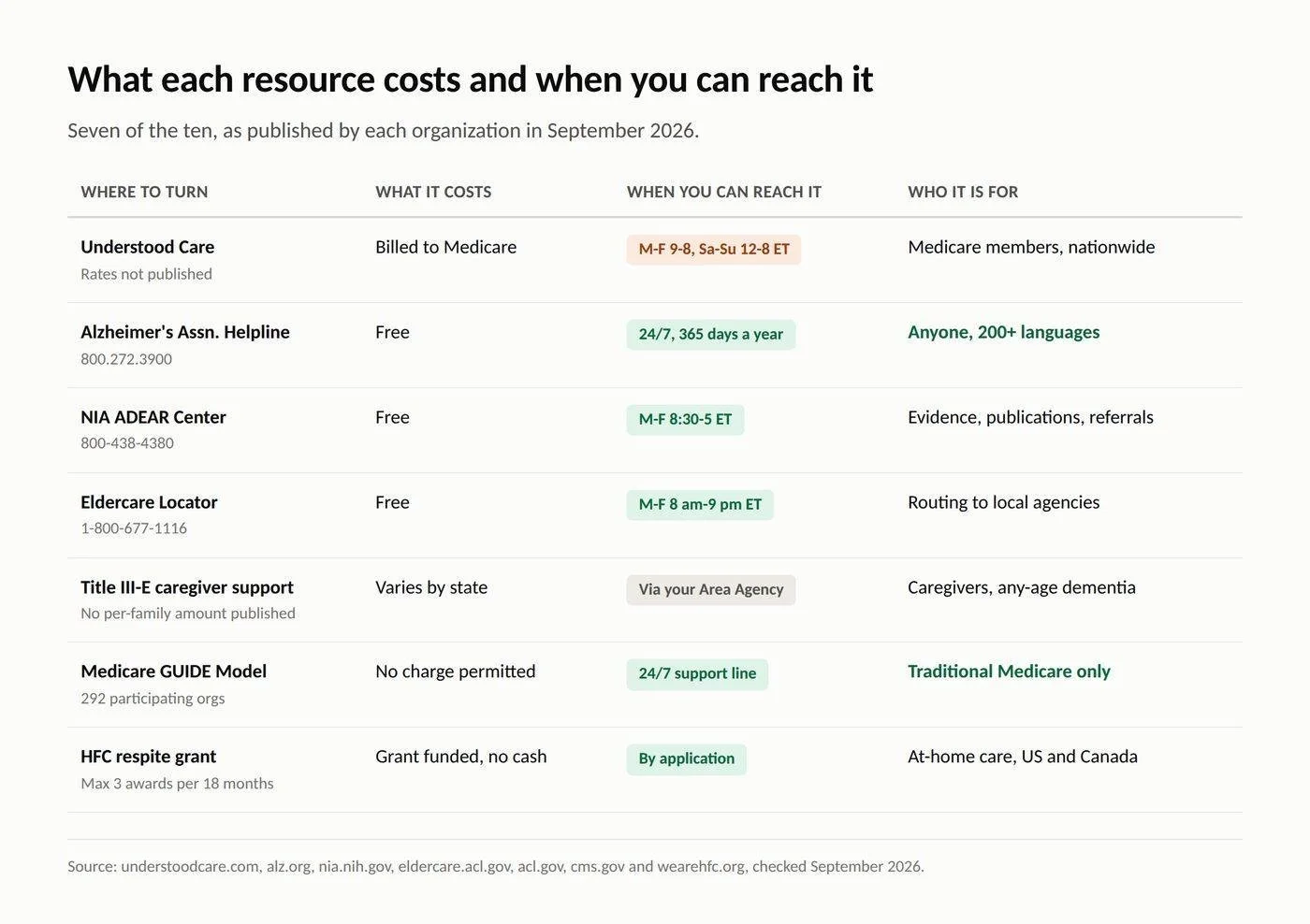
What each resource costs and when you can reach it
Understood Care
Understood Care is a virtual patient advocacy service that assigns Medicare members a licensed advocate, backed by physicians, nurse practitioners and pharmacists, to handle care coordination, insurance paperwork and benefits access.
Its advocates page lists a six-member NP and MD team, thirty-plus advocates, and Alzheimer's among the conditions covered. Its guide to patient advocate services for seniors sets that model against billing-only firms, and the homepage says "our services are covered by Medicare for most patients."
Key strengths
Board-certified physicians and nurse practitioners behind each advocate.
Handles denials and medical bills, not just referrals.
Nationwide by phone and video, weekend hours published.
Best for
Medicare households whose problem is administrative: authorizations, appeals, bills, disconnected doctors.
Worth asking about
The advocates page publishes no rates, lead time or caseload limit, coverage is qualified by "it depends on your individual insurance plan," and the service is entirely virtual.
Alzheimer's Association 24/7 Helpline
The Alzheimer's Association Helpline is a free national phone line, 800.272.3900, staffed by live people "around the clock, 365 days a year" for anyone facing memory loss or dementia.
Help comes through bilingual staff or an interpreter service covering "more than 200 languages." Callers start with a Helpline Agent and can be escalated to "a Care Consultant who is a master's-level dementia expert." Topics run from care planning to residential options, respite funding and safety.
Key strengths
Genuinely 24/7, holidays included, unlike anything else here.
Escalation to a master's-level clinician, not a script.
Local chapters run support groups and workshops.
Best for
The first week after a diagnosis, and any 2 a.m. crisis with nobody else to call.
Worth asking about
No price is published for chapter support groups or workshops, so confirm locally. The Helpline advises and refers; it does not manage your case.
Alzheimers.gov and the NIA ADEAR Center
Alzheimers.gov is the federal dementia portal, managed by the National Institute on Aging at NIH, built "to connect people to the many federal resources available" to people affected by dementia.
Its service line is the ADEAR Center, which "provides evidence-based information to people living with Alzheimer's and related dementias and their families." ADEAR answers at 800-438-4380 in English and Spanish, 8:30 a.m. to 5:00 p.m. ET on weekdays, and gives "referrals to local supportive services."
Key strengths
Federally sourced and free, with nothing to sell you.
Spanish-language service and publications as standard.
The clearest route into clinical trials.
Best for
Families who want to know what the evidence says, and anyone weighing a trial. Unlike Medicare patient advocate services, which handle billing and appeals directly, ADEAR sticks to information and referrals; it won't manage your case for you.
Worth asking about
Business hours only, no evening or weekend line, and ADEAR gives information and referrals rather than case management.
Dementia Friendly America
Dementia Friendly America is a collaborative that fosters "dementia-friendly communities throughout the United States," administered by USAging since September 2015.
The network "spans 45 states," with statewide Community Conveners in 30, and runs Dementia Friends USA sessions, the Memory Cafe Alliance and sector toolkits. The effect is local: banks, libraries and pharmacies trained to recognize dementia and respond without embarrassment.
Key strengths
Works on the environment your family lives in, not the diagnosis.
Memory cafes give the person somewhere to go.
Dementia Friends sessions are short and open to anyone.
Best for
Early and middle stages, while the person is still out in the world.
Worth asking about
DFA delivers no care and no money, what exists near you depends on local volunteers, and no count of active communities or memory cafes is published.
Family Caregiver Alliance
Family Caregiver Alliance is a San Francisco nonprofit working "to improve the quality of the life for family caregivers and the people who receive their care," as it has "for more than 40 years."
Two national tools are free. CareNav is a personal dashboard with "expert fact sheets and informative videos," local resource help and "free, secure, and private messaging." Its Services by State tool covers all 50 states plus Washington DC, with resources in Spanish, Chinese, Vietnamese and Tagalog.
Key strengths
Written for the caregiver, not the patient.
A state directory that goes past the obvious charities.
Four languages beyond English.
Best for
Caregivers who want expert reading and one place to track what they tried.
Worth asking about
The hands-on services, including assessment, care planning, respite and legal or financial vouchers, run through the Bay Area Caregiver Resource Center and are free only to residents there.
Eldercare Locator and Area Agencies on Aging
The Eldercare Locator is the national referral line for older adults and their families, "a public service of the Administration for Community Living," free at 1-800-677-1116, Monday to Friday, 8:00 a.m. to 9:00 p.m. ET.
Administered by USAging since 1991, it refers callers "to more than 600 Area Agencies on Aging and nearly 300 Title VI Native American Aging Programs," on roughly 400,000 requests a year. Your Area Agency holds the local money for meals, transportation and respite.
Key strengths
One number that works anywhere, rural counties included.
Long weekday hours, open until 9 p.m. Eastern.
Connects you to the agency holding local funding.
Best for
Anyone who does not know what exists in their county, and long-distance caregivers.
Worth asking about
It refers, it does not provide. What you get depends on which Area Agency on Aging covers your zip code, and no weekend hours are published.
National Family Caregiver Support Program
The National Family Caregiver Support Program is a federal grant program, created in 2000, funding "supports that help family and informal caregivers care for older adults in their homes for as long as possible."
Authorized by Title III-E of the Older Americans Act, it requires states to fund five things: information, help gaining access to services, counseling and training, respite care, and "supplemental services, on a limited basis." Eligibility reaches caregivers of "individuals of any age with Alzheimer's disease and related disorders."
Key strengths
Respite is a required service in every state.
The any-age rule covers early-onset families most programs miss.
Reached through the Area Agency on Aging you already called.
Best for
Caregivers who need funded hours off but earn too much for Medicaid.
Worth asking about
Money is allocated by each state's share of the population aged 70 and over, so respite hours and waiting lists differ sharply. ACL publishes no per-family amount.
Medicare's GUIDE Model
GUIDE, or Guiding an Improved Dementia Experience, is what CMS calls "a voluntary, nationwide model testing the impact of providing comprehensive services and supports for people with dementia and their caregivers."
It began on July 1, 2024, runs eight years, and CMS lists 292 participating organizations as of August 2026. Aligned patients get care navigation, a 24/7 support line, caregiver training and "respite services up to $2,500 annually." Participants "are not permitted to charge aligned patients any amount for GUIDE services."
Key strengths
A funded respite budget inside Medicare, no cost sharing.
A named navigator and a round-the-clock line on your care team.
CMS publishes the participant list, so you can check.
Best for
People on Traditional Medicare at home whose care falls between specialists.
Worth asking about
Eligibility is strict: Parts A and B, and "not enrolled in Medicare Advantage, including Special Needs Plans, or PACE programs," not a long-term nursing home resident, not in a memory care unit, not on hospice.
Adult Day Health Programs
Adult day services are professionally staffed community programs providing "therapeutic, social and health-related services" in a group setting during business hours, as the National Adult Day Services Association defines them.
NADSA sorts centers into social, medical or health, and specialized, the last serving people with dementia. Offerings typically include door-to-door transportation, meals, personal care and therapeutic activities, at "one direct care worker for every six participants."
Key strengths
Gives the person a day with other people, not supervision.
Transportation is often built in, removing the usual blocker.
Covers a full working day, unlike most in-home respite.
Best for
Working caregivers, and anyone whose relative is becoming isolated at home.
Worth asking about
NADSA's count of 5,685 programs dates from 2014 and no national price is published, so rates must be collected center by center. Medicare will not pay: medicare.gov states that "Medicare doesn't pay for long-term care."
HFC Caregiver Respite Grants
HFC, formerly Hilarity for Charity, is "a national non-profit on a mission to care for families impacted by Alzheimer's disease," and its respite grants have funded 530,000 hours of in-home care relief.
Grants "cover the cost of professional, in-home or Adult Day Center care," coordinated with Home Instead, and HFC issues no cash awards. The guidelines require a professionally diagnosed dementia, Alzheimer's, frontotemporal, Lewy body, vascular, mixed or Parkinson's related, and the person cared for must live at home with the applicant.
Key strengths
Pays for real professional care hours, not a pamphlet.
Accepts several dementia diagnoses, not Alzheimer's alone.
Free online support groups, grant or no grant.
Best for
Families caring at home who cannot fund an aide themselves.
Worth asking about
The guidelines do not publish how many hours a grant covers. Awards are capped at "a maximum of THREE (3) awards per applicant within 18 months," and none go to "Puerto Rico or other U.S. territories."
What Medicare pays for after a dementia diagnosis, and what lands on you
Here is the position as medicare.gov publishes it. At the yearly Wellness visit, covered once every 12 months, your provider will "perform a cognitive assessment to look for signs of dementia, including Alzheimer's disease," and you pay nothing if the provider accepts assignment.
If that screen raises a flag, Part B covers a separate, longer visit to review cognitive function, confirm a diagnosis and build a care plan. That is not free: "after the Part B deductible, you pay 20% of the Medicare-approved amount."
Then comes the wall. Medicare "doesn't pay for long-term care," and because most long-term care is non-medical, neither Medicare nor most Medigap policies cover help with dressing, bathing, meals or transportation. Skilled nursing care requires a qualifying inpatient stay of "at least 3 days in a row" and runs to 100 days per benefit period: days 1 to 20 cost $0 after the $1,736 deductible, days 21 to 100 cost $217 a day, then you pay everything.
Start with the sentence that sounds like you
The screen is free, the follow-up is not. Families assume the cognitive assessment and care plan visit is part of the annual Wellness visit, then get a bill. Two rules: the screen costs nothing if the provider accepts assignment, the assessment carries the deductible plus 20% coinsurance.
Questions to ask before you commit to anything
Is this information, or is someone taking ownership of my case? Only one ends your problem.
What does it cost me, in writing, if my insurance does not cover it as the website implies?
Does the person's Medicare enrollment rule this out? Traditional Medicare versus Advantage decides GUIDE eligibility.
Is the respite measured in hours, days or dollars, and what happens when it runs out?
Who do I call at 3 a.m.? If nobody, keep the Helpline number on the fridge.
Where to start
In the first week, make two calls. Ring the Alzheimer's Association Helpline at 800.272.3900, any hour, and ask for a Care Consultant. Then ring the Eldercare Locator at 1-800-677-1116 on a weekday and ask for your Area Agency on Aging, specifically about Title III-E respite.
After that, decide which job you are solving. On Traditional Medicare and living at home, check the CMS GUIDE participant list: a funded navigator plus $2,500 a year of respite is the strongest thing here. If the trouble is denials and bills, that is advocacy work. If the trouble is that you have not slept, apply for an HFC grant and ask your Area Agency on Aging about respite the same week.
Details come from the organizations' own sites and from medicare.gov, cms.gov, acl.gov and nia.nih.gov, checked September 2026. Rules, hours, eligibility and cost-sharing change; Medicare figures quoted are 2026 amounts. Confirm anything you act on with the organization.
